
Pricy presidency? The Ksh.23.5 billion budget by State House amid austerity pledges
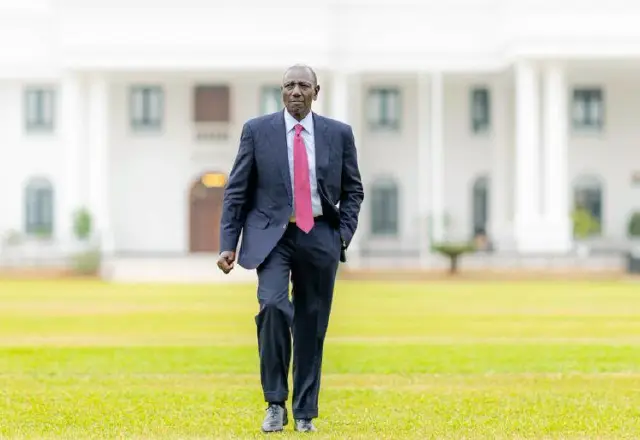
President William Ruto takes a stroll following a meeting with the National and County Governments at State House, Nairobi on September 8, 2026. Photo/PCS

Audio By Vocalize
State House Comptroller Katoo Ole Metito told the National Assembly Administration and Internal Security Committee that State House needs Ksh.23.565 billion, against the Ksh.15.138 billion proposed in the 2027 Budget Policy Statement.
That is a funding gap of 55.7% on top of the ceiling.
Recurrent spending accounts for most of it. It seeks to undertake renovations and upgrades at State House and state lodges, plus ICT and communication equipment.
State House is seeking to purchase furniture worth at least Ksh.43.4 million against Ksh.3 million allocated. Further, it is seeking to purchase specialized plant, equipment, and machinery at an extra Ksh.33.8 million against Ksh.28.7 million already allocated.
The ‘house on the hill’ has also cited the need for the money to cover operations & housing at a cost of Ksh.26M. These funds are earmarked to support presidential constitutional functions and general operations.
However, this is a request from the Comptroller of State House, not an approved budget. But is revealing, because the State Office of the President is telling Parliament that a ceiling, already well above what it had two years ago, is "inadequate."
State House budgets under Ruto
The budget allocations to State House under President Ruto show steady growth followed by a sudden jump.
State House spent Ksh.9.1 billion in 2022/23, Ksh.11.3 billion in 2023/24 and Ksh.12 billion in 2024/25.
Spending therefore rose by about a third in two years. The 2025/26 year was different.
The budget approved by the National Assembly stood at Ksh.8.58 billion, and a first supplementary budget added Ksh.8.43 billion, taking it to Ksh.17 billion.
Numbers show that nearly all of the increase sat in State House, Nairobi, and Treasury's data show the full-year budget was almost used up by January 2026.
If the 2027/28 requests are met in full, it would be about 2.6 times what State House spent in 2022/23.
But maybe State House's defense of its budget deserves a fair hearing.
Ole Metito complained that the national budget rose from Ksh.4.3 trillion to Ksh.4.8 trillion while State House's allocation “fell” from Ksh.17 billion.
He has also said recurrent costs make up nearly 90% of the budget, with most staff being presidential personnel on contract who are paid gratuity. These are real structural pressures. An analysis of these factors alone cannot explain the quest that is doubling the budget.
A look into other public sector budgets
For State House to seek a budget of Ksh.23.565 billion, it has to be compared and contrasted against core government ministries for a full understanding of the enormity of this demand.
The 2026/27 budget gave free primary education Ksh.7 billion, unchanged from the previous year. The extra Ksh.8.427 billion State House wants is therefore larger than the entire annual allocation for free primary education (about 1.2 times).
The sector's own numbers show the squeeze. For 2027/28, the Basic Education department says free primary education has Ksh.7.01 billion against a need of Ksh.9.97 billion, a shortfall of about Ksh.2.96 billion, for 6.39 million learners.
State House's request is nearly three times that gap. This paints a stark picture of what matters to the government in light of its funding priorities.
Before the current financial year, the contrast between what the State House budget was allocated vis-à-vis basic primary needs was grimmer.
At the Ministry of Education, the Department of Primary Education said it needed Ksh.15.67 billion to fund capitation at Ksh.2,330 per learner, against the Ksh.7 billion allocated.
The shortfall was serious enough that, according to one report, every pupil would receive about Ksh.1,097 instead of the stipulated rate, or millions would get nothing.
Education overall is not neglected in headline terms. It gets Ksh.784.5 billion, much of it for the Teachers Service Commission's wage bill, with Ksh.30.9 billion for junior secondary capitation. The contrast lies in the details: a large sector envelope, seen by all to deserve better funding, but what it gets is a paper- thin per-child grant at the primary level.
The health sector received Ksh.177.2 billion in 2026/27, including Ksh.19.1 billion for the Primary Healthcare Fund and Ksh.18.5 billion for the Global Fund, which supports HIV, malaria and tuberculosis programs. State House's full proposed 2027/28 requirement of Ksh.23.565 billion exceeds each of these lines individually.
If Parliament were to allocate the Ksh.23.565 billion to the affordable housing program, the amount would build roughly 6,500 to 13,000 standard affordable housing units, or up to 36,800 smaller social housing units depending on the unit size and typology.
This is in light of the standard affordable housing rates priced around Ksh.48,000 per square meter.
Renovations and ‘hidden’ budget
The headline numbers may understate what is spent on the presidency. Metito said the renovation of State House Nairobi was being funded through security agencies' budgets: the pavilion by the Defense Department and the main house by the National Intelligence Service, because it is a security facility. That arrangement is legal and defensible, but it makes the true cost of State House harder to see.
The relevant spending is therefore spread across several votes, and no single line shows it; it remains obscure.
Categories such as hospitality, travel and vehicles are discretionary within the State House budget, and therefore prices are hard to benchmark.
It is presumed that spreading the renovation costs across security budgets reduces transparency and clarity.
The Auditor-General, the Controller of Budget and the Public Accounts Committee are the proper checks. The practical test is whether State House's procurement records, tender awards and vehicle purchases are published and audited, and whether MPs are willing to ask for them.
The austerity question
This is where the optics are worst. Metito told MPs that President Ruto was himself concerned about the amounts and wanted State House to lead from the front on austerity.
The numbers sit uneasily with that message. An office that is asking for a rise of more than half above its ceiling, while the schools ministry reports a shortfall for primary capitation, is not leading from the front.
State House responds that the demand is driven by delegations, functions and receptions, which cannot easily be refused by a head of state.
Budget documents cited an increase in functions, delegations and receptions hosted at State House. That is a fair explanation of the cause.
It is also the critics' point: a presidency that chooses to host constantly is making a spending choice, and austerity is about choices. It has chosen mandazi and tea to delegations as capitation is put on the back burner.
The public’s perception
For households facing rising prices, the issue is perception as much as arithmetic. Ksh.8.4 billion is small next to a Ksh.4.8 trillion budget.
But symbolic spending is judged differently from technical spending. When parents are told the primary capitation grant cannot be raised, a presidency asking for billions more for travel and hospitality reads as a government that protects its own comfort first.
The most useful response from State House would be transparency, not justification. That would mean publishing a line-by-line breakdown of the Ksh.23.565 billion, the full cost of the renovations across all votes, and what spending would be dropped if the ceiling holds.
MPs, for their part, can test whether the request is a need or a negotiating position by approving only what is itemized.
The money involved will not fix or break Kenya's budget. What it signals is the question that matters most: whether the people asking taxpayers to tighten their belts are visibly sharing it.
Join the Discussion
Share your perspective with the Citizen Digital community.
No comments yet
This discussion is waiting for your voice. Be the first to share your thoughts!