
President Ruto signs VAT Bill into law, cutting fuel tax to 8% amid uproar
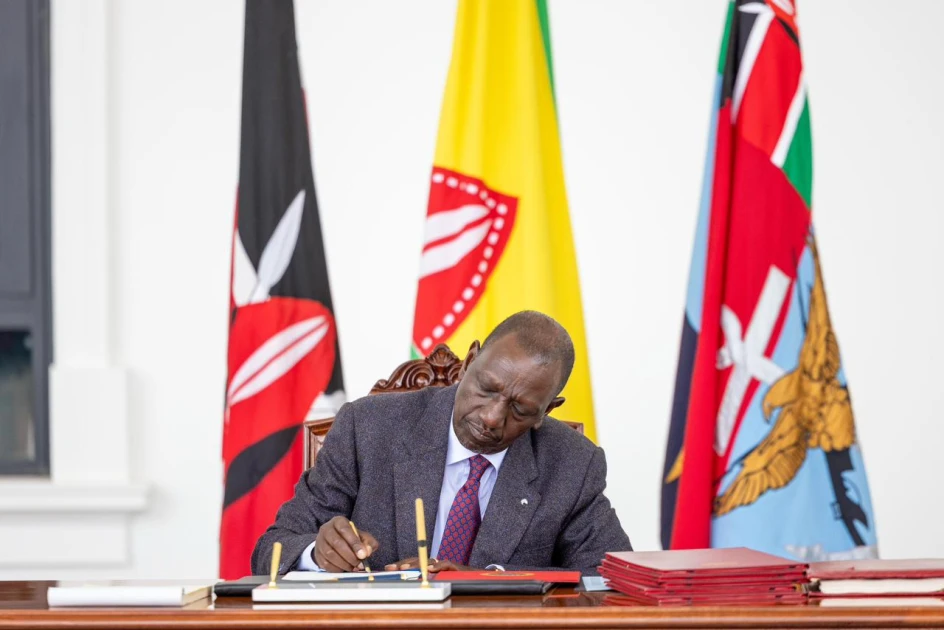
President William Ruto assents to the Value Added Tax (Amendment) Bill, 2026, at State House, Nairobi on April 17, 2026. PHOTO| PCS

Audio By Vocalize
The Bill, sponsored by National Assembly Majority Leader Kimani Ichung'wah, followed a request from the Executive to urgently address the impact of the ongoing conflict in the Middle East on petroleum supply.
Lawmakers introduced, debated and passed the Bill on April 16, 2026, without amendments, highlighting the urgency of the intervention.
The amendment reduces VAT on petroleum products from 16 per cent to 8 per cent, going beyond the limits set under the VAT Act, which caps Treasury Cabinet Secretary John Mbadi’s powers to reduce VAT at 25 per cent.
Under the new law, the reduced VAT rate will apply for an initial period of 90 days, with provisions allowing CS Mbadi to extend the relief for a further 90 days if necessary.
The reduction is also backdated, taking effect from April 15, 2026, in line with the President’s request to Parliament.
As recently announced by the Energy and Petroleum Regulatory Authority (EPRA), the tax cut lowers the price of super petrol by Ksh.9.37 per litre and diesel by Ksh.10.21 per litre.
This means that the maximum retail price for Super Petrol now stands at Ksh.197.60 per litre, with Diesel retailing at Ksh.196.63 per litre and Kerosene remaining at Ksh.152.78 per litre.
Officials noted that fuel costs have a ripple effect across the economy, influencing transport, food prices and the cost of essential goods and services.
The government’s move has, however, drawn criticism, with some arguing that it often creates the problem by sharply increasing fuel prices only to later reduce the cost slightly in a way that appears responsive to public outcry.
Join the Discussion
Share your perspective with the Citizen Digital community.
No comments yet
This discussion is waiting for your voice. Be the first to share your thoughts!