
President Ruto calls on Kenyans to prioritise local products over imports
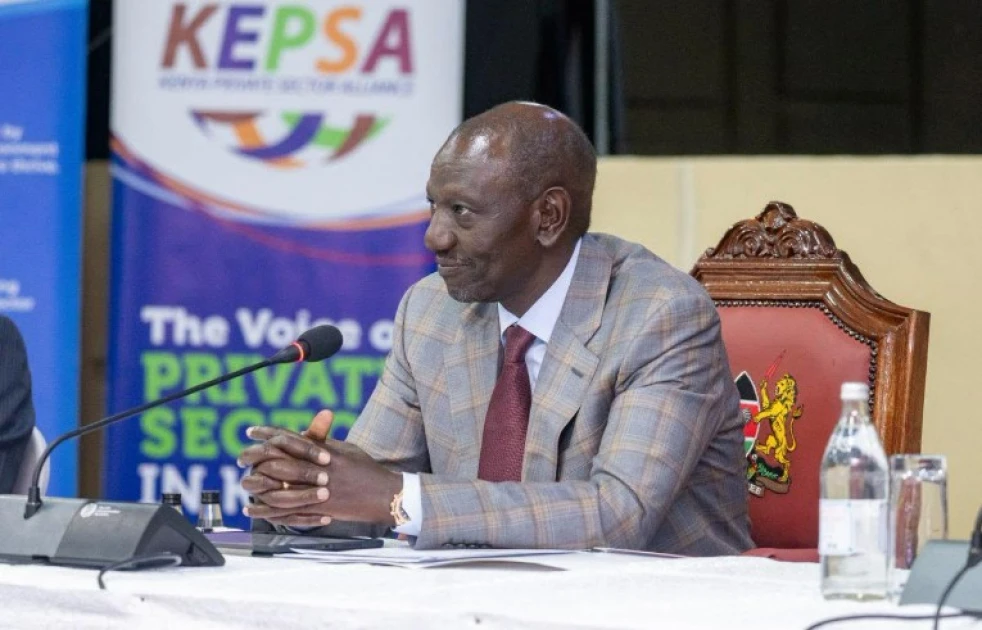
President William Ruto opens the Industrialisation Summit at the Kenyatta International Convention Centre (KICC) in Nairobi on November 4, 2026. Photo/PCS

Audio By Vocalize
The President pointed out that the country's prosperity will ultimately depend on its capacity to produce, process and export competitive goods.
He called on Kenyans to support locally manufactured products as the country seeks to reduce dependence on imported finished goods.
President Ruto was addressing entrepreneurs, investors and manufacturers at the Industrialisation Summit and Changamka Shopping Festival at the Kenyatta International Convention Centre (KICC) in Nairobi on Wednesday.
The summit brought together more than 400 manufacturers, including large industries and micro, small and medium enterprises, to showcase Made-in-Kenya products and celebrate local innovation, quality and enterprise.
"When we Buy Kenya, we Build Kenya," he said, noting that every locally manufactured product strengthens business, creates employment, opens markets for farmers and retains wealth within the economy.
The President said his administration is deliberately shifting Kenya from exporting raw materials to producing finished and value-added goods capable of competing favourably in regional and global markets.
He renewed his commitment to increase the contribution of manufacturing to the country's Gross Domestic Product (GDP) from 7.1 per cent in 2025 to 20 per cent by 2030, creating one million jobs in the process.
He acknowledged that progress towards the target remains slow, noting that manufacturing grew by only 2 per cent in 2025, compared with overall economic growth of 4.6 per cent.
"These figures remind us that the industrial transformation we seek must move faster," he said.
Explaining that Kenya's economic prosperity should be measured not merely by what the country consumes, President Ruto stated that the country's productive capacity must also be taken into account.
"It is measured by the factories we build, the value we add to our resources, the enterprises we grow, and the jobs we create for our young people," he said.
The President said the Government is implementing policy and reforms designed to make local consumption a catalyst for industrial expansion while creating opportunities for domestic manufacturers.
At the same time, he identified the Affordable Housing Programme as one of the most significant drivers of domestic manufacturing, saying it has created substantial demand for locally produced construction materials.
Across the 47 counties, he said, 303,910 housing units are at various stages of completion, generating markets for cement, steel, glass, tiles, timber, hinges, doors and windows.
He noted that 97 per cent of the materials used in the programme are sourced locally while Jua Kali artisans have secured contracts worth Ksh.61 billion.
"Previously, you could not talk about billions and Jua Kali in the same sentence," he said, describing the programme as an example of how housing development and industrialisation could reinforce each other.
The President highlighted interventions aimed at expanding access to finance for small businesses and strengthening agricultural value chains.
The Government, he explained, is in the final stages of establishing an Industrialisation Fund that will provide manufacturers with affordable credit at single-digit interest rates, enabling enterprises to expand production and invest in modern technology.
Through the Hustler Fund, he stated, Ksh.98 billion has been advanced to small businesses without conventional collateral, with a further Ksh.5 billion planned by the end of the year. Another Ksh.10 billion has been disbursed through concessionary enterprise financing since July 2023.
Join the Discussion
Share your perspective with the Citizen Digital community.
No comments yet
This discussion is waiting for your voice. Be the first to share your thoughts!