
Phoebe Okowa: The rise of Kenyan jurist to the world’s highest court

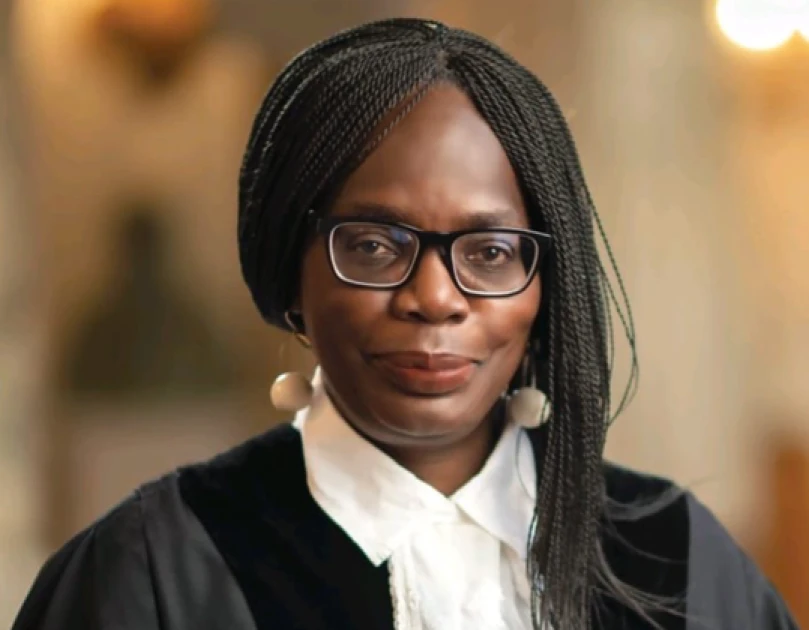
Judge Phoebe Okowa was on Tuesday re-elected to the International Court of Justice (ICJ). Photo: Handout

Audio By Vocalize
Judge Okowa won out of 9 candidates after securing an absolute majority of votes in both the Council and the General Assembly, that is, eight votes in the Council and 97 votes in the General Assembly.
She extends her term as an ICJ Judge, having been elected to fill a vacant position in November 2025, for a term ending February 5, 2027, sitting in for Judge Abdulqawi Ahmed Yusuf of Somalia, who resigned.
Judge Okowa, 61, will now commence her new term on February 6, 2027, but she has maintained a stellar record in the corridors of justice since 1990.
She became an advocate and was called as a member of the Kenyan Bar in October 1990.
She was awarded Doctor of Philosophy (DPhil) in Public International Law from the University of Oxford (1994), a Bachelor of Civil Law (BCL) from the same University (1990), a Diploma in Legal Practice, Kenya School of Law (1988), and a Bachelor of Laws (LLB – First Class Honours), University of Nairobi (1987).
She lectured at Queen Mary University of London as a Professor of Public International Law from 2014 and took a leave of absence from September 2025 to February 2027.
She was also a Reader in Public International Law (2006-2014) and a Senior Lecturer (2002-2006).
Judge Okowa was also a Lecturer in Law at the University of Bristol from 1994 to 2001.
Adding to her academic contributions, she taught a Special Course on “Historic Responsibility in International Law” at The Hague Academy of International Law (2026).
She was a Fellow in Law and Normative Thinking, University Center for Human Values, Princeton University (2024-2025), a Lecturer at Tokyo International Law Seminar, Ministry of Foreign Affairs, Tokyo (2025), Lecturer at the UN Regional Course in International Law for Latin America and the Caribbean, Santiago (2024), a Visiting Professor at Graduate Institute of International and Development Studies, Geneva (2024), a Lecturer at United Nations Regional Course in International Law for Asia-Pacific, Bangkok (2023) and a Global Visiting Professor at Katholieke Universiteit Leuven (2023).
She also lectured at the UN Regional Course in International Law for Africa (for Diplomats and Government Officials) in Addis Ababa (2020 and 2023), Lectured on Protection of Natural Resources in Situations of Armed Conflict, UN Audiovisual Library of International Law (2019), was a Visiting Lecturer for Law and Development Programme at the University of Antwerp (2018) and a Global Visiting Professor, New York University School of Law (2015-2016).
Between 2010 to 2013, she was a Visiting Professor and Lecturer at the Pace University School of Law (2012-2013), New York University School of Law 2011-2012) and the Catholic University of Lille (2009-2010).
She also lectured at Erik Castrén Institute of International Law and Human Rights, University of Helsinki (2009), a Visiting Fellow at Lauterpacht Centre for International Law, University of Cambridge (2007), a Visiting Professor, University of Stockholm (2006) and a Visiting Fellow,
St John’s College, University of Oxford (1995).
Awards.
She was awarded the Doctor of Laws (Honoris Causa) by the University of Stockholm (2024), received the Elder of the Order of the Burning Spear for Distinguished Service in International Law, in 2022), CB Madan Laureate for Contributions to the International Rule of Law by Strathmore University, and the Kaplan and Stratton Prize, Best Final Year Student in the Moots Court and Fourth Term Programme Essay in the Faculty of Law (1988), the Gandhi Memorial Prize for being Best University of Nairobi Final Year Student in the Faculty of Law (1987).
Professional positions.
The experienced Judge is a Member of the Advisory Board at the British Institute of International and Comparative Law since 2021, an Advisory Board Member of the African Association for International Law since 2015, and holds the same position at the Stockholm Centre for International Law and Justice since 2006.
Judge Okowa is also a Member of the African Society of International Law since 2000 and holds the same position at the British Branch of the International Law Association since 1995 and at the Society of Legal Scholars since 1993.
She has served as a Member of the UN International Law Commission (2023-2025), Chair of the Drafting Committee, 75th Session of the UN International Law Commission (2024), and Associate Member, Institut de droit international from 2025 to present.
She was a Member of the Permanent Court of Arbitration (2017-2022), a Member of the International Law Association Committee on Transnational Enforcement of Environmental Law (1997-2006), and a current Member at the Advisory Committee on International Dispute Resolution, Centre for International Law, National University of Singapore, from 2023.
Likewise, she was a Joint Editor (with Roger O’Keefe) at Oxford Monographs in International Law, Oxford University Press (2024-2025), a Member of the Editorial Advisory Board at Max Planck Yearbook of United Nations Law (2022-present), a Member of the Editorial Advisory Board, African Yearbook of International Law (2020).
She was also a Joint Editor (with Professor Malcolm Evans) at the Foundations of Public International Law, Oxford University Press (2005-2020), a Member of the Board of Editors at the International Community Law Review (2005-2018).
President William Ruto has lauded her victory, terming it an example of the integrity that Kenya continues to contribute to the international community.
"As you take up this distinguished responsibility, we wish you great success in discharging your mandate with diligence and in advancing the ICJ’s mission of upholding international law and promoting the peaceful resolution of disputes among nations," he said.
The ICJ consists of 15 judges elected for nine-year terms by the Security Council and the General Assembly. Five seats come up for election every three years.
Join the Discussion
Share your perspective with the Citizen Digital community.
No comments yet
This discussion is waiting for your voice. Be the first to share your thoughts!