
PAPSS targets 40 countries on pan-African payment system by 2027
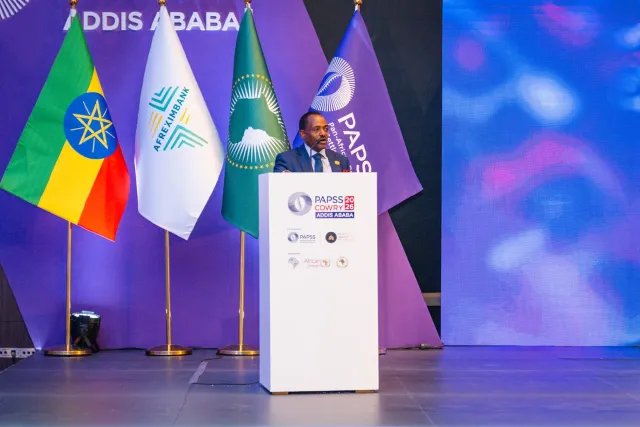
Safaricom Ethiopia Chairman Ermias Eshetu speaking during day two of the Pan-African Payment and Settlement Conference in Addis Ababa, Ethiopia, on November 27, 2026. PHOTO | COURTESY

Audio By Vocalize
Nearly five years after its launch, stakeholders said expanding the platform and connecting Africa's fragmented payment networks will be key to unlocking the continent's trade potential.
Stakeholders in Africa's payment sector are calling for greater integration of payment systems to reduce the cost and time involved in cross-border transactions.
They pointed out that reliance on multiple intermediaries and fragmented payment networks continues to slow the movement of money across the continent, restricting trade and economic growth.
“Fragmentation remains our biggest challenge as Africans. It weakens the few links we have before they can mature, reduces bank-to-bank efficiencies and traps capital. Trapped capital creates a vicious circle, leaving a system forever hungry for new injections of capital because the capital it already has cannot move,” Safaricom Ethiopia Chairman Ermias Eshetu stated.
Eshetu stated that Africa's reliance on foreign financial systems also makes cross-border payments more expensive, with transactions between neighbouring countries sometimes routed through financial centres outside the continent.
He noted that Africa must move beyond this dependence by building and connecting its own payment infrastructure.
“Africa's physical decolonisation was a historic achievement, but we cannot ignore the fact that in one important sense, we remain colonies of financial systems elsewhere," Eshetu stated.
"When a payment between two neighbouring African countries must be settled through New York and London, converted twice into someone else's currency, with the fees leaving the continent, that's not a technical inconvenience. It's a form of dependency."
As the African Payment Conference 2026 comes to an end in Addis Ababa, the consensus among more than 2,500 delegates is the need to decolonise Africa's payment systems, ensuring that money moves as fast as the continent's growth ambitions.
Join the Discussion
Share your perspective with the Citizen Digital community.
No comments yet
This discussion is waiting for your voice. Be the first to share your thoughts!