
Over 10,000 children reported missing in one year

Audio By Vocalize
A total of 10,581 children have been reported missing in the past year, marking a sharp increase from the 8,800 cases recorded in 2024.
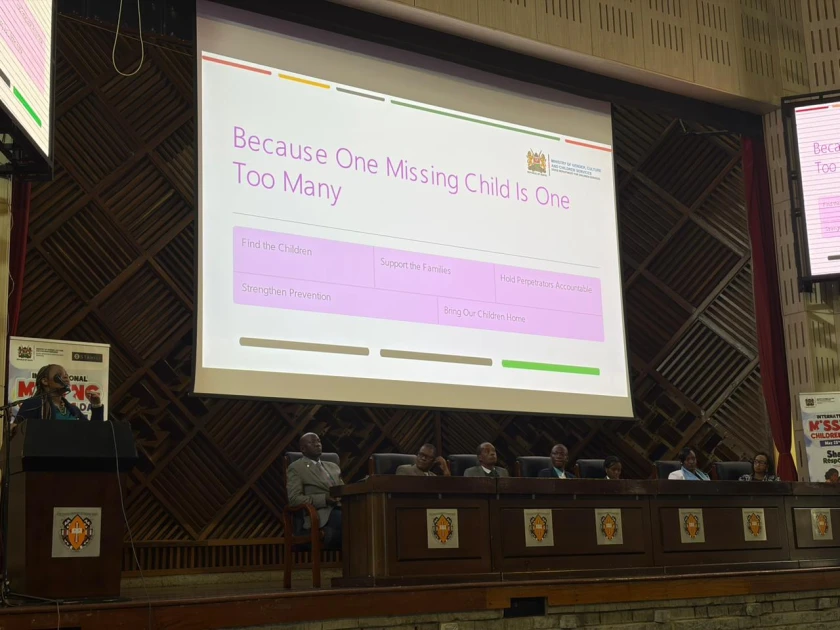
The alarming figures were revealed on Monday by Cabinet Secretary for the Ministry of Gender, Culture and Children Services, Hanna Cheptumo, during the commemoration of International Missing Children’s Day at Catholic University of Eastern Africa.
More than 300 participants drawn from schools, government institutions, civil society, parents and students attended the event, which was held under the theme: “Strengthening Parental and Community Care to Prevent Child Disappearance.” The theme underscored the need for collective responsibility in protecting children.
“As government strengthens systems, families and communities must also play their role,” said Cheptumo.
The event highlighted the importance of community involvement in addressing the growing crisis of missing children. Principal Secretary for Children Services CPA Carren Ageng’o said the day served as a platform to amplify the plight of missing children and reinforce collaborative efforts to safeguard them.
“We are glad that the university is hosting us for this important event,” she said. “This day provides us an opportunity to support the plight of missing children.”
Children officer for Githunguri, June Wachira, warned against downplaying cases of child disappearance, noting that oversimplifying the issue places more children at risk. She pointed to ongoing national interventions, including policy guidelines, county-level child protection structures, multi-sector partnerships and follow-up mechanisms aimed at improving response efforts.
Speakers at the forum stressed that protecting children should not be left to government agencies alone. Schools, religious institutions, neighbours and families all have a role to play.
“A child does not belong to one institution or one parent — a child belongs to each and every one of us,” said Janet Mbugua.
Mbugua emphasised the power of social media in raising awareness about missing children. Leveraging her audience of more than one million followers, she regularly shares information on missing children cases online. Participants at the event also promoted the hashtag #IMCD2026NeverForgotten, encouraging Kenyans to amplify awareness digitally.
At the same time, speakers warned about the dangers children increasingly face online. They noted that threats are no longer confined to the streets but can also emerge through smartphones and digital platforms. Online grooming, exploitation and harmful digital content were identified as growing risks targeting unsuspecting children with false promises.
Athena Morgan urged parents to actively monitor their children’s online activity and establish safeguards on social media use. She encouraged parents to educate children about responsible online communication, protecting personal information and avoiding meetings with strangers.
“Safety is not guaranteed by a child staying in the house. Safety is only guaranteed if a child has been educated,” said Morgan.
According to Mbugua, one of the most important shifts society must make is abandoning the culture of indifference and reviving the African philosophy of Ubuntu — “I am because you are.” She called for a return to the communal spirit where children are raised collectively rather than left solely to individual families.
The message resonated strongly with students attending the event, some of whom lamented the erosion of close-knit neighbourhood relationships.
“There was ujamaa previously, but today we live together, yet people do not know each other,” said one student from the university.
The student reflected on childhood experiences where neighbours and passersby freely looked out for children playing outdoors, warning them about dangers such as approaching vehicles. He argued that restoring such community vigilance would make it easier to trace missing children because neighbours, teachers and classmates would all notice when a child disappears.
Citizens were also encouraged to adopt a “see something, say something” approach whenever a child appears lost, abandoned or distressed.
“A child who appears lost, abandoned, distressed or under suspicious control should not be ignored,” said Cheptumo. “There is no waiting period to report a missing child.”
The National Child Helpline 116 featured prominently throughout the event as authorities urged the public to report cases immediately.
Among the most emotional moments was the testimony of Torus Pilly, a father of two whose three-year-old son disappeared in March.
Pilly recalled initially assuming the child was visiting neighbours, only for panic to set in as the hours passed. Since then, he has reported the case at several police stations and sought media attention, but the search remains unsuccessful.
“My question is, how can a child just get lost like that? How long do I keep waiting?” he asked.
He also spoke of the isolation families experience after reporting such cases, saying that despite visiting police stations daily, he has received little emotional support or follow-up from authorities.
The event concluded with a renewed call for communities to become more proactive in protecting children. Organisers stressed that every child should be visible and accounted for — at home, in school, within the community and online.
“A child must be known at home, noticed in school, protected in the community and safe online,” participants reiterated.
Join the Discussion
Share your perspective with the Citizen Digital community.
No comments yet
This discussion is waiting for your voice. Be the first to share your thoughts!