
Opposition unveils ‘People’s Budget’, tears into Ruto’s Ksh.4.8 trillion spending plan
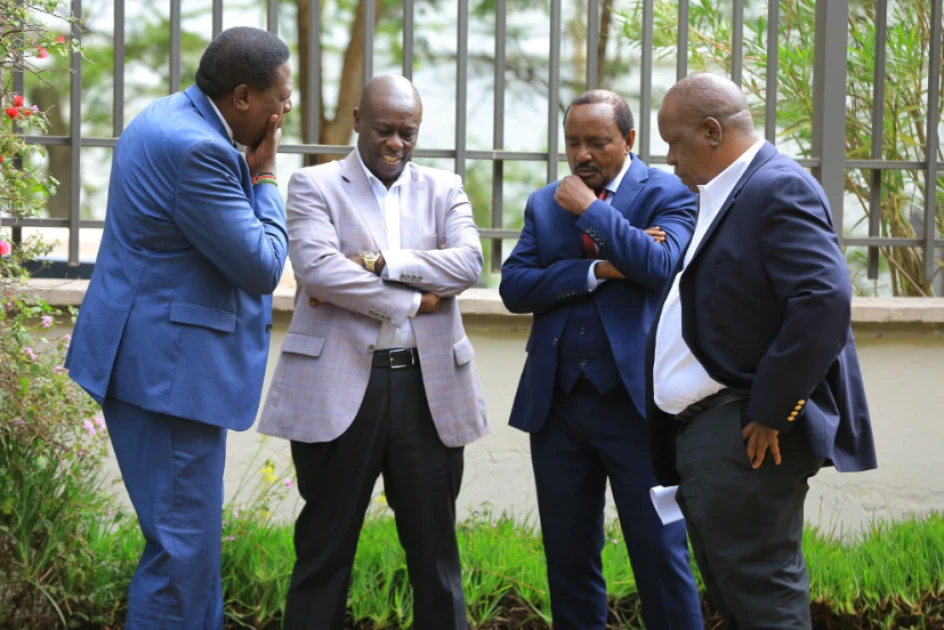
Opposition leaders Eugene Wamalwa (DAP-K), Rigathi Gachagua (DCP), Kalonzo Musyoka (Wiper), and Fred Matiang’I (Jubilee) during a past meeting. PHOTO | COURTESY

Audio By Vocalize
The opposition coalition, operating under the banner of the United Alternative Government, has launched a blistering attack on President William Ruto’s administration ahead of the presentation of the 2026/2027 national budget on Thursday, accusing the government of presiding over a fiscally reckless, debt-ridden and anti-poor economic agenda.
In a joint statement read by Wiper Party leader Kalonzo
Musyoka on Wednesday, the opposition unveiled what it termed the “People’s
Budget,” an alternative fiscal framework which it says prioritises education,
healthcare, job creation and lowering the cost of living while reducing the
country’s fiscal deficit.
Kalonzo described the government’s proposed budget as “the
largest spending plan in the history of the Republic of Kenya,” arguing that
it is built on unsustainable borrowing and misplaced priorities.
He was flanked by fellow opposition co-principals, including
Democracy for Citizens Party (DCP) leader Rigathi Gachagua, his Democratic
Party of Kenya (DP) counterpart Justin Muturi, and Jubilee Deputy Party Leader
Dr. Fred Matiang’i during the address.
“I have been in public service for over four decades. I have
sat at cabinet tables, at the Office of the Vice President and peace
negotiations. I have seen Kenya at its best and I have seen what bad governance
does to a people who deserve so much better than they have been given,” Kalonzo
said.
“Nothing, though, in all these years of public life, has
prepared me for the cruelty of this budget. Because that is what it is. Not
just incompetence and miscalculation but cruelty.”
According to the opposition, the government’s proposed Ksh.4.82
trillion expenditure plan far exceeds projected revenues of Ksh.3.63 trillion,
leaving a deficit of Ksh.1.11 trillion that will have to be financed through
borrowing.
Kalonzo termed the debt burden “generational slavery,” arguing
that future generations would shoulder the cost of loans they had no role in
contracting.
The coalition further faulted the government for what it
described as excessive debt servicing, noting that Ksh.1.5 trillion has been
allocated to debt obligations and pensions.
“To put that in language every Kenyan understands, interest on
domestic debt alone costs more than the entire education budget. We are
spending more on paying bankers than on teaching children,” Kalonzo said.
Education emerged as one of the opposition’s key areas of
concern, with the coalition accusing the government of failing to adequately
fund free education despite constitutional guarantees.
The opposition cited what it described as major funding gaps
in Free Primary Education, Junior Secondary School and Free Day Secondary
Education programmes, arguing that parents are increasingly being forced to
shoulder costs that should be covered by the State.
“Free means free. All the way from Class One to Form Four. For
every Kenyan child,” Kalonzo stated, while outlining the coalition’s
alternative plan.
The coalition also linked recent cases of unrest and fires in
schools to underinvestment in student welfare, safety infrastructure and mental
health services.
It criticised the government for allegedly neglecting school
safety and failing to provide dedicated funding for student mental health
programmes despite a series of incidents in learning institutions across the
country.
On healthcare, the opposition renewed its criticism of the
Social Health Authority (SHA), describing the scheme as mandatory taxation
disguised as healthcare reform.
Kalonzo argued that despite mandatory contributions by
Kenyans, many patients continue to experience difficulties accessing services
due to system failures and funding gaps.
“SHA, in its current form, is not a health policy. It is a
compulsory tax with a hospital logo,” he said.
The coalition also questioned the government's decision to
proceed with what it described as a Ksh.104 billion technology contract linked
to SHA while public health facilities continue to face shortages of medicines
and personnel.
It pledged to cancel the contract and redirect the funds to
frontline healthcare services if elected as the next government in the 2027
General Election.
The opposition also took issue with several proposals
contained in the Finance Bill 2026, accusing the government of introducing
indirect taxes that disproportionately affect ordinary Kenyans.
Among the measures criticised were the proposed 16 per cent
Value Added Tax (VAT) on mobile money platform fees and a 25 per cent excise
duty on mobile phones at network activation.
“The grandmother in Wajir waiting to receive Ksh.1,000 from
her grandson working in Mombasa will pay more for that transfer. The mama mboga
in Gikomba paying her supplier through M-Pesa will pay more,” Kalonzo said.
He further warned that expanded powers for the Kenya Revenue
Authority (KRA) to access taxpayer information could create what he termed a
“tax surveillance state” that exposes citizens to excessive monitoring and
punitive taxation.
The coalition additionally accused the government of seeking
to dispose of strategic national assets to address fiscal challenges.
It specifically cited concerns over the future of the Kenya
Ports Authority (KPA) and the government's stake in Safaricom, arguing that
such assets should not be sold without extensive public participation and
parliamentary approval.
“These are our crown jewels. They are what this country built
across generations,” Kalonzo said.
As an alternative, the United Alternative Government proposed
a Ksh.4.32 trillion spending plan, which it says would reduce the fiscal
deficit to Ksh.593.5 billion, equivalent to 2.8 per cent of GDP, compared to
the government’s projected 5.3 per cent.
The coalition says it would increase revenue collection
through efficiency measures and compliance rather than imposing new taxes.
The proposed “People’s Budget” includes increased allocations
for education and health, restoration of programmes such as Linda Mama and Edu
Afya, a Ksh.80 billion youth employment initiative, the abolition of the Affordable
Housing Levy and the removal of taxes proposed on mobile money services and
mobile phones.
The coalition also pledged to reduce expenditure at State
House and the National Intelligence Service (NIS) and redirect the savings
towards irrigation projects aimed at boosting food security.
“We will also implement a Single Treasury Account to eliminate
ghost workers, duplicate payments and pending bills that are an Auditor
General-verified leakage of Ksh250 billion per year,” Kalozno stated.
“Every contract requires confirmed exchequer backing before
work begins. Any accounting officer with an adverse Auditor-General report must
steps aside immediately.”
Kalonzo also accused the government of failing to honour
promises made to victims of the June 2024 anti-government protests, noting that
the proposed budget contains no specific allocation for compensation or
rehabilitation of victims of police brutality and other human rights
violations.
Addressing Members of Parliament ahead of debate on the budget
and Finance Bill 2026, the opposition leader urged lawmakers to reject what he
described as harmful fiscal proposals and instead defend the interests of
ordinary Kenyans.
“You were not elected to be a rubber stamp. A mother woke
before dawn, walked to a polling station, queued for hours, and marked your
name because she believed you would go to Nairobi and fight for her,” he said.
“When you vote to approve a Ksh.28.4 billion Free Day
Secondary capitation shortfall, you vote against the children of the poor. When
you vote to approve an Ksh.11 billion hole in SHA, you guarantee that the next
Kenyan will be turned away at a hospital gate. When you vote for sixteen
percent VAT on M-Pesa platform fees, you tax the only bank most Kenyans have
ever had.”
The opposition maintained that its alternative budget offers a
people-centred approach focused on easing the economic burden on households
while restoring accountability in public spending.
“We came to write a different budget entirely, one built on
the principle that in the Republic of Kenya, the government serves the people,
not the other way around,” Kalonzo said.
Join the Discussion
Share your perspective with the Citizen Digital community.
No comments yet
This discussion is waiting for your voice. Be the first to share your thoughts!