
OPINION: What young Kenyan men say when no one is watching
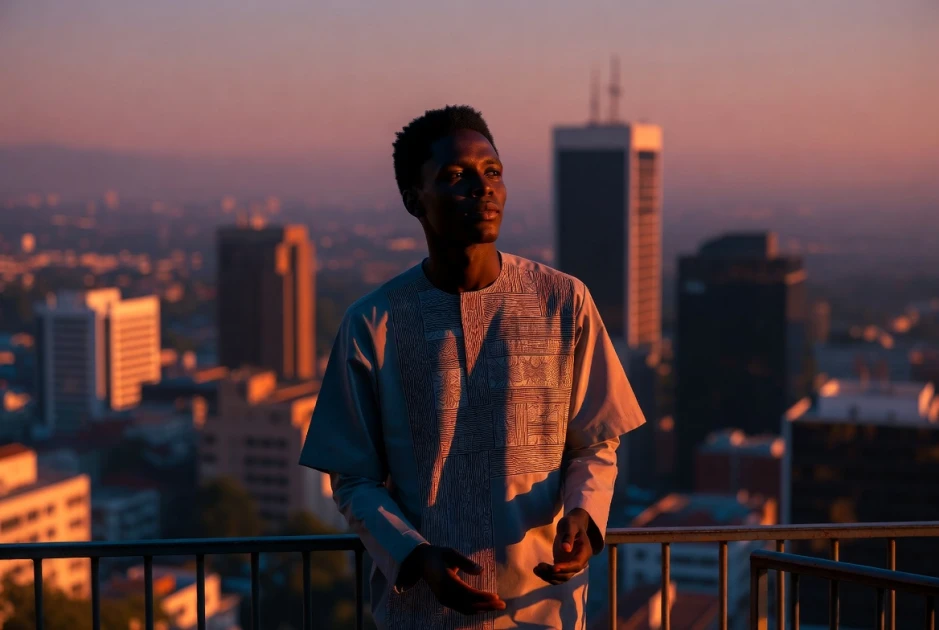
An AI-generated image of a young man in Kenya.

Audio By Vocalize

A young
Kenyan man recently sent this anonymous message to a chatbot late at night:
“Mbogi wanasema mimi si mwanaume nisipolala na huyo mama…
tangu lini mtu ashajiita mwanaume kwa sababu ya kulala na wanawake?”
This
translates loosely to English to “My crew tells me I’m not a man if I don’t
sleep with her. Since when did sleeping with women make someone a man?”
That
single sentence may explain more about the state of masculinity in Kenya than a
dozen policy reports.
Across
the country, young men are navigating a rapidly changing social and economic
reality with very few spaces to process what it means. The old expectations of
manhood remain firmly in place - provide financially, dominate socially,
suppress vulnerability, prove masculinity constantly - but the conditions
needed to meet those expectations are shifting.
And
many are struggling quietly.
This
struggle is unfolding against the backdrop of a much larger crisis. Kenya now
ranks among the world’s most active hubs for online manosphere content in the
English-speaking internet. Conversations rooted in resentment, performative
masculinity, misogyny and emotional isolation are no longer fringe internet culture.
They have entered mainstream youth spaces - WhatsApp groups, TikTok feeds,
Telegram channels and everyday peer conversations.
At the
same time, Kenya recorded its deadliest year for women in 2024, with femicide
cases rising sharply. Statistics show that in 2025 alone, at least 220 women
were killed, with many deaths linked to intimate partners or family members and
often preceded by abuse, threats or coercion. Young men also continue to die by
suicide at a rate three to five times higher than young women, often in
silence.
These
crises are connected more than we often admit.
One of
the clearest windows into this reality is emerging through anonymous youth
engagement platforms and chatbots where young men speak more honestly than they
often can in public. In these spaces, several themes appear repeatedly.
Many
young men feel crushed by the pressure to provide financially in an economy
where stable work is increasingly uncertain. Some describe sleepless nights
worrying about how they will feed their children. Others speak openly about
shame, failure and hopelessness.
Peer
pressure also continues to police masculinity aggressively. Young men describe
being mocked for showing emotional vulnerability, remaining loyal in
relationships, or refusing sexual pressure from friends. Masculinity becomes
something constantly performed for other men.
Economic
shifts inside households are creating further tension. As more women gain
financial independence, some young men are struggling to reconcile this with
older ideas of male identity tied almost entirely to provision and control. The
cultural script for masculinity has not evolved as quickly as the realities
young people are now living.
And
into that uncertainty, the global manosphere is arriving fast.
The
language is increasingly familiar: “simp”, “nice guys finish last”, women
as manipulators, emotional detachment as strength. Many young Kenyan men
are repeating scripts imported almost directly from American online culture,
often without fully recognising where those ideas originate or the harm they pose.
What
makes this dangerous is that many young men do not feel safe discussing these
pressures openly. Vulnerability itself is often treated as weakness.
Help-seeking feels unmasculine. So, the questions, fear and confusion remain
underground until they surface through violence, withdrawal, emotional collapse
or online radicalisation.
This is
why the conversation around gender equality in Kenya needs to become more
nuanced.
Too
often, public discourse frames young men only as perpetrators, obstacles or
problems to solve. But many are also navigating deep social confusion, economic
anxiety and emotional isolation. A society that ignores this reality creates
fertile ground for more resentment, not less.
Addressing
masculinity is therefore not separate from addressing gender-based violence. It
is central to it.
This is
where narrative and culture matter.
Young
people do not form their understanding of masculinity primarily through policy
papers or workshops. They absorb it through stories, peers, music, influencers,
family dynamics and digital ecosystems. If harmful narratives are spreading at
scale, healthier alternatives must also exist at scale.
Programmes
such as Surround Sound Kenya are beginning to show what this can look like in
practice: combining mass media storytelling with anonymous digital safe spaces
where young men can ask questions without fear of judgement
Encouragingly,
many young Kenyan men are already questioning the old scripts quietly. They are
asking whether manhood must always be defined through dominance, sexual
conquest or financial control.
The
challenge is that these voices often remain private. The task now is to make
them visible.
Not
through moral lectures but through relatable stories, trusted platforms and
public conversations that reflect the realities young people are already
living. Young men need to see versions of masculinity that feel aspirational,
culturally grounded and socially accepted.
Because
this conversation is ultimately not about political correctness. It is about
social stability.
A
generation of young men is negotiating identity in real time under economic
pressure, digital influence and cultural transition. What emerges from that
negotiation will shape the future social fabric of the country itself.
The
good news: many young men are already trying to write a different story. Here’s
what one told us recently:
I
realize that being a 'man' doesn't mean I have to act tough and silent all the
time. True strength is having the courage to speak up about my challenges, to
be vulnerable and to show respect to my female peers."
The
question is whether we are willing to hear them before the louder voices drown
them out.
[Bridget
is the MD, Shujaaz Inc. and Wame Jallow is the Executive Director of Shuga
Global]
Join the Discussion
Share your perspective with the Citizen Digital community.
No comments yet
This discussion is waiting for your voice. Be the first to share your thoughts!