
OPINION: Positive discipline in parenting - Raising responsible, respectful and resilient children
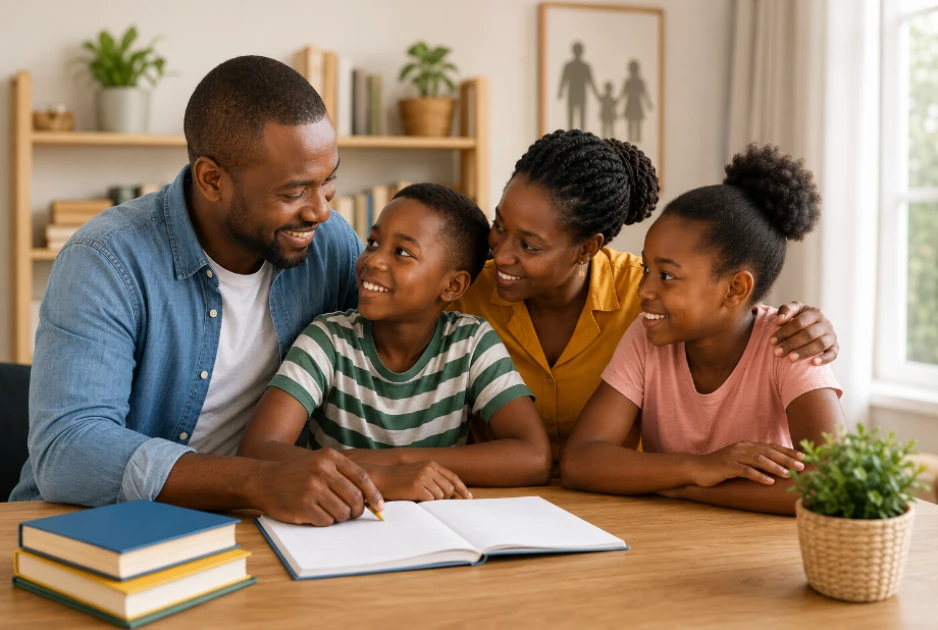
An AI-generated image of anAfrican family at a study table.

Audio By Vocalize
By CPA Carren
Ageng’o
The debate on child discipline has recently taken centre stage in Kenya following a worrying rise in cases of student unrest, including incidents of school arson and other forms of indiscipline. These incidents have generated public concern and renewed calls for stricter disciplinary measures. While the concern is understandable, it is important to remember that both the Constitution of Kenya and the Children Act provide clear guidance on how children should be disciplined.
Article 53(1)(d)
of the Constitution guarantees every child the right to protection from abuse,
neglect, all forms of violence, and inhuman treatment or punishment. This
constitutional safeguard, reinforced by the Children Act, prohibits corporal
punishment and requires parents, caregivers, schools, and institutions to adopt
positive, non-violent approaches that uphold the dignity and best interests of
the child.
Discipline should
not be confused with punishment. The purpose of discipline is to teach children
self-control, responsibility, respect for others, and an understanding of the
consequences of their actions.
Punishment,
especially when harsh, physical, or humiliating, may create fear but often
fails to build the values and decision-making skills required for responsible
adulthood. Positive discipline, on the other hand, corrects behaviour while
preserving the child’s self-esteem and strengthening the parent-child
relationship.
Parents and
caregivers play the most significant role in shaping a child’s character. The
home is the first school, and parents are the first teachers. Long before
children interact with teachers, peers, or the wider society, they learn
values, attitudes, and behaviour from the adults around them.
Children who grow
up in environments where honesty, respect, responsibility, and empathy are
consistently demonstrated are more likely to exhibit these qualities in school
and in society.
One of the most
effective approaches to raising well-rounded children is positive parenting.
This involves creating a nurturing environment where children feel loved,
valued, and heard while understanding that actions have consequences. Children
thrive when there are clear rules, predictable routines, and consistent
expectations. Parents should communicate these expectations clearly and explain
the reasons behind them. When children understand why certain behaviours are
expected, they are more likely to comply willingly rather than out of fear.
Recognizing the
importance of positive parenting, the State Department for Children Services is
rolling out a robust Positive Parenting Programme aimed at strengthening
parenting skills, promoting positive discipline, and supporting the holistic
development of children. The programme seeks to empower parents and caregivers
with practical knowledge and skills for nurturing responsible, confident, and
resilient children.
Communication is
at the heart of effective parenting. Many behavioural challenges arise when
children feel misunderstood, neglected, or unable to express themselves.
Parents should create opportunities for open and honest conversations with
their children. Regular family discussions provide a safe space for children to
share their concerns, fears, and aspirations. Such engagement allows parents to
identify emerging challenges early and provide guidance before problems
escalate into serious misconduct.
Consistency is
equally important. Children need boundaries and structure. Rules should be
applied fairly and consistently, regardless of circumstances. When expectations
constantly change or consequences are unpredictable, children become confused
and may test limits. Consistent parenting helps children understand
accountability and builds trust in parental authority.
Parents should
also embrace non-violent corrective measures when addressing misconduct. These
may include withdrawing privileges, assigning age-appropriate responsibilities,
requiring restitution for wrongdoing, or implementing reasonable and
proportionate consequences. Such measures help children connect their actions
to outcomes of the actions while learning responsibility and accountability.
Positive
reinforcement is another powerful parenting tool. Parents often focus on
correcting mistakes while overlooking opportunities to acknowledge good
behaviour. Children are more likely to repeat behaviours that are recognized
and appreciated. Praising honesty, responsibility, kindness, and effort can
significantly boost a child’s confidence and encourage positive conduct.
Recognition does not necessarily require material rewards; words of
encouragement and affirmation are often more effective and sustainable.
Parental presence
and involvement cannot be overstated. In today’s fast-paced world, many parents
struggle to balance work and family responsibilities. However, children require
more than material provision. They need emotional support, guidance, and meaningful
engagement. Spending quality time together, taking an interest in children's
daily experiences, participating in school activities, and monitoring
friendships help strengthen family bonds and provide opportunities for
mentorship.
The digital age
presents additional parenting challenges. Social media, online content, and
peer influence can shape children’s attitudes and behaviour in profound ways.
Parents must therefore remain actively involved in their children’s digital
lives by setting reasonable limits on screen time, monitoring online
activities, discussing internet safety, and teaching responsible use of
technology. Open dialogue about digital influences helps children develop
critical thinking skills and resilience against harmful content.
Parents should also recognize that discipline is most effective when accompanied by emotional support. Children experience stress, anxiety, disappointment, and frustration just like adults. Some behavioural challenges may be symptoms of deeper emotional or psychological difficulties.
Rather than responding solely with
punishment, parents should seek to understand the underlying causes of
behaviour and provide appropriate support. Where necessary, guidance from
teachers, counsellors, religious leaders, or child welfare professionals should
be sought.
Children learn not
only through instruction but also through observation. Parents who demonstrate
self-control, honesty, respect, and peaceful conflict resolution provide
powerful examples for their children. It is difficult to expect children to
manage their emotions appropriately if they regularly witness aggression,
hostility, or disrespect within the home. Positive role modelling remains one
of the most effective forms of discipline.
As the nation
grapples with concerns about youth behaviour and school unrest, there is a need
for collective responsibility. Schools, religious institutions, community
leaders, and government agencies all have important roles to play. However,
sustainable solutions begin at home. Parents and caregivers remain the
foundation upon which children's values, attitudes, and behaviour are built.
The goal of
discipline is not merely to raise obedient children but to nurture responsible,
confident, compassionate, and resilient citizens. Positive discipline
strengthens parental authority by building mutual respect, trust, and
understanding. Through non-violent parenting, open communication, clear
boundaries, and consistent guidance, parents can contribute significantly to
the balanced development of children and help shape a generation capable of
making responsible choices for themselves and for society.
A disciplined child is not one who fears punishment, but one who understands responsibility, respects others, and is guided by strong values. That journey begins at home.
Join the Discussion
Share your perspective with the Citizen Digital community.
No comments yet
This discussion is waiting for your voice. Be the first to share your thoughts!