
OPINION: Kenya’s Guangzhou gateway and the rise of RMB transactions
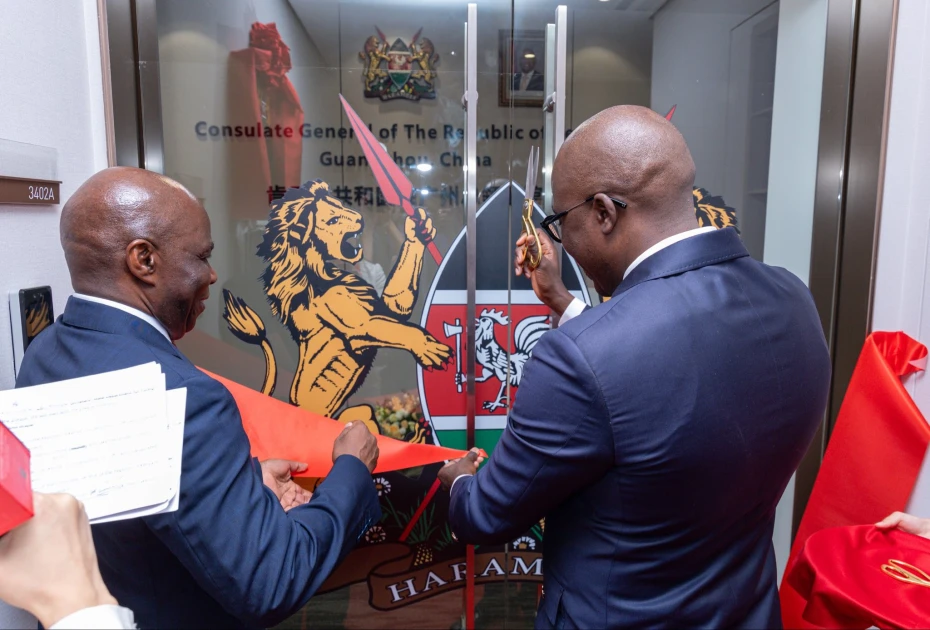
Foreign Affairs PS and Consul General James Muhati during inauguration of the Consulate General of the Republic of Kenya in Guangzhou.

Audio By Vocalize
Kenya’s decision to deepen the use of the Chinese renminbi in cross-border transactions, alongside the opening of its Consulate General in Guangzhou, points to an important evolution in the country’s economic diplomacy.
Taken together, the two developments show how trade, finance and diplomacy can reinforce one another when a country positions itself close to the markets where economic opportunities are being created.
The growing availability of RMB settlement for Kenyan businesses is particularly significant because China remains one of Kenya’s most important commercial partners.
Through China’s Cross-Border Interbank Payment System, Kenyan clients can access RMB settlement, creating a more direct channel for payments connected to trade and investment.
This can make transactions more efficient by reducing the number of currency conversions and intermediaries involved in some cross-border payments.
The significance goes beyond the mechanics of banking. Currency is an essential part of trade infrastructure. When businesses can transact in a currency used by their major trading partners, they gain another practical instrument for managing international commerce.
For Kenyan importers, exporters and investors engaging with Chinese counterparts, wider access to RMB settlement can support smoother financial relationships and encourage greater familiarity with China’s financial ecosystem.
This is where Guangzhou becomes particularly important.
Guangdong is one of China’s major economic centres, with Guangzhou serving as a major commercial and manufacturing hub.
Establishing a Kenyan Consulate General there gives Kenya a closer institutional presence in a region with substantial commercial, industrial and technological activity.
The mission’s mandate to promote and safeguard Kenya’s economic and trade interests places economic diplomacy at the heart of its work.
The relationship between the RMB channel and the Guangzhou mission is therefore mutually reinforcing.
Financial connectivity can make trade easier, while diplomatic presence can help businesses discover, understand and pursue the opportunities that improved financial connectivity creates.
For Kenyan enterprises, this combination could be especially valuable for small and medium-sized businesses seeking to enter Chinese markets.
A stronger institutional presence can help connect companies with potential partners, provide information about market opportunities and facilitate engagement with relevant authorities and business communities.
At the same time, more accessible RMB settlement can provide businesses with an additional mechanism through which those commercial relationships can operate.
Guangzhou also offers Kenya a strategic platform for promoting its exports. Kenya has products, services and investment opportunities that can benefit from greater visibility among Chinese consumers, companies and investors.
A permanent diplomatic and commercial presence in southern China can support sustained engagement rather than relying mainly on periodic trade missions or high-level visits.
The broader lesson is that modern diplomacy increasingly extends beyond political representation.
Embassies and consulates are becoming gateways for investment, trade, innovation, tourism, education and business networking. Financial systems, meanwhile, are becoming part of the architecture of international economic relations.
Kenya’s engagement with the RMB should therefore be viewed not as a replacement for existing international currencies, but as an expansion of its economic toolkit.
Greater currency choice can give businesses another avenue for conducting international trade, particularly where commercial relationships with China are growing.
Likewise, the Guangzhou Consulate should be understood as more than a facility for consular services. Its presence creates a platform from which Kenya can engage one of China’s most dynamic economic regions with greater consistency and purpose.
Together, these developments point toward a more connected Kenya-China economic relationship.
The RMB provides a financial bridge, while Guangzhou provides an institutional bridge. One facilitates transactions; the other facilitates relationships. Their value lies precisely in this complementarity.
For Kenya, the opportunity is to convert connectivity into enterprise: more partnerships, stronger export visibility, increased investment flows, expanded business networks and deeper people-to-people links.
As economic relationships become increasingly sophisticated, successful diplomacy will depend on creating practical pathways through which businesses and citizens can participate.
For policymakers, the priority now should be ensuring that these channels remain accessible, business-friendly and closely aligned with Kenya’s wider trade ambitions abroad.
The combination of RMB transaction capacity and a dedicated presence in Guangzhou offers such a pathway.
It reflects an economic diplomacy that is increasingly focused on access, connectivity and opportunity, while opening another chapter in Kenya’s engagement with China and the wider Asian market.
The writer, Onyango K’Onyango, is a Journalist and Communications Consultant
Join the Discussion
Share your perspective with the Citizen Digital community.
No comments yet
This discussion is waiting for your voice. Be the first to share your thoughts!