
OPINION: Kenya must fix women’s football after FIFA Series success
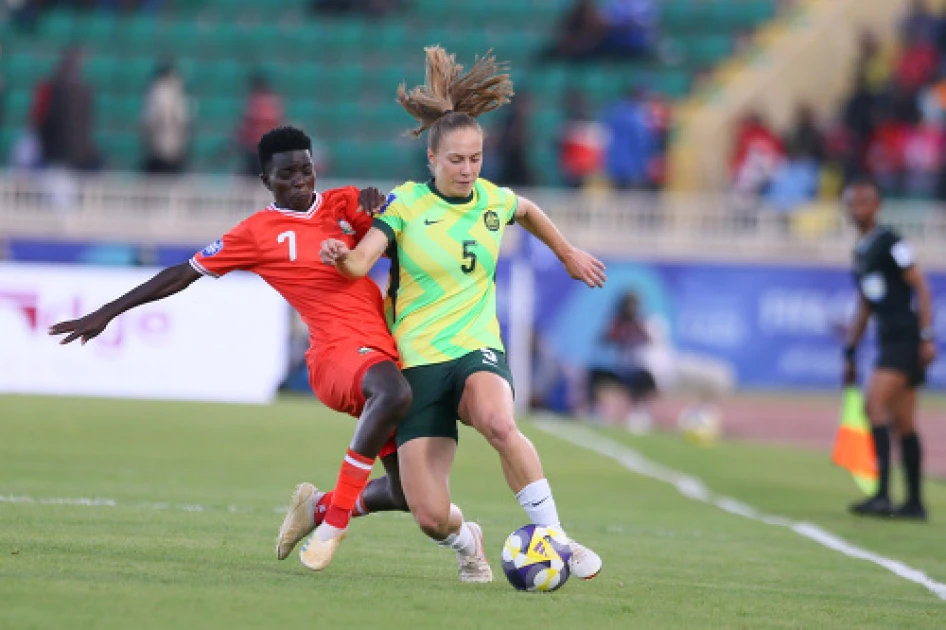
Shalyne Opisa (Left) of Harambee Starlets tackle Rankin Jamila of Australia Matilda during their FIFA Women's Series 2026 match at Nyayo National Stadium on April 15, 2026. Photo/Sportpicha

Audio By Vocalize
The colorful just-concluded inaugural edition of the 2026 FIFA Women’s Series held in Kenya was a moment that briefly placed women’s football in the spotlight with its meticulous organization and stiff competition giving a glimpse of the game’s progress.
Unfortunately, the moment is now a distant memory with and the local women’s league is back to a more familiar reality, one shaped not by international fixtures, but by the long-standing challenges within the Kenya Women Premier League (KWPL).
The boycott that disrupted the league earlier this year may have already happened, but the issues behind it were never temporary.
These issues are structural, persistent, and, most importantly, unresolved which is a contradiction at the heart of women’s football in Kenya today.
The FIFA Series showed what is possible when the game is given proper attention, organization, visibility, and respect since the players competed in an environment that reflected international standards.
Yet to many of those players, that experience does not reflect their weekly reality.
The KWPL has long struggled with challenges that go beyond results on the pitch, issues of inadequate funding, inconsistent administration, limited media coverage, and concerns around player welfare.
The boycott was not an isolated protest; it was a culmination of frustrations that have been building over time.
And that is the key point, the problem is not that the boycott happened but why it had to happen at all.
It is easy to point to events like the FIFA Series and claim progress. And to some extent, that is true, exposure matters and international competition is essential for growth.
But there is also a danger in overvaluing these moments. They can create an illusion that the game is moving forward faster than it actually is.
Because real growth is not measured in tournaments but in functional structures that breed a winning culture.
A successful women’s football system is not built around occasional international events; it is built on a stable, functional domestic league. It is built on players who are supported consistently, not just when they are representing the national team. It is built on governance that listens before issues escalate into boycotts.
Until those fundamentals are addressed, the gap between promise and reality will persist.
So, did the FIFA Series change the narrative of women’s football in Kenya?
Not really. It highlighted the potential but it also exposed the contrast.
If anything, it made the situation harder to ignore. It showed that the country is capable of delivering quality football environments, but chooses, or struggles, to replicate that consistency at the domestic level.
The challenge now is not to create another moment. It is to build continuity.
Because until the realities of the Kenya Women Premier League match the promise seen during international events, women’s football in Kenya will continue to exist in two parallel worlds, one aspirational and one all too real.
Join the Discussion
Share your perspective with the Citizen Digital community.
No comments yet
This discussion is waiting for your voice. Be the first to share your thoughts!