
OPINION: Development planning cannot pause in favour of polarising politics
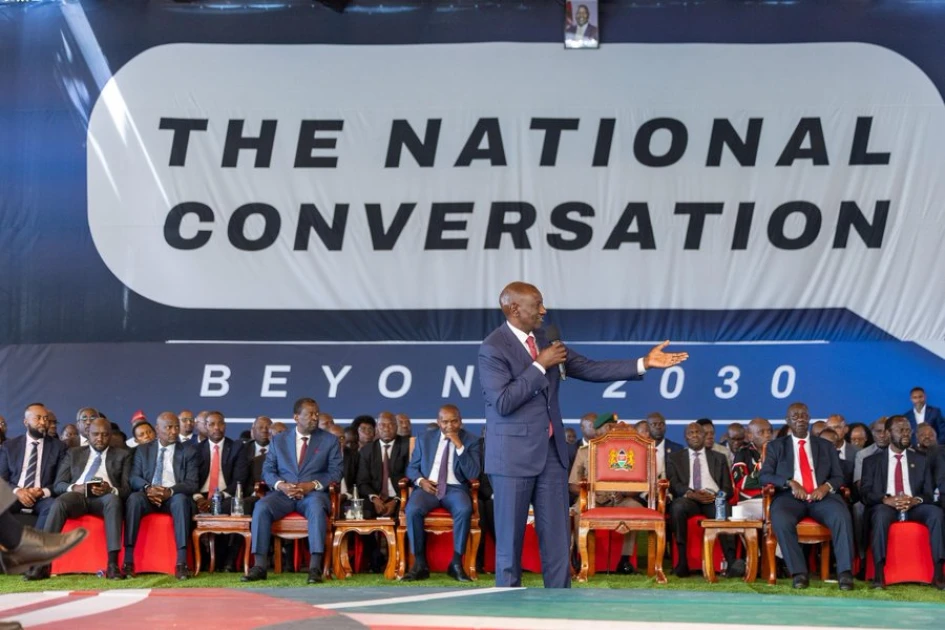
President Ruto speaks at the National Conversation on Beyond Vision 2030, held at the Kenyatta International Convention Centre in Nairobi.

Audio By Vocalize
Individuals may sometimes suspend their dreams, but nations have no such luxury. Nations build dreams, not based on superficial optimism, but on practical, realistic and deliberate interest through sifting of ideas and harnessing their potency.
Every country needs greatly imaginative, creative, competent and progressive leaders in its orbit. Leaders with ideas must remain bold and unyielding to the wet-blanket attitude of their detractors.
It is for this reason that President William Ruto’s assertive call for Kenyans to review and reflect on their development journey thus far, and to cast their sights yonder to a prosperous, modernised and developed future, has to be appreciated.
To achieve this, Kenyans need to sustain a healthy nudge for better ideas, helpful initiatives, and sustained idealism together with their leaders. The call for a National Conversation on a new Development Charter is crucial.
Kenya has for decades sat on its laurels, underestimated its real economic potency and failed to fully invest in the diverse human and material resources, the real nuclear power for its desired rise.
Multisectoral, inclusive and robust discussions have to be enhanced to harness the country’s inherent capacity to transition from a vegetative and socially fragmented, low-income nation into a bustling, modernised regional power.
Kenya’s development path has been paved by development roadmaps ideologically pruned to steer the middle-class course in the post-independence economic ecosystem, and lift the masses at the lower rungs of the economic ladder toward socio-economic liberation.
Development pathways are intentional and purposive. Considering Sessional Paper No. 10 of 1965 hinged on African Socialism and its Application to Planning in Kenya, moving through regional frameworks like the District Focus for Rural Development plan, and stretching to the current long-term master plan like Kenya Vision 2030, Kenya’s longing to rise and truly modernise cannot be second-guessed.
After the Second World War, Japan chose a relentless pursuit of the sunlit path of innovation, discipline, high moral ground, human capital development, national savings, effective corporate governance, and uncompromising work ethic.
The Japanese Economic Miracle model propelled that nation from the despicable post-war ruin to the world's second-largest economy by 1968. It took bold aspirations, and not election anxieties.
Kenya Kwanza’s Bottom-Up Economic Transformation Agenda has demonstrated the workability of development plans when prioritised and well resourced.
The boom of infrastructure projects across the country, healthcare reforms through Universal Health Coverage, reforms in the coffee and sugar sectors, investment in education, equitable distribution of resources and inclusive governance, as demonstrated by President Ruto’s leadership, should inspire us about the possibilities that lie ahead in Kenya’s development.
Visionary leaders and nations have to conceive ideas and bring them forth for themselves and generations yet unborn that will lift them to greatness.
Beyond Vision 2030, the initiative will be instrumental in the architecture of Kenya’s commercial and industrial remodelling.
Visions of nations cannot be divorced from politics; what is important is positive politics, not negative politics driven by false idealism among a select few purveying the narrative that whenever faced by elections, everything should be frozen to give room to polarising rhetoric.
To be persuaded by that would be akin to placing a candle in the wind and expecting its light to endure. Fascination with obstructive policies, negative energy, and intellectual numbness that is averse to generative governance policies is antithetical to national progress.
Buoyed by deep and inescapable historical consciousness of political squabbles and post-election violence, it is time enough that Kenyans should not tie their lives to political rhetoric and let national development planning suffer.
Digesting the discernible and undiscernible issues, from varying perspectives of insight or desire, is welcome, and should happen in the arena of public participation.
It is helpful now, henceforth, for Kenyans to keep their heads above the waters of dystopian politics of tribal enthusiasm, truth decay, and where progressive ideas are treated with cynicism by leaders who have no alternative ideas. Kenyans have to cast a long view beyond Vision 2030, and the time is right to do what is right.
Parochial political interests shrouding some opposition leaders like Rigathi Gachagua should not be construed as intelligent caution, but a bold exposition of their lack of ideas or interest in determining the building blocks for Kenya’s development future.
Facts, truncated with compelling empiricism, must lead us to one conclusion: that Kenya can no longer be saddled by the yoke of narrow tribal political mobilisation and pursuit of political power at the expense of long-term national development.
Javas Bigambo is a Lawyer and Governance Expert based in Nairobi, Kenya.
Join the Discussion
Share your perspective with the Citizen Digital community.
No comments yet
This discussion is waiting for your voice. Be the first to share your thoughts!