
OPINION: China’s economic resilience creating new opportunities for the World
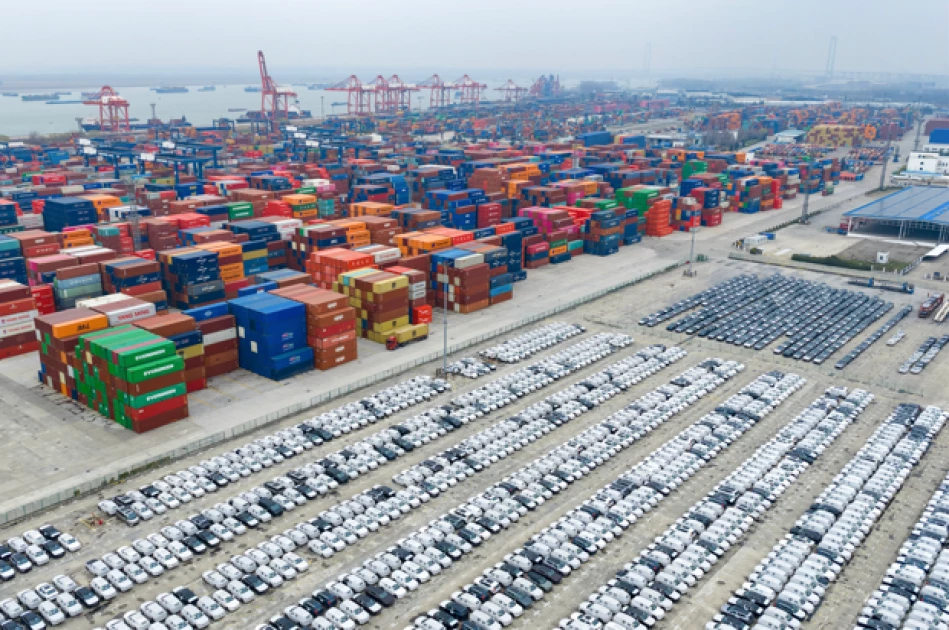
This aerial photo shows vehicles awaiting export at the port in Nanjing, in China’s eastern Jiangsu province on March 15, 2026. (Photo by CN-STR / AFP) / CHINA OUT

Audio By Vocalize
At a time when geopolitical tensions, trade uncertainties and uneven economic recovery continue to weigh on the global economy, China’s latest economic performance offers an important lesson in resilience.
Rather than being defined by external pressures, the world’s second-largest economy is demonstrating an ability to sustain growth while developing new engines capable of supporting its next phase of development.
The figures from the first seven months of 2026 point to an economy that remains active across key sectors. Industrial output grew by 5.3 per cent year on year, while the service sector production index expanded by 4.7 per cent.
Employment remained broadly stable, with the average surveyed unemployment rate at 5.2 per cent, unchanged from the same period last year. Consumer prices also remained moderate, with the Consumer Price Index rising by 0.5 per cent in July.
Perhaps more significant is the performance of China’s external trade. Total trade reached 30.1 trillion yuan during the period, representing a 17.3 per cent increase from a year earlier. Exports grew by 14 per cent, while imports rose by 22 per cent.
The stronger growth in imports is particularly important because it reflects an economy that is not simply relying on selling goods abroad, but one that continues to participate actively in global supply chains and markets.
China’s domestic consumption also deserves closer attention. Claims that Chinese consumers are not spending enough overlook the changing nature of demand.
Consumption is increasingly moving beyond the purchase of physical goods towards experiences and services.
Retail sales of consumer goods reached 28.8 trillion yuan between January and July, an increase of 1.2 per cent year on year, while retail sales of services expanded by 5 per cent.
This shift reveals an economy undergoing qualitative change. Chinese households are showing greater interest in tourism, culture, leisure and environmentally friendly products.
Such changes are characteristic of an economy where rising expectations and evolving consumer preferences are creating new opportunities for businesses and service providers.
At the same time, China’s emerging industries are strengthening the foundations of future growth.
High-tech manufacturing and digital products accounted for 50.9 per cent of the growth in value-added industrial output.
Production of 3D printing equipment, lithium-ion batteries and industrial robots rose by 52.3 per cent, 40.2 per cent and 28.5 per cent respectively.
Artificial intelligence is adding another dimension to this transformation. Rather than remaining confined to laboratories or technology companies, AI is increasingly being integrated into manufacturing and other industries.
Growth in memory chips, electronic components and optical fibres reflects the expanding industrial ecosystem supporting digital transformation.
For developing economies, particularly in Africa, these developments are significant. China’s economic strength is not an isolated national story. Its large market creates opportunities for exporters, investors and businesses around the world, while its industrial innovations can help countries improve productivity and accelerate modernisation.
Affordable technologies such as industrial robots, lithium batteries and 3D printers can be especially valuable to emerging economies seeking to expand manufacturing without carrying the enormous costs traditionally associated with industrial transformation.
African enterprises can benefit from technologies that improve efficiency, reduce production costs and support the development of smarter manufacturing systems.
It is therefore misleading to portray China’s technological progress principally as a threat to the global economy.
Competition is an inherent part of innovation, but the wider effect of technological advancement can also be greater access, lower costs and improved productivity. What matters is how countries use these opportunities to strengthen their own productive capacity.
China’s economic resilience should consequently be viewed through the broader lens of global interdependence.
Its continued growth supports demand, trade and investment, while its technological advances create possibilities for industrial upgrading far beyond its borders.
The emerging picture is not one of an economy standing apart from the world, but of one increasingly connected to global markets through trade, innovation and shared production networks.
For countries seeking new markets and practical pathways to industrialisation, this presents considerable possibilities.
China’s experience demonstrates that resilience is not merely the ability to withstand difficulties. It is also the capacity to adapt, innovate and discover new sources of momentum.
As the global economy searches for stronger and more sustainable growth, China’s evolving economic model offers not only evidence of its own vitality, but also opportunities for partners willing to engage with its expanding market and technological transformation.
The writer, ONYANGO K’ONYANGO, is a Journalist and Communications Consultant
Join the Discussion
Share your perspective with the Citizen Digital community.
No comments yet
This discussion is waiting for your voice. Be the first to share your thoughts!