
OPINION: Building Africa’s farm-to-market agricultural systems for food sovereignty
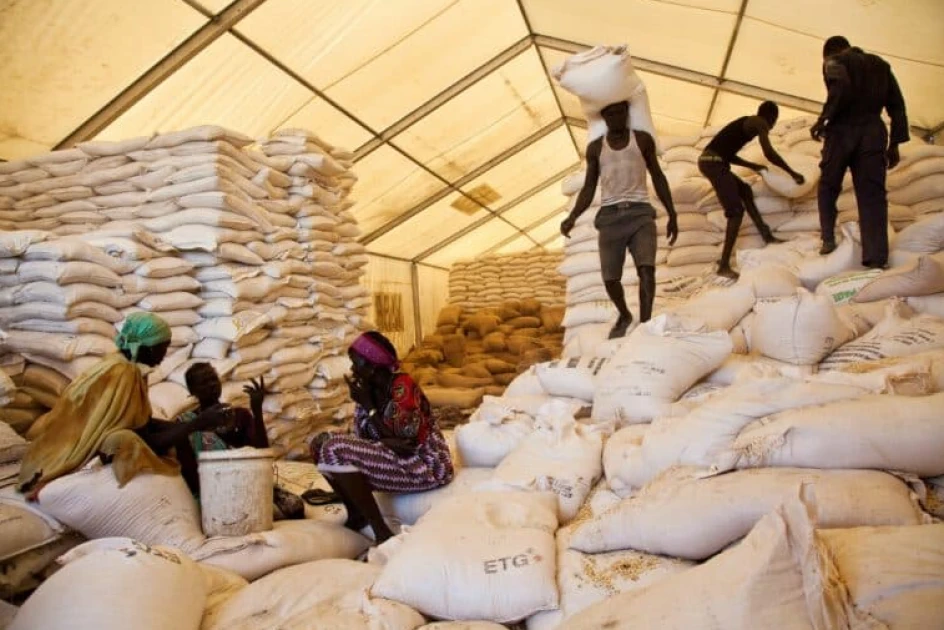
FILE PHOTO: Men carry bags of food while women wait for their rations at the United Nations World Food Programme (WFP) food distribution site in Pibor, South Sudan, June 25, 2012. Picture taken June 25, 2012. REUTERS/Adriane Ohanesian/File Photo

Audio By Vocalize
Food security can no longer mean simply producing enough food. Africa must simultaneously pursue food safety, food security and food sovereignty: ensuring that food is safe, available and affordable, while building domestic capacity to produce the seed, grow the crop, preserve it, process it and efficiently deliver it to consumers.
Potatoes and onions illustrate both the challenge and the opportunity. Kenya produced about 2.31 million tonnes of Irish potatoes in 2023, up from 1.83 million tonnes in 2022.
The crop was valued at approximately KSh65.9 billion and occupied about 239,000 hectares. Potato consumption is estimated at about 40 kilograms per person annually. This means that population growth alone will create substantial additional demand.
The UN projects Kenya’s population to rise from about 55.9 million in 2024 to 86.5 million by 2054.
If potato consumption merely remained at today’s estimated 40 kilograms per capita, potential national requirements would approach 3.5 million tonnes annually by the mid-2050s—roughly 50 per cent above Kenya’s 2023 production.
Rising incomes, urbanisation and expansion of fast-food and processing industries could push demand even higher.
The onion story is equally instructive. Kenya produced approximately 150,000 tonnes of bulb onions in 2024, provisionally, compared with about 136,000 tonnes in 2023.
Yet the Agriculture and Food Authority reports that domestic demand already exceeds local supply, requiring imports from Tanzania and other neighbouring countries.
This is why Africa must think beyond increasing acreage, instead using technology, including climate agriculture practices, to increase production.
Kenya’s post-harvest strategy notes that losses of up to 25 per cent occur in some key staple value chains because of inadequate storage, poor cold-chain management, transport constraints and other weaknesses.
Producing four tonnes and losing one is economically equivalent to never producing that tonne in the first place.
During my visit to Poland, one of the strongest lessons was therefore the power of an integrated agricultural ecosystem involving planting-material producers, farmers, aggregators, storage operators, packers, processors and distributors.
At Mini Tubers Potato Growing (MTPG), Kalinowa, modern in-vitro technology is used in the production of healthy and genetically consistent potato planting material.
Agrosad, which has operated for more than 30 years, combines farmer networks with potato and onion production, cold storage, sorting, packaging, logistics and distribution.
Green Group similarly integrates local farmers with controlled storage, sorting, packaging and transport, including temperature, humidity and ventilation management. There are lessons here, and we plan to transfer technology to Kenya and Africa at large.
The principle is straightforward - starting at Laboratory to planting material, engaging farmers from harvest to storage, grading and packing and processing and ending up in the market.
Africa should increasingly shift from isolated farms to such coordinated farm-to-market systems.
Moving forward, automation will be critical. Mechanised planting and harvesting can reduce labour bottlenecks.
Optical sorting systems can grade produce by size and quality. Sensors can monitor temperature, humidity and ventilation in storage facilities.
Artificial intelligence, satellite imagery, drones, soil sensors and digital weather platforms can help farmers determine when to plant, irrigate, fertilise and harvest.
The goal should not merely be mechanisation, but smart automation: producing more from less for more people, with less land, less water, less energy and fewer losses. This is what I observed at AGROSAD at Blaszki.
Food sovereignty must also begin with the seed. Governments, universities, research institutes and industry should invest in disease-free potato seed, tissue culture, rapid multiplication, biotechnology, conventional breeding, mutation breeding and climate-resilient varieties.
The philosophy should be - Protect the seed. Multiply the seed. Produce more. Preserve more. Process more. Prosper more.
Agricultural subsidies should consequently extend beyond fertiliser. Governments should consider targeted support for certified seed, irrigation, mechanisation, renewable energy, crop insurance, aggregation centres, cold stores and processing equipment, particularly through cooperatives and organised farmer groups.
Storage itself must be regarded as agricultural infrastructure. It reduces post-harvest losses, protects quality and enables farmers to avoid distress-selling immediately after harvest.
Potatoes can be transformed into chips, crisps, starch, flour and other products, while onions stored under properly controlled conditions can supply markets for longer periods.
The demographic imperative makes this transformation urgent. The UN projects the population of sub-Saharan Africa to increase by about 79 per cent by 2054 to approximately 2.2 billion people.
Feeding that population using yesterday’s productivity, storage and distribution systems will become increasingly difficult. We must use technology and innovation- and we don’t need to reinvent the wheel.
The Poland experience provides an important lesson for Kenya and Africa: the future of agriculture is not an isolated farm—it is an integrated system.
Our ambition must be to control the journey from laboratory to field, field to store, store to processing plant and processing plant to market.
With science, automation, quality seed, modern storage, farmer participation, strategic subsidies and private-sector investment, potatoes, onions and other crops can become instruments not merely of food security, but of food sovereignty, industrialisation, employment and national prosperity.
The writer, Prof. Shaukat Abdulrazak, is the Principal Secretary for the State Department for Science, Research and Innovation in Kenya
Join the Discussion
Share your perspective with the Citizen Digital community.
No comments yet
This discussion is waiting for your voice. Be the first to share your thoughts!