
One of last Mau Mau funerals for 'forgotten' independence fighters
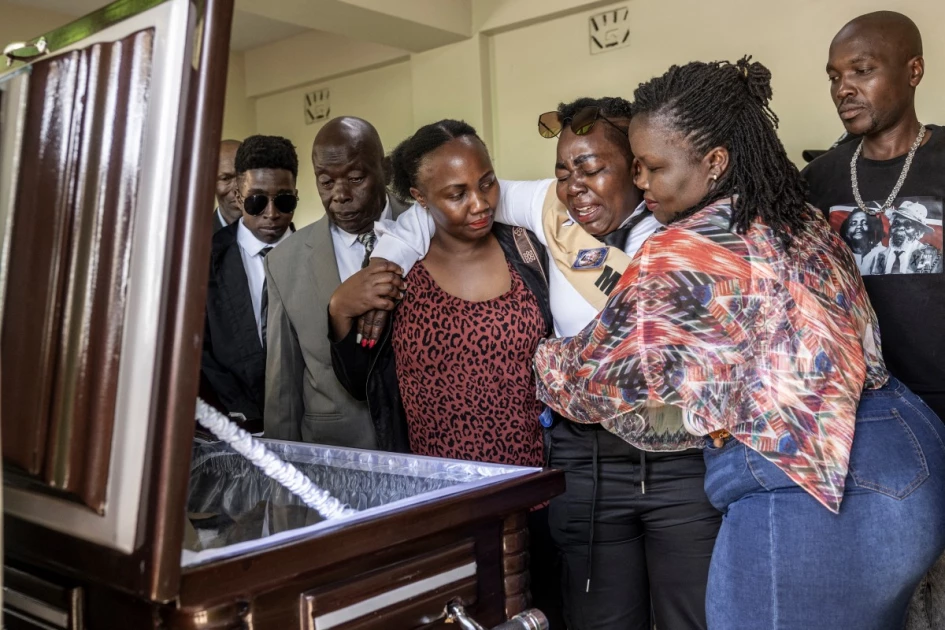
Relatives react as they view the remains of one of Kenya's last Mau Mau resistance fighters, Christopher Njora Muronyo, known as "General Kiambati", during his burial in Nyandarua County on February 14, 2026. Photo by SIMON MAINA / AFP

Audio By Vocalize
At the funeral for one of the last leaders of Kenya's Mau
Mau resistance movement on Saturday, his daughter is bitter: he fought to
liberate a country that never thanked him.
Christopher Njora Muronyo died at the age of 106 in poverty,
still carrying three bullets in his body from his time as a Mau Mau rebel
against the British in the 1950s.
Hundreds gathered for his burial near Kenya's Aberdare
mountains, but it was a modest affair, with no government dignitaries and the
family relying on donations to host it.
"He was a hero but today I am not celebrating, the
national government did nothing for him," his daughter Emily Kiambati told
AFP.
"General Kiambati", as he was known, was close to
the iconic leader of the Mau Mau movement, Dedan Kimathi, who was executed by
the British in 1957.
The rebellion began in 1952 in response to the massive
takeover of land in central Kenya by British settlers, who turned the region
into the "White Highlands".
It was a key chapter in the road to independence in 1963,
and the British response was one of the bloodiest episodes in its colonial
history.
Estimates for the number of Kenyans killed range from 10,000
to 90,000. The Kenya Human Rights Commission says 160,000 were also imprisoned
in camps where executions, torture and ill-treatment were common.
In 2013, the British government acknowledged abuses after a
landmark court case in London and agreed to compensate more than 5,000 Kenyans.
Yet many Mau Mau veterans ended their lives in poverty,
never having received recognition from the Kenyan government or recovered the
land for which they fought.
Muronyo, who never saw any of the British compensation, was
one of many "forgotten generals".
"He lived in abject poverty. His home had been
destroyed," his son, Wilson Maina Kiambati, told AFP.
The children grew up with a violent, traumatised father who
received "no recognition for the role he and others played in liberating
this country," he said.
Kenya's first president after independence, Jomo Kenyatta,
seeking to maintain good relations with the West and fearing resistance to his
own rule, did little to praise the Mau Mau's contribution in public, said
Kenyan historian Macharia Munene.
The new leaders of the independent country "went out of
their way to downplay (the Mau Mau) so as not to scare the West," Munene
told AFP.
Some Mau Mau were arrested or even killed by the Kenyatta's
administration, and the movement was still classified as a
"terrorist" organisation into the early 2000s.
"They were shocked, disappointed and confused that the
government they had fought and shed blood for was now actively hunting them
down," said lawyer Kelvin Kubai, whose grandfather was a Mau Mau fighter
who ended up imprisoned under Kenyatta for five years.
"This betrayal was more painful to the Mau Mau than the
actual bullet of the colonial forces," he told AFP.
The Mau Mau were a taboo for years in part because many
Kenyans had sided with the colonial regime during the uprising.
"The government is still ignoring our suffering,"
said Njoroge Kinuthia, 99, one of Muronyo's comrades-in-arms, at the funeral.
Join the Discussion
Share your perspective with the Citizen Digital community.
No comments yet
This discussion is waiting for your voice. Be the first to share your thoughts!