
National school census exposes teacher shortages, infrastructure gaps

Audio By Vocalize
According to the 2024 Kenya School Census Report, the national learner-to-teacher ratio based on TSC-employed teachers in junior schools stands at 74:1, with counties such as Mandera, Marsabit, Wajir and Turkana bearing the heaviest burden.
Kenya's education system is expanding, with millions of children enrolled in schools across the country. According to the 2024 Kenya School Census Report launched on Thursday by KNBS, there are a total of 121,873 basic learning institutions across the country.
Enrolment in public schools stands at 14,042,706, accounting for 78.9 per cent of the total enrolment, while that of private schools stands at 3,746,636 (21.1 per cent).
Gender parity recorded a notable improvement, with an almost 50:50 ratio of boys to girls enrolled in pre-primary, primary, junior and secondary schools. But beneath the impressive numbers lies a question of adequacy.
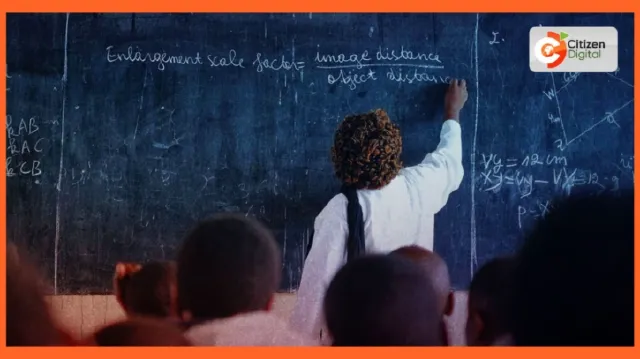
On teacher availability, the census puts the ratio at 74 learners for every TSC-employed teacher.
The disparities between counties are even more striking, with Mandera recording 140 learners for every TSC teacher in public schools, followed by Marsabit at 134, Kirinyaga at 133, Wajir at 130 and Nyandarua at 100 learners per teacher.
This is despite sustained assurances by the government that it has employed 100,000 teachers in the last four years.
"Already, plans are underway to employ an additional 20,000 teachers to ensure that the teacher-learner ratio is within the allowed target in all the counties," officials stated.
On infrastructure, of the 492,652 classrooms across the country, 12.7 per cent were temporary structures.
Public schools had a higher proportion of permanent classrooms (91.7 per cent) compared to those in private schools (76.5 per cent).
Turkana County had the highest learner-to-classroom ratio in both pre-primary and secondary schools, at 76 and 64 learners respectively.
The report further interrogated the steps taken towards the inclusion of learners with special needs.
"Only 7.1 per cent of schools reported enrolling learners with special needs, and just about 2 per cent of our classrooms were adapted for them, which points to the fact that we have a long way to go in terms of inclusion," officials stated.
The census also revealed a worrying digital gap, with only 6.4 per cent of schools equipped with computer laboratories, 19.6 per cent having internet connectivity and 29.8 per cent using computers for teaching.
"This provides evidence of accelerated delivery of our commitment in the education and training sector, disaggregated at the institutional level," an official stated.
"The picture we have gotten paints a picture of where our children are as a country and where our children obtain skills for the future," the official added.
KNBS also launched the first national mapping and census of TVET institutions for 2026, which provides an important foundation for planning and strengthening the sector.
Join the Discussion
Share your perspective with the Citizen Digital community.
No comments yet
This discussion is waiting for your voice. Be the first to share your thoughts!