
Nairobi: Hustlers forced to master more than one skill to survive tough times
Photo/Courtesy

Audio By Vocalize
Although he is a carpenter by trade – his work profile often change in the course of the day depending on a customer's needs.
If you don’t find him fixing broken door locks, or fitting woodworks in a new building, you are likely to find him working as ‘Mtu wa Mkono’ for one of his mason friends. Or, you will find him working as a loader; helping residents of the estate to carry luggage – and for a small fee.
Like many residents in the capital, Dennis begins his day at around 7:30 am – that’s when sleep departs his 45-year-old eyes.
“You cannot sleep when you have these many bills to pay,” he says with a little smile.
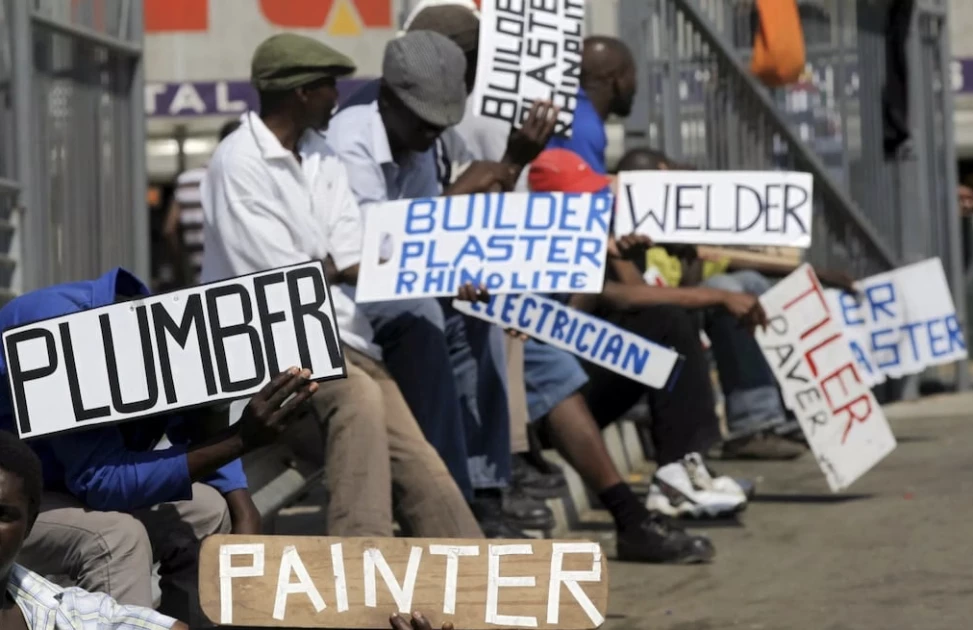
This morning he is at their usual meeting place; a dusty veranda outside a shop (and there are many casual labourers here) each waiting patiently for good fortune to smile on them.
Here you will find masons, plumbers, electricians, loaders, transporters, drivers, and just about anyone you need.
“There is always someone who can do whatever it is a customer wants, provided it’s legal,” he says with a creased smile.
“This is like our little office,” he says, pointing to the dusty veranda with the skin of his mouth.
Over 10 adult males, people with a special set of skills, congregate here daily; from Monday to Monday hoping for work.
It’s like a common labour market, where small services are aggregated, and the charges are friendly.
On a good day, Dennis can land up to two job requests; these are small fitting jobs like fixing a broken door lock, breaking or fixing a door in the estate.
“I keep my work tools in the house, which is not very far from here. Once I get a request, I just dash to the house to get my tools and get to work,” he says.
“Some of the work is not much, just fixing this and that, and I get paid for my work,” he told Wananchi Reporting.
He says that demand for small time services are in high demand in Kayole, Komarocks, Nasra and Nyama Villa estate – although sometimes it gets very dry.
“Sometimes I sit here the whole day, waiting for just one customer who needs their furniture fixed, but I get none,” he says, adding that he has to depend on referrals a lot.
“You will find people coming and asking for a plumber, electrician or a mason. So, as a carpenter, you are left staring as your colleagues with these set of skills land jobs. This is why some of us are learning other skills to compete,” he says.
Dennis does not charge much – and says that payments are often negotiated depending on a number of circumstances.
“I charge between Sh200 and Sh500 for small jobs which take only a few minutes or hours to complete,” he says.
“There are days when you can get an engagement that runs for a few days, especially if it’s a new building coming up in this area. This is more stable, and you are assured of an income at the end of each day,” he says.
“It’s however, not easy, because there is no guarantee you will get a job when you wake up in the morning, and remember some of us have families to feed and rent to pay,” adds Dennis.
According to him, most of the casual workers leave one day at a time.
They don’t save for any emergencies – which to them come almost all the time – neither do they save for their sunset days.
“Our lives are already an emergency,” he says with a distant smile.
“You only save money if you have surplus. Tell me, how do I save money for the future when I am struggling to pay rent and feed my family today?” he asks.
The recent findings of a household survey by the Central Bank of Kenya (CBK), FSD Kenya and the Kenya National Bureau of Statistics (KNBS) showed that 25.2 percent of Kenyans depend on others for survival while 28.5 percent work as casuals.
The share of casual workers in wealthy counties was higher than the national average, with percent of adults working as casuals in Nairobi being (31.1 percent), behind Mombasa (38.3 percent), Kisumu (39.5 percent), Nakuru (38.8 percent), and Kiambu (32.8 percent).
Dennis is one of the thousands of hustlers who have had to comb the streets of Nairobi, looking for casual jobs and leaving one day at a time.
To enhance their chances of landing more job opportunities, many casual labourers are now forced to master more than one skill to survive.
“That is why you will find a mason who can fix doors, and still do plumbing. At the moment, I am learning masonry, bricklaying and stuff like,” he says.
Join the Discussion
Share your perspective with the Citizen Digital community.
No comments yet
This discussion is waiting for your voice. Be the first to share your thoughts!