
Mwaura: Persons with disabilities must have a voice in Kenya’s political processes
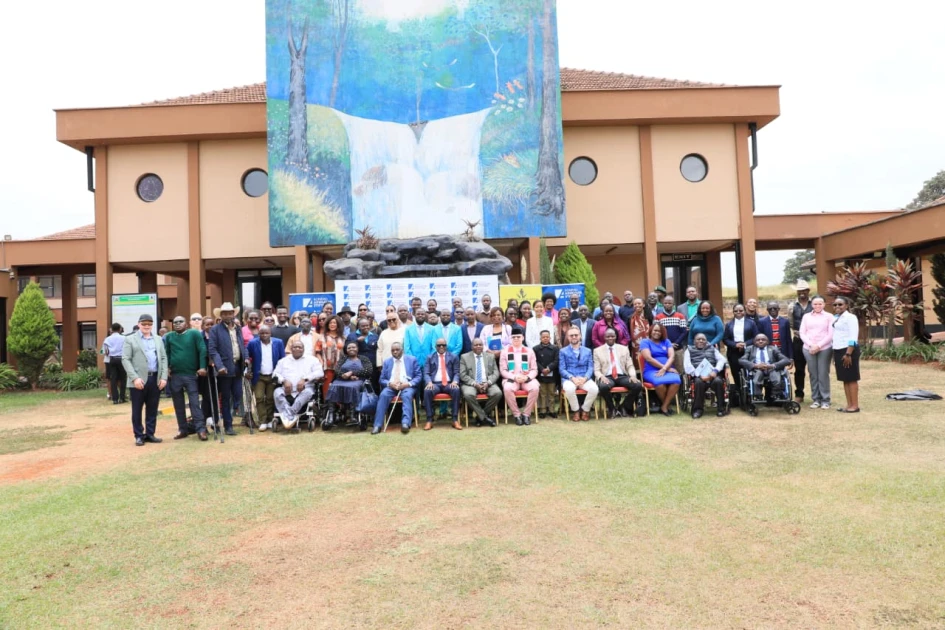
Secretary for Administration in the Office of the President, Dr Isaac Mwaura, with stakeholders after an inaugural meeting at the Kenya Institute of Special Education (KISE).

Audio By Vocalize
Persons with disabilities must be fully included in Kenya’s
resource allocation and political decision-making processes, Secretary for
Administration in the Office of the President, Dr Isaac Mwaura, has said.
Speaking during an inaugural
stakeholders’ meeting at the Kenya Institute of Special Education (KISE),
Mwaura said the government is prioritising budgetary allocations to ensure
persons with disabilities and other marginalised groups receive the resources
and support intended for them.
“The government is keen on
ensuring that persons with disabilities are fully accounted for in the
distribution and utilisation of resources,” Mwaura said.
He added that budgetary
allocations were being prioritised to ensure every county and category of
beneficiary is catered for, urging stakeholders in the disability sector to
help ensure resources reach the intended beneficiaries and are put to proper
use.
Mwaura said inclusion must also
extend to Kenya’s political and democratic processes, arguing that the concerns
of persons with disabilities risk being overlooked when they are absent from
decision-making spaces.
“Political participation should
not be limited to voting,” he said, adding that it should also include the
ability to engage with political parties, seek leadership positions,
participate in public debate and contribute to policy development.
He called on political parties,
policymakers and other stakeholders to create space for issues affecting
persons with disabilities and other marginalised groups to be reflected in
policy discussions.
Mwaura also urged stakeholders to
address barriers that make it difficult for persons with disabilities to
participate in democratic processes.
“For persons with disabilities,
meaningful political participation also depends on practical accessibility,
including access to information, voting processes, public meetings and other
democratic spaces,” he said.
He further said organisations
representing persons with disabilities have a key role in ensuring the concerns
of their members are communicated clearly to policymakers.
“People who are affected by
public policies should have an opportunity to help shape the decisions that
affect their lives,” Mwaura said.
Meanwhile, KISE Director Dr
Norman Kiogora said the institution is conducting a nationwide assessment of
schools and institutions serving learners with disabilities to establish the
state of special needs education across the country.
Kiogora said the exercise is
examining infrastructure, accessibility, learning facilities, assistive devices
and human resources, while geotagging institutions and assistive devices.
“The information helps expose disparities
between regions and identify communities where learners may have limited access
to specialised educational facilities,” he said.
He said the findings would
provide the Government with a stronger basis for determining where additional
classrooms, equipment, personnel and accessibility improvements are needed.
Konrad Adenauer Stiftung Kenya
Country Director Mathias Kamp said partnerships between Government, civil
society, the private sector and development partners would be critical in
addressing barriers faced by marginalised communities.
“Inclusion requires more than
individual programmes because lasting change depends on institutions, systems
and processes that can continue delivering results over time,” Kamp said.
He said disability inclusion cuts
across education, employment, technology, infrastructure, public services,
political participation and economic empowerment, making coordinated
interventions necessary.
Join the Discussion
Share your perspective with the Citizen Digital community.
No comments yet
This discussion is waiting for your voice. Be the first to share your thoughts!