
MOTOR HUB: Automotive courses explained

Audio By Vocalize
Probably because they lacked someone to take them through the courses before applying.
Unfortunately when courses are advertised through print, digital or social media. no one bothers to explain to the applicants about expected future careers after course completion. Everyone assumes engineering is basic and self-explanatory.
Perhaps this is the reason many Kenyans opt to drop out of tertiary education ( diploma and lower) or finish then end up in a different career.
Apart from formal training institutions, many established workshops carry out on-the-job training, which has helped change many lives of young Kenyans.
But the confusion is still very rampant on course selection.
Just a few weeks ago, KCSE exam results were out and I believe soon most colleges will be advertising courses and engineering courses will be among them. Having gone through tertiary training and now running an automotive garage, I still see the same confusion happening to my trainees.
For this reason, I opted to break down some of the courses related to the automotive industry that usually bring about confusion during course selection.
Mechanical Engineering
Most instructors and teachers will agree with me that mechanical engineering is a course that a lot of applicants choose, thinking that it's related to mechanics.
Mechanical engineering is a wide course that is not directly related to automotive engineering, even though it touches on basic principles of the internal combustion engine. It majors in three key fields, but we shall talk about two because the third one is studied at higher levels
1 Plant option: in this category, a trainee is focused on learning how to repair and maintain heavy farm equipment and earthmoving machines (plant mechanic). Tractor repairs are not included. The on relationship with automotive engineering in this is the internal combustion engine but the rest is purely hydraulics.
2 Mechanical engineering (production option): In basic terms, mechanical engineering production option is where a technician works on a lathe machine to produce parts from scratch. Many people refer to them as "kalasinga wa kuchonga chuma".
Also in this category, there is specialising in all sorts of welding ranging from gas welding, arc welding, MIG welding TIG welding etc.
Automotive engineering.
This is the main body of an automotive technician otherwise known as a mechanic. depending on the institution, the applicant will be taught some electrical basics but will major mainly in all the systems of the automobile ranging from chassis systems, steering systems braking systems, suspension systems, ignition systems transmission systems, and engine systems with all its components and functions. At the end of the course, the student will be able to carry out his/her duties as a fully-fledged mechanic without any difficulties. The syllabus may vary from one institution to the other depending on the examining body but all in all the job title remains a mechanic. With the current new-age vehicles full of automation and sensors, motor vehicle mechanic is slowly incorporating or shifting to auto electrician.
Auto electrician
An automotive electrician is a person who handles all electrical issues related to an automobile. From lighting systems, charging systems, electrical auxiliary and accessories, the ignition system is often shared between the auto elect and automotive mechanic depending on depth. In some higher learning institutions offering degree courses, one can combine both mechanical and electrical engineering under a course known as mechatronics.
Panel beaters
Another big confusion usually comes up when it comes to panel beating. Many people associate panel beaters with vehicle painters. Their jobs are almost similar but should not be mistaken. Panel beaters only deal with vehicles panel fittings and body straightening in case of an accident. They may also carry out gas and arc welding if need be. Chassis jigging is also under their speciality depending on workshop establishment. Before any car undergoes a paintwork, the first person to work on it will be a panel beater.
Automotive painters
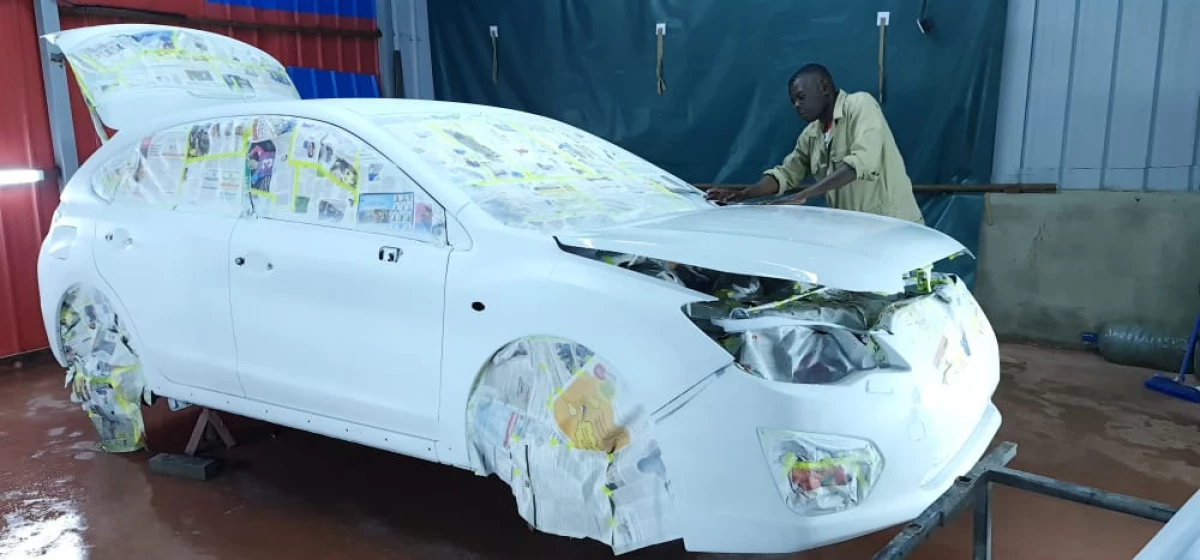
This is self-explanatory. Once a panel beater has finished up with the panels, he hands over the car to the painter who gives it a fresher look that appeals to the eye. Depending on how good he trained in the field , he may be able to carry out the final detailing of buffing out the car or in some places buffing is done by someone else only dedicated to buffing.
In higher learning institutions a combination of all the above corses is done under a corse known as mechatronics where an applicant studies mechanical engineering automotive engineering and electrical engineering all combined
Kindly note the above courses the next time you are applying for an automotive course for yourself or your dependents.
We hope this has been enlightening
Until next week have a blessed week full of easy selection.
The writer is the owner of Boosted Auto car repair shop
Join the Discussion
Share your perspective with the Citizen Digital community.
No comments yet
This discussion is waiting for your voice. Be the first to share your thoughts!