
Mau Conservation Marathon returns as ecosystem restoration efforts gain momentum

Audio By Vocalize
This transformation is at the heart of the second edition of the Mau Conservation Marathon, unveiled in Nairobi by Environment Principal Secretary Dr. Eng. Festus Ng’eno.
The marathon is part of the wider Mau Forest Integrated Conservation and Livelihood Improvement Programme (MFC-ICLIP), a 10-year initiative designed not only to restore degraded ecosystems but also to uplift communities living around Kenya’s largest water tower.
Dr. Ng’eno said the Mau Forest Complex remains central to Kenya’s survival, feeding major rivers and lakes while supporting agriculture, hydropower generation and millions of livelihoods across the country.
Yet beyond its environmental significance, the programme is increasingly reshaping how communities interact with forests through integrated conservation and livelihood systems.
At the core of this approach is the Trees Establishment and Livelihood Improvement Scheme (TELIS), which enables households to grow food crops while nurturing tree seedlings. More than 4,600 households are currently participating in the initiative.
For many families, TELIS has become a reliable source of both food and income, with farmers engaged in potato farming, avocado production, pyrethrum cultivation, beekeeping and agroforestry activities.
Since its launch, the programme has restored about 1,500 hectares of degraded land and planted 1.5 million trees, with a reported survival rate of 99 per cent—an indicator of strong community ownership and technical support.
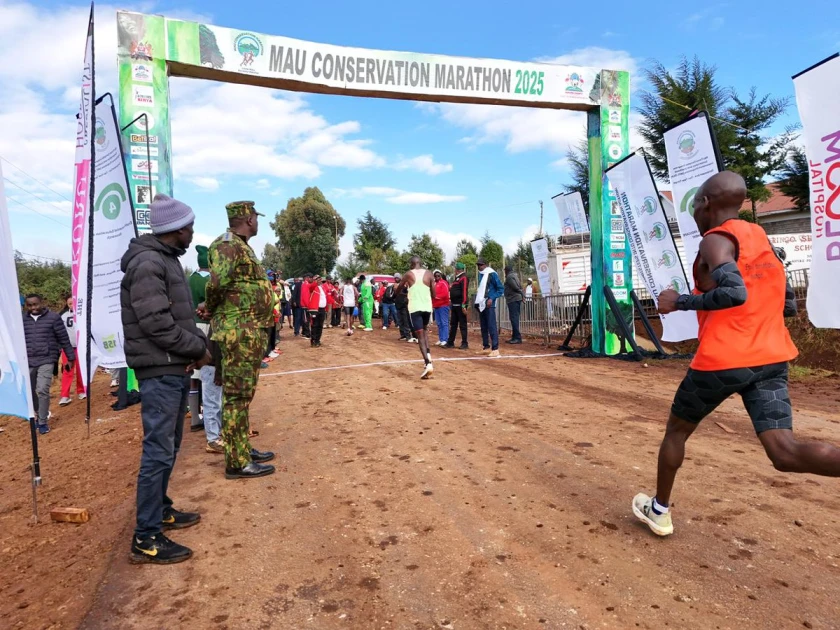
The upcoming Mau Conservation Marathon is scheduled for July 3, 2026, and will be staged under Athletics Kenya sanctioning. The event will feature four race categories, including a 42km full marathon, 21km half marathon, 10km race and a 5km corporate fun run.
Organisers say the route will traverse the scenic Mau landscape, with participants expected to experience high-altitude terrain as the race unfolds across one of Kenya’s most important ecological zones.
To attract elite athletes and boost participation, organisers have also increased prize money, with winners of the full marathon set to receive KSh600,000, while top performers in the half marathon and 10km categories will take home KSh350,000 and KSh100,000 respectively, contributing to a total prize pool of KSh7.8 million.
The race is expected to attract about 2,500 participants, although early registration figures show approximately 500 runners had signed up by early June. Registration closes on June 25, 2026.
Organisers have described the event as more than a sporting competition, positioning it as a conservation-driven platform under the theme “Transforming Footsteps into Conservation Action.”
Dr. Ng’eno urged greater participation from institutions, development partners and the public, noting that every contribution strengthens water security, clean energy access, biodiversity protection and community livelihoods.
The initiative also aligns with Kenya’s broader national restoration agenda led by President William Ruto, which targets the planting of 15 billion trees by 2032.
The programme seeks to reverse deforestation, restore 5.1 million hectares of degraded landscapes and strengthen climate resilience under the African Landscape Restoration Initiative launched in December 2022.
This continental and national effort brings together governments, civil society, private sector actors and communities in a coordinated push to combat climate change, restore biodiversity and secure natural ecosystems.
As part of this vision, Kenya aims to increase forest cover from the current 8.8 per cent to at least 10 per cent before 2030, an expansion expected to improve air quality, strengthen rainfall patterns and boost agricultural productivity across the country.
Through initiatives such as the Mau Conservation Marathon, conservation is increasingly being positioned not just as an environmental obligation, but as a shared national development priority linking ecosystems, livelihoods and long-term economic resilience.
Join the Discussion
Share your perspective with the Citizen Digital community.
No comments yet
This discussion is waiting for your voice. Be the first to share your thoughts!