
Maraga report: What ails police service and Ksh.106 billion reform blueprint
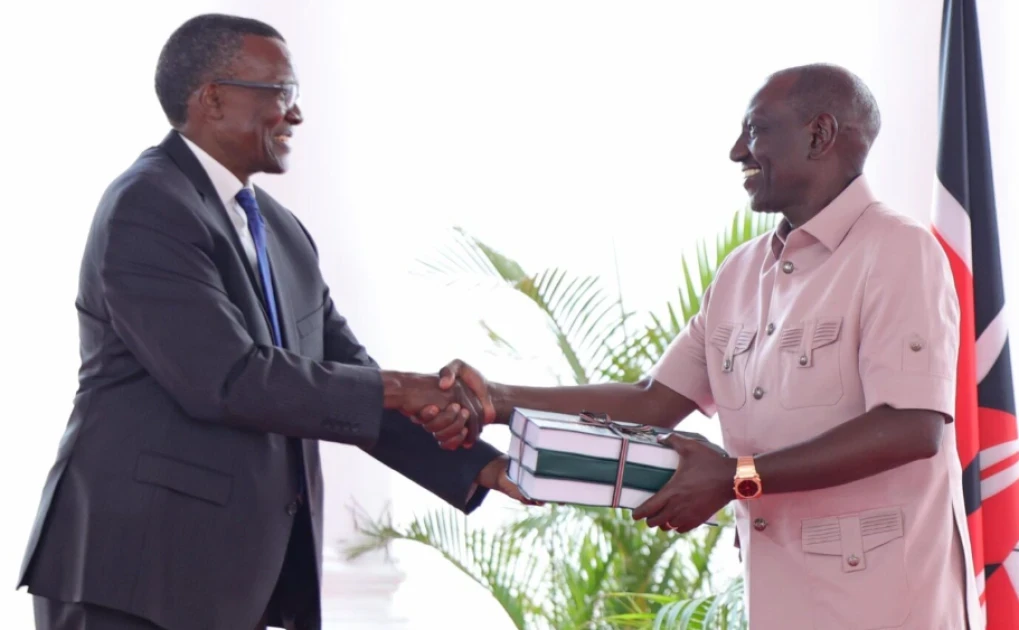
Former Chief Justice David Maraga (left) hands over police reform taskforce report to President William Ruto (right) in November 2023. Photo: FILE

Audio By Vocalize
On Monday, retired Chief Justice David Maraga did what he said he never wanted to do: shared the full report himself. Because the man he handed it to at State House on November 16, 2023, President William Ruto, never did.
It is a quietly extraordinary moment, a former Chief Justice publishing a government report on social media because the government would not.
But behind the ultimatums is a story that matters more than the standoff itself. What happens to a police officer, a prison warder, or an NYS instructor when the state that deploys them does not house them, and when it does, it is a spectacle, does not pay them enough, does not train them properly, or trust them with independence.
Are they serving a hidden purpose in their current sorry state which genuine reforms would overthrow? Indeed, they have become pawns in a game of chess, which only the player might know why, when and how to deploy.
A Report Born of Frustration, Buried by Convenience
Ruto appointed Maraga in December 2022 to chair a 23-member taskforce, initially tasked with reviewing the welfare and terms of service of the National Police Service (NPS) and Kenya Prisons Service.
In March 2023, its mandate widened to include the National Youth Service, with a broad remit to examine the legal, policy, administrative and operational problems facing all three institutions after consulting the public and other stakeholders.
The final report landed on Ruto's desk in November 2023. It identified underfunding, endemic corruption, weak leadership and poor human-resource management as the core issues eroding these services.
These are not abstract bureaucratic findings, but plain explanations for why a constable posted to a rural station might sleep in a leaking iron-sheet clad quarters, why a prison officer might go months without a proper uniform, and why a young NYS trainee might emerge from truncated training unprepared for real responsibility.
At the report's public release on Monday, Maraga said the taskforce's recommendations had largely gone unimplemented, despite having reached the President's desk nearly three years earlier.
The frustration in his voice was not new, it had been building for months.
The Ultimatum That Forced the President's Hand
In an August 18 letter, Maraga gave Ruto seven days to release the complete, unedited report, or he would release it himself.
He accused the President of failing to restore the police service's independence and of allowing brutality and impunity to persist, invoking the constitutional right of access to information, since a report prepared with public money belonged to the public.
Ruto let the deadline pass. Maraga had hoped the President would unveil the report during Katiba Day celebrations, or at a recent police pass-out parade in Kiganjo Police Training College; instead, Ruto used that Kiganjo event to unveil new police uniforms.
On Monday, Maraga finally posted the report's link himself.
At the press briefing that followed, his language sharpened. Referring to legal provisions placing police leadership under presidential control, Maraga argued that current sections of the National Police Service Act effectively hand the President a grip over the force's deputies and director, something he bluntly called not reform, but "capture."
It is rare to hear a retired Chief Justice use that word about the very government that appointed him to fix the problem.
What the Report Actually Found
Strip away the politics, and the taskforce's diagnosis reads like a quiet indictment of decades of neglect. Underfunding sits at the root of nearly everything else: officers who cannot afford decent housing near their stations, prisons that cannot feed inmates adequately, let alone rehabilitate them, an NYS that struggles to equip its trainees.
Endemic corruption festers in that same soil of scarcity; when salaries are low and oversight is weak, informal "taxation" of the public becomes, for some officers, a survival strategy rather than a moral failing alone.
Weak leadership compounds it further, leaving capable officers stuck for years with no clear path forward, while transfers become currency for patronage rather than merit.
None of this is abstract to the people who wear the uniform. A constable earning a modest starting salary, expected to maintain a professional bearing while renting a room he can barely afford, is not an administrative statistic; he is a man whose family bears the weight of an underfunded system too.
A prison officer working a punishing roster with inadequate protective gear carries that same quiet toll home each evening.
The taskforce's recommendations read less like policy jargon and more like an attempt to restore basic dignity to public service.
A Blueprint Worth Ksh.106 Billion
The taskforce's proposed remedies were sweeping and costed. Among the headline recommendations were a 40% salary increase for the lowest ranks, phased over three years, bringing NPS, Prisons and NYS pay into alignment with the Kenya Defense Forces.
It also touched on raising the minimum recruitment age to 21 and the academic qualification threshold to a grade C-, to attract more mature, better-prepared recruits.
It calls for longer, more rigorous training programs across all three services. It recommends substantial upgrades to medical cover and housing, addressing one of the most persistent officer grievances and a maximum three-year tenure per station for officers, to curb entrenchment, cronyism and localized corruption networks.
It proposes fresh vetting of senior officers, alongside competitive, transparent appointment processes for the Inspector-General and Deputy Inspectors-General, a direct challenge to the current system of presidential appointment.
The report demands modernization of equipment, from vehicles to protective gear to digital case-management systems.
The taskforce put the total implementation cost at approximately Ksh.106 billion, a substantial figure, but one it argued was modest against the cost of a demoralized, under-resourced, and occasionally predatory security apparatus.
Selective Implementation
To the government's credit, it has not ignored the taskforce entirely. The National Police Service Commission says it has made headway on some fronts, salary reviews, promotions, and proposed amendments to the NPSC Act, while the administration has also rolled out a police modernization program worth an estimated Ksh.28 billion over two years, covering equipment, digitization, vehicles, ammunition and housing.
These are nothing; for an officer who finally gets a functioning vehicle or a long-delayed promotion, the difference is real.
But the criticism, from opposition leaders, and now pointedly from Maraga himself, is that the government has cherry-picked the easiest, most visible reforms while quietly shelving the ones that would actually redistribute power and accountability. Nothing illustrates this better than the new police uniform.
The government has allocated an estimated Ksh.2.8 billion for new uniforms, at roughly Ksh.25,000 per set, unveiled with fanfare at the Kiganjo parade in late August.
The irony is almost too neat: the taskforce had actually recommended the NPS revert to its old uniform for three years while a properly consultative process designed a new one, after finding overwhelming dissatisfaction with the current attire's color and quality.
Instead, the government pushed ahead with an entirely new uniform, and even that has been engulfed in controversy.
Maraga has openly questioned the procurement process, alleging opacity and possible corruption, though the NPS has denied any irregularity, saying the manufacturing contract was awarded lawfully to a registered local supplier.
Opposition leaders have seized on the contrast between a multi-billion-shilling wardrobe change and the unresolved welfare crisis underneath it.
DAP-K's Eugene Wamalwa has pressed for the report's release, citing unresolved housing shortages and payslip deductions still weighing on officers. Democratic Party leader Justin Muturi argues officers need training in human rights far more than a new look.
Wiper's Kalonzo Musyoka has separately called for an overhaul of the police training curriculum, particularly on handling public demonstrations.
Maraga has also turned his attention to leadership tenure itself, questioning the continued stay in office of Inspector-General Douglas Kanja and DCI Director Mohamed Amin, both of whom he says have passed the mandatory retirement age, and urging the National Police Service Commission to advertise their positions for a competitive, transparent recruitment process.
Beyond the Headlines
It would be easy to read this as one more chapter in Kenya's long history of taskforces whose reports vanish into the filing cabinets of power. But the human cost is not abstract.
Every year the report sits unimplemented is another year an officer's family absorbs housing costs the state should cover, another intake of NYS recruits trained too fast and too thin, another cohort of prison staff working without the equipment or numbers to do their jobs safely and humanely.
As long as the document remained withheld, the public had no way of judging which recommendations the government had genuinely accepted, which it had quietly shelved, and which it simply hoped Kenyans would forget.
Maraga's decision to publish it himself does not, on its own, rebuild a barrack roof or raise a constable's salary.
But it makes the promise visible again, and puts the burden of explanation back where it belongs: on the President who received it, and on a government now forced to answer, uniform in hand, why the easy reform came first and the hard ones did not come at all.
Join the Discussion
Share your perspective with the Citizen Digital community.
No comments yet
This discussion is waiting for your voice. Be the first to share your thoughts!