
Macondo Literary Festival 2026 to explore Africa’s ‘silenced’ histories, cultural restitution
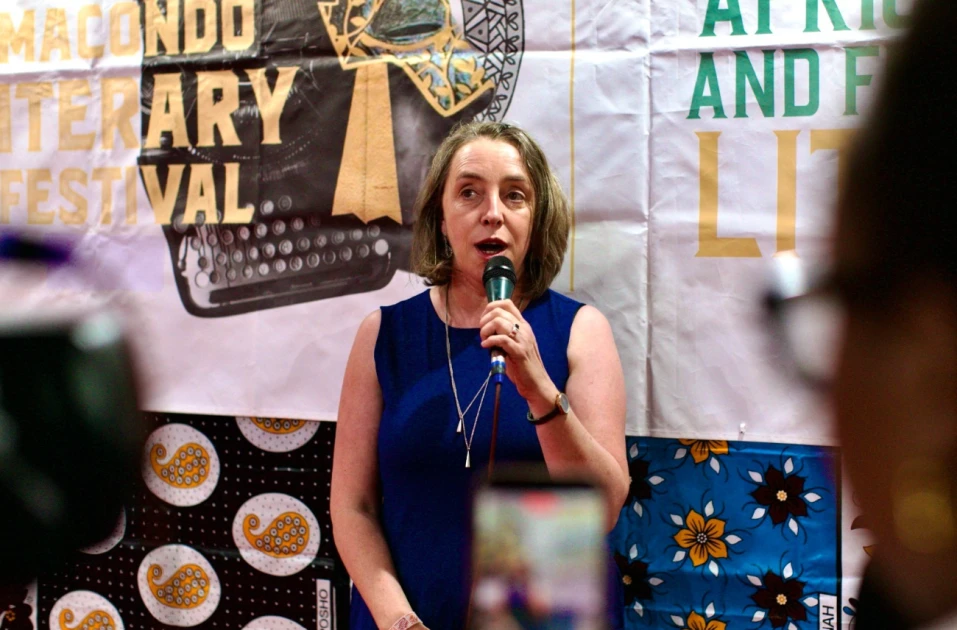
Anja Bengelstorff, the co-founder of the Macondo Book Society, explains this year’s theme during the launch at Maktaba Kuu, Upper Hill, Nairobi.

Audio By Vocalize
The Macondo Literary Festival will this month bring together writers, artists and cultural practitioners to examine Africa’s contested histories, cultural memory and the restitution of heritage taken from the continent.
The sixth edition of the Nairobi-based festival will run from
September 18 to 20 under the theme “Ink, Sea, Silence”, with a programme
combining literature, music, film, dance, food and art.
The festival’s programme was unveiled on September 4 at
Maktaba Kuu, where discussions centred on the looting of African artefacts, the
suppression of African heritage and the impact of these omissions on historical
archives.
A panel hosted by Mutanu Kyany’a of African Digital Heritage
brought together Kenyan poet, writer and filmmaker Ngwatilo Mawiyoo and French
art historian Bénédicte Savoy, a leading authority on the provenance and
restitution of looted cultural heritage.
The discussion examined what the festival described as
“archives of silence”, including the continued absence of African artefacts
from their countries of origin.
According to the festival, an estimated 90–95 per cent of
African artefacts remain in Western museums and private collections, despite
their importance to the continent’s history and heritage.
Savoy, who co-authored the 2018 Sarr-Savoy Report on the
restitution of African cultural heritage commissioned by then-French President
Emmanuel Macron, said African artefacts and manuscripts had been systematically
looted and subsequently classified in ways that obscured their origins.
She cited African manuscripts held at France’s Bibliothèque
Nationale as an example, saying some were classified as Arabic manuscripts
despite being written in African languages using Arabic script.
“It is African language but in Arabic letters,” Savoy said,
arguing that such categorisation contributes to the silencing of African
intellectual contributions.
She called for France and other Western countries to return
manuscripts and artefacts to their countries of origin, including Mali, Senegal
and Guinea.
Mawiyoo, meanwhile, challenged Africans to take a more active
role in demanding the return of their cultural heritage, arguing that
restitution requires what he termed a “fighting spirit.”
He pointed to Namibia’s campaign for restitution following the
massacre of the Herero people as an example of what collective activism can
achieve.
“When I look at us over a long time, I find in East Africa
we're very accepting of circumstances. We just sit here, we internalize, and we
stop there,” Mawiyoo said.
The festival organisers said the debate also highlighted an
imbalance in who controls the global conversation on African heritage.
They cited the 2022 ‘Reclaiming Restitution’ report by Open
Restitution Africa and Africa No Filter, which found that in 2020 non-Africans
were 17 times more likely than Africans to be referenced, interviewed or author
articles on African heritage restitution.
Anja Bengelstorff, co-founder of the Macondo Book Society
alongside Kenyan novelist Yvonne Adhiambo Owuor, said the festival would
question not only what has been left out of African history, but also who has
controlled the writing of that history.
“Africa’s story has been inscribed by many hands, not always
in goodwill,” Bengelstorff said, adding that the festival would examine how
African writers are reclaiming the narrative and shaping new visions of the
continent’s present and future.
The three-day festival will feature authors from Africa and
beyond, including Canadian novelist of Ghanaian heritage Esi Edugyan, Sudanese
author Abdelaziz Baraka Sakin, Nigerian writer and photographer Emmanuel Iduma,
Egyptian writer Yasmine El Rashidi and Botswana writer Lauri Kubuitsile.
Other featured guests include Réunion Island author Gaëlle
Bélem, Indian poet and novelist Meena Kandasamy, Iranian-American author Said
Khatibi, Brazilian novelist Itamar Vieira Junior, Nigerian author Tochi Eze and
Indian/UAE-based author Deepak Unnikrishnan.
They will be joined by Kenyan literary prize winners Dominic
Maina, Edwin Omindo and Nicholas Ogal, as well as performers Rebian, Adam
Chienjo, Dorphanage and Kevin Munyi & Friends.
The programme will feature conversations in French,
Portuguese, English, Arabic and Swahili, alongside eight sessions interpreted
in Kenyan Sign Language.
Four sessions will also be livestreamed for audiences outside
Kenya.
The festival will further screen ‘Dahomey’ (2024), Mati Diop’s
film about the return of 26 looted royal treasures from Paris to Benin.
Other events include the interdisciplinary performance “Scribes
on Silent Waves”, combining spoken word and dance, live music, and
masterclasses covering children’s stories, nature writing, protest writing and
“write-to-destroy” techniques.
Organisers say the festival is open to the public and seeks to
use literature and multimedia storytelling to reconnect communities with
histories that have been displaced, forgotten or deliberately silenced, while
creating space for conversations on identity, cultural heritage, memory and
restitution.
Join the Discussion
Share your perspective with the Citizen Digital community.
No comments yet
This discussion is waiting for your voice. Be the first to share your thoughts!