
Language barriers and resource gaps silencing Africa's critical climate stories, new study reveals
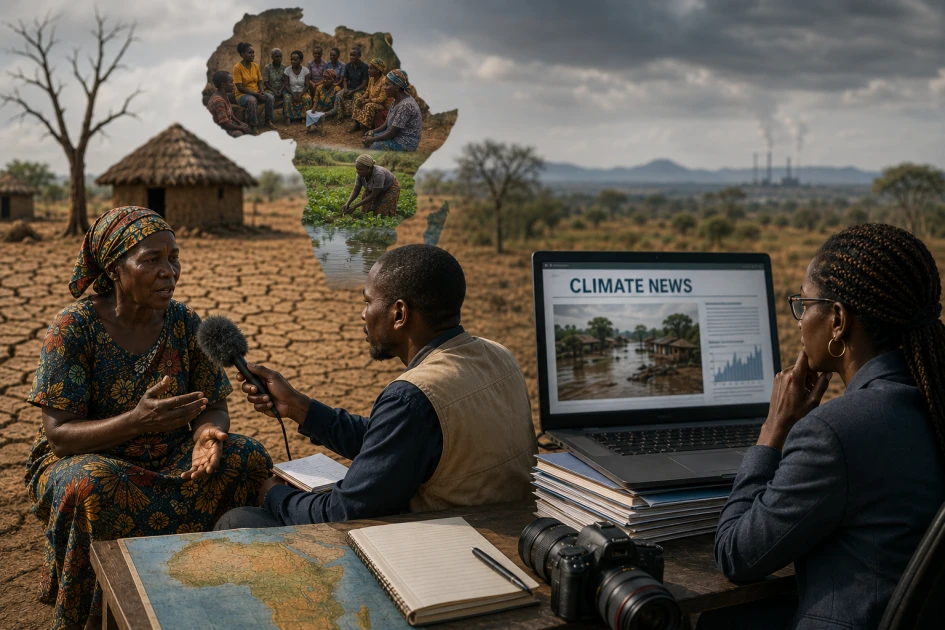
AI-generated illustrative image depicting the challenges facing climate change reporting in Africa, including language barriers, limited newsroom resources, and the need to amplify grassroots voices. The image is for illustrative purposes only and does not depict actual people or events.

Audio By Vocalize
This was revealed as part of findings of a preliminary research, titled Action Research to Enhance Effective Coverage of Climate Change Issues in Africa, (ARECCA), which painted a grim picture of a media landscape struggling to elevate grassroots realities to the global stage.
Presenting the findings, Dr Osir Otteng of Maseno University noted that despite Africa being on the frontline of climate vulnerability, the continent’s media narrative remains detached from its most vital sources being indigenous and rural populations.
“Looking at the performance of some of the field studies, only 5% of the audience engaged with the stories filed by journalists. While this means that there was some level of understanding and response, this is something that can always get better," he said.
The findings also showed how a lack of resources for investigative journalism amidst shrinking revenues impacts the overall quality of climate change reporting, making newsrooms focus on event-based outcomes rather than long-form pieces that could better outline the nuances of climate change.
Lost in Translation
While the global climate discourse is dominated by English, the main language in documenting complex scientific terminology, rural communities experiencing the direct impacts of environmental degradation speaking in local dialects have not been adequately featured.
Because many localized ecological terms, traditional weather-forecasting methods, and environmental shifts have no direct Western equivalents, the nuance is stripped away during the reporting process. Journalists, the study finds, are often forced to oversimplify or mischaracterise indigenous knowledge, hindering proper reporting that genuinely touches on grassroots populations.
“There was also something positive to report on, which is that journalists are deliberately going out to speak to communities in the villages and not in hotel rooms. This shows there is the goodwill for authenticity,” highlighted Dr. Otteng’.
Complex Data, Empty Pockets
The research also points to a glaring deficit in data-driven and investigative journalism on the continent. Dr Otteng noted that there is a severe lack of in-depth investigations on climate change reporting across African newsrooms.
This stagnation is largely attributed to the highly complex datasets associated with modern climate science, such as meteorological modelling and tracking climate finance, coupled with a widespread lack of resources within media houses.
Participants in the study noted that without specialised data journalism training, dedicated funding for field travel, or the time required to pursue protracted investigations, reporters are frequently restricted to reactive, surface-level coverage of extreme weather events rather than uncovering systemic corruption or policy failures.
Patrilineal Gatekeepers
The study further exposed deep gender disparities in climate sourcing, particularly within East and Southern Africa.
In countries like Zimbabwe and Tanzania, women are still not adequately represented in climate stories due to strong, enduring patriarchal systems.
The exclusion presents a major blind spot for environmental journalism. In both nations, women comprise the vast majority of the agricultural labor force and bear the primary responsibility for water and food security, making them the most acutely impacted by shifting seasons. However, deeply entrenched cultural norms dictate that male community leaders or husbands act as the primary spokespersons for the household, effectively locking women out of the media narrative.
By failing to bypass these patriarchal gatekeepers, journalists are missing the critical perspective of the very demographic navigating the daily realities of climate adaptation.
A Call for Action
Media analysts argue that the action research study arrives at a pivotal moment, as African nations demand greater climate accountability and loss-and-damage compensation from global emitters.
The consensus from the report underscored the need to accurately shape the Africa climate story; media stakeholders must deliberately invest in resources for local investigative journalists, develop frameworks to preserve indigenous languages in reporting, and actively dismantle the patriarchal barriers that keep vulnerable women invisible.
The study was conducted over the last year by eight journalists from across the continent and was spearheaded by the Media for Environment, Science, Health and Agriculture (MESHA) alongside the International Development Research Centre (IDRC).
Join the Discussion
Share your perspective with the Citizen Digital community.
No comments yet
This discussion is waiting for your voice. Be the first to share your thoughts!