
Ksh.4.8 trillion 2026/27 budget: How it will be financed and the new tax measures

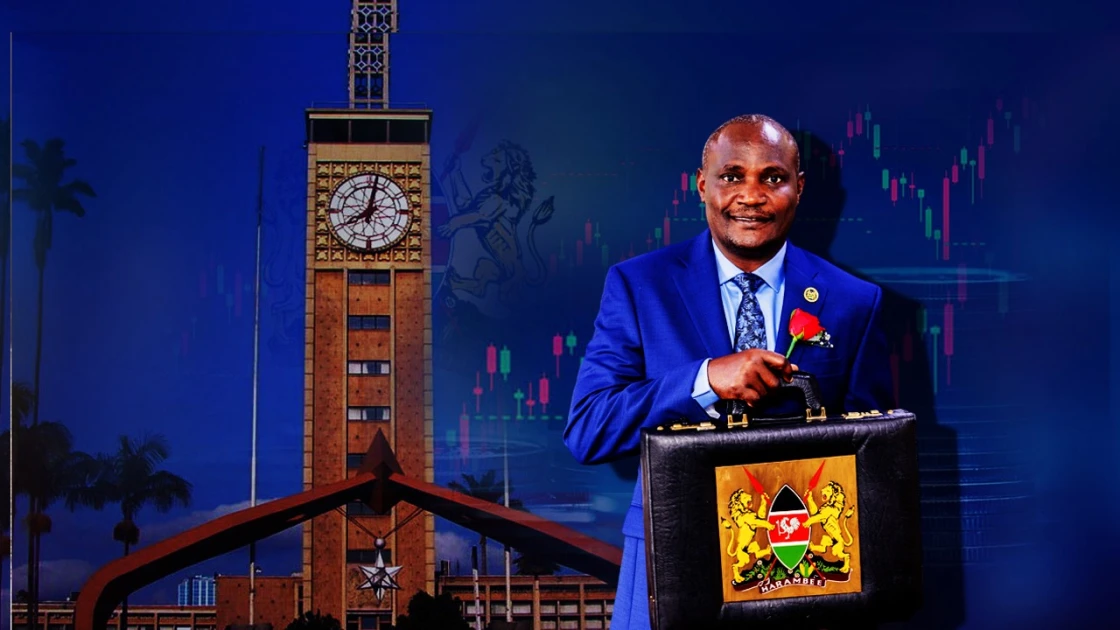
Treasury CS John Mbadi

Audio By Vocalize
While reading out the Budget Statement for the Financial Year 2026/27 in Parliament, Treasury Cabinet Secretary John Mbadi said the government expects total revenue of Ksh 3.631 trillion, inclusive of Appropriations-in-Aid (A.I.A), alongside grants amounting to Ksh.44 billion
Despite the projected revenue, the budget faces a deficit of Ksh.1.146 trillion with the shortfall expected to be financed through a combination of external and domestic borrowing.
Net foreign financing is projected at Ksh 0.116 trillion, while net domestic financing is expected to account for Ksh 1.030 trillion, making domestic borrowing the main source of deficit funding.
Tax measures to boost revenue
To bridge the financing gap, the government has introduced wide-ranging tax reforms across VAT, income tax, excise duty, and customs duty aimed at expanding the tax base and improving compliance.
Under Value Added Tax measures, VAT on Mitumba will be charged only at importation, with local sales exempt. The baggage duty-free threshold for travellers has been raised from USD 300 to USD 2,000 to ease travel costs.
Key exemptions include VAT relief for large commercial aircraft and spare parts, dialyzers used in kidney treatment, public-private partnership (PPP) projects, and scrap metal.
Income tax reforms
Income tax changes include the exemption of Capital Gains Tax and Stamp Duty on property transfers into approved Real Estate Investment Trusts (REITs), aimed at boosting investment.
The corporate tax rate for non-resident petroleum contractors has been reduced from 37.5% to 30%, alongside clarification of a 15% tax on repatriated income for petroleum firms.
Other measures include a simplified taxation framework for non-resident landlords, revised filing timelines for individual income tax returns, a 20% withholding tax on lottery and prize winnings, and a 1.5% withholding tax on scrap metal transactions.
Excise duty adjustments
Excise duty proposals reflect a mix of public health considerations and revenue optimisation. Bottled water will be exempted from excise duty to improve affordability, while sugar-sweetened beverages will face an increased levy to KSh 20 per litre.
Mobile phone taxation will be streamlined into a single 25% excise duty applied at the point of activation, eliminating multiple tax layers.
To promote environmental sustainability, a 10% excise duty will be imposed on both imported and locally manufactured plastic articles.
In the alcohol sector, excise duty on Extra Neutral Alcohol will be reduced from Ksh 500 to Ksh 80 per litre, while preferential treatment previously enjoyed by small independent brewers has been removed to ensure tax fairness.
Customs duty measures
On customs duty, the government has introduced measures aimed at supporting local manufacturing and agriculture. Importation of inputs for assembling smart telecommunications devices will be duty-free, alongside raw materials for motorcycle parts, with Completely Knocked Down (CKD) motorcycle kits attracting a 10% duty remission.
To protect domestic industries, finished textile imports will attract a 35% duty, while selected processed agricultural products will also be subjected to a 35% import duty to boost local production and employment.
Wheat imports will attract a reduced 10% duty under remission, down from 35%, while rice imports will remain at 35% instead of the previous 75%. Import duty exemptions will also apply to PPP projects.
The Treasury says the combined approach of tax reforms, improved compliance, and borrowing will help finance the Ksh.1.146 trillion deficit while supporting priority sectors such as health, agriculture, manufacturing, and infrastructure.
Join the Discussion
Share your perspective with the Citizen Digital community.
No comments yet
This discussion is waiting for your voice. Be the first to share your thoughts!