
Kenya's fight against learning poverty as Reading Day campaign targets 1 million children
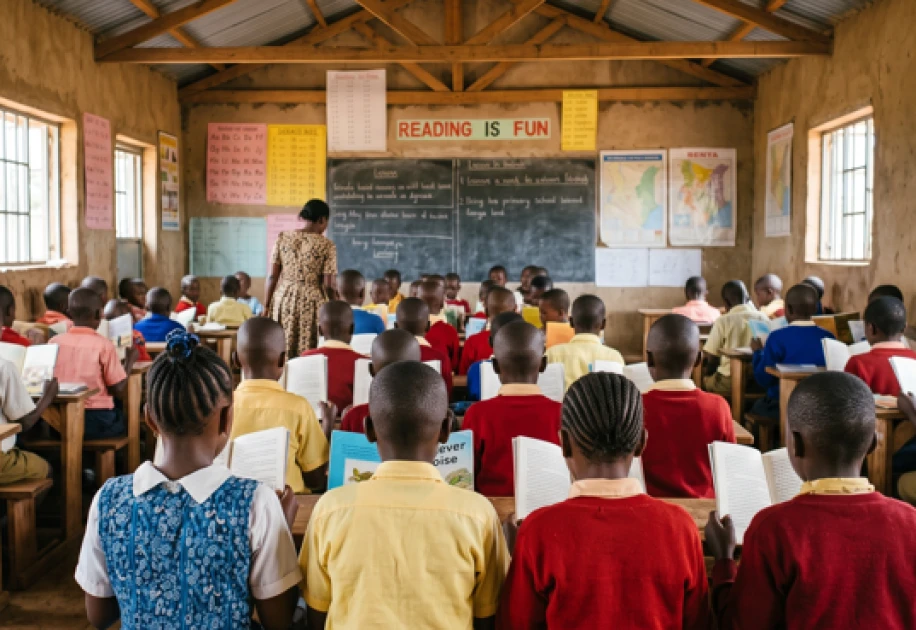
An AI-generated image shows children reading in a classroom.

Audio By Vocalize
A 13-year-old boy, Mathew (not his real name), was at home after missing school for three consecutive days due to illness. He is the eldest of five children in a household where formal education remains a distant aspiration. The youngest sibling, aged five, has not yet enrolled in school.
Mathew’s mother speaks only Maa, does not know her exact age, and has never obtained a national Identity card.
Together, these circumstances reflect barriers that some people in remote pastoralist communities continue to face in accessing civil registration, public services and formal education systems.
They also make it harder for parents to engage with schools, access government programmes and fully exercise their rights as citizens.
Their 32-year-old father has never attended school and openly admits he plays little role in supporting his children's education.
Speaking through a local sub-chief who translated from Maa, the father explained that although some relatives, including a brother who is a medical doctor, attained higher education, they live away from the family homestead and are unable to provide regular academic support.
The encounter painted a picture of how intergenerational illiteracy, language barriers, poverty and geographical isolation continue to shape children's access to education in many pastoralist communities.
Here, learning is not simply about enrolling in school. It is about whether children have books to read, adults who can support them, and learning materials that reflect their language and culture.
Mathew's story mirrors a wider crisis. According to UNESCO and World Bank learning poverty estimates, nine out of ten children in Sub-Saharan Africa cannot read and understand a simple text by the age of ten.
The burden falls heaviest on marginalized communities where poverty, limited infrastructure, low adult literacy and language barriers combine to weaken foundational learning.
Years ago, five-and-a-half-year-old Mike Saito disappeared into the vast wilderness of the Maasai Mara. For five days, his family searched desperately as hopes of finding him alive faded.
According to Saito, a lioness stayed close to him throughout much of the ordeal until a vehicle from Fairmont Mara Safari Club eventually spotted the animal and traced the missing child.
Today, that extraordinary survival story has become The Boy and the Lion, a children's book published in English and Kiswahili and now serves as the centrepiece of Kenya's National Read Aloud campaign.
This year's campaign uses the book not only to encourage reading but also to teach children about human-wildlife coexistence, an issue that affects millions of Kenyans living near wildlife habitats.
The initiative seeks to overturn the long-held stereotype that Africans do not enjoy reading and instead promote literacy as something enjoyable, communal and relevant to children's everyday lives.
"We want children to see reading as exciting and fun. Reading is not just for examinations; it builds imagination, confidence and lifelong learning," says Evelyne Mwandia, Executive Director of Start a Library, who believes reading should become part of Kenya's national identity.
"The National Read Aloud was born from a common saying: if you want to hide something from an African, put it in a book. Read Aloud is about demystifying that," she says.
She says the campaign has evolved into a nationwide literacy movement.
"We want children to see reading as exciting. It should be as enjoyable as football, and every child should feel they belong."
On July 10, 2026, to mark Kenya's National Reading Day, they aim to bring together one million children from more than 3,000 schools across all 47 counties to read the same book simultaneously in an attempt to set a new world record.
The current record, held by the United States, stands at 223,363 participants across 909 venues. Kenya came close in 2015 when more than 229,000 children in 1,097 schools across 44 counties participated in the National Read Aloud initiative.
"This is not simply about breaking records," Mwandia says. "It is about ensuring every Kenyan child discovers the power of books and the confidence to use their voice."
She argues that literacy is the foundation upon which opportunity, dignity and active citizenship are built.
"Children, especially those in rural communities and urban informal settlements, need support to acquire literacy because literacy is the foundation for opportunity, education, dignity and voice."
Yet she believes Kenya still lacks a strong policy framework to support reading beyond the classroom.
"As a country, we do not yet have a strong policy governing library reading and foundational learning. Libraries should be part of national investment in education."
That policy gap may soon begin to narrow as the National Assembly has approved the Kenya National Library Service Bill, 2023, legislation that seeks to modernise library services, promote literacy and preserve Kenya's literary and cultural heritage.
Sponsored by MP Dan Wanyama, the Bill gives effect to Article 11(2)(a) of the Constitution, which requires the State to promote literature, libraries, publications, science, communication and other forms of cultural expression.
If enacted, the law will clearly define the responsibilities of both levels of government. The national government will develop policies, standards, research programmes, a national virtual library and an integrated web catalogue, while county governments will establish and manage county libraries, reading centres, literacy campaigns, outreach programmes and access to community learning resources.
Education experts believe the legislation could significantly improve access to books, particularly in underserved rural communities where libraries remain scarce.
The proposed national virtual library could also help bridge geographical barriers by providing learners and teachers with digital access to educational materials regardless of location.
For literacy advocates, such reforms complement initiatives like the National Read Aloud campaign by ensuring children continue reading long after national events have ended.
The urgency is reflected in recent learning assessments. The 2025 Foundational Literacy and Numeracy Assessment (FLANA) found that more than half of Grade Six learners cannot read and comprehend a Grade Three-level text. Education experts warn that advancing learners into upper primary subjects without foundational reading skills risks creating long-term learning gaps.
Teachers say these challenges are already evident in classrooms.
Milka Maina, Headteacher at Joseph Apudo Comprehensive School in Nairobi, identifies limited parental involvement as one of the biggest obstacles.
"The reading challenges commonly faced by learners in our school are linked to lack of parental involvement. Children rely heavily on teachers because many parents are unable to support reading at home."
She says weak literacy affects nearly every subject.
"When learners struggle with spelling, pronunciation and comprehension, it affects both English and Kiswahili and ultimately their overall academic performance."
Beyond academics, the consequences affect children's confidence.
"Some learners have low self-esteem and lack confidence."
At Wangu Primary School in Nairobi's Dandora, Deputy Headteacher Imelda Milulu says inadequate learning materials make personalised learning difficult.
"After reading books, children become excited, more creative and eager to learn," she says.
She adds that regular reading strengthens communication skills.
"Reading helps learners speak better English and improves their writing."
For children growing up in households where parents cannot read, where books are scarce and where language barriers persist, education begins with significant disadvantages long before they enter a classroom.
It is here that culturally relevant books acquire deeper significance. By publishing the story in English and Kiswahili and potentially Maa in the future educators hope to bridge not only language barriers but also children's sense of identity and belonging within education.
Across Kenya, millions of children are now reading stories of lions, elephants and human coexistence together, transforming literacy from an examination requirement into a shared national experience.
For Mike Saito, whose remarkable encounter with a lioness once captured the nation's imagination, the story has come full circle.
What began as a survival story in the wild has become a vehicle for learning, helping children discover that books can expand their imagination, strengthen their confidence and perhaps change the course of their own lives.
Join the Discussion
Share your perspective with the Citizen Digital community.
No comments yet
This discussion is waiting for your voice. Be the first to share your thoughts!