
Kenyans still waiting for Gov't to fulfil promises - Report
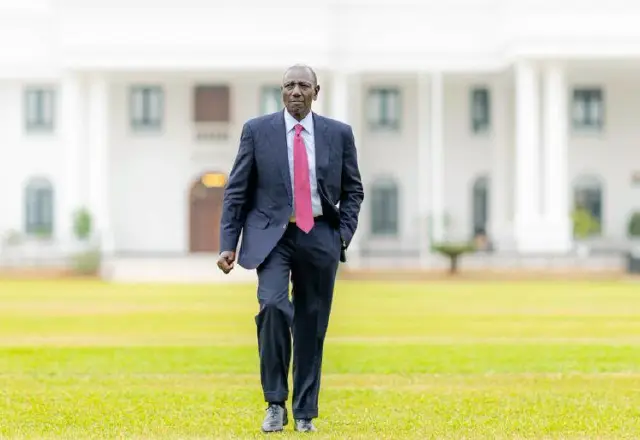
President William Ruto takes a stroll at State House, Nairobi, following a meeting with the national and county governments on September 8, 2026. Photo/PCS

Audio By Vocalize
The report also highlights governance challenges that continue to affect public service delivery and the government's inability to fulfil its pledges, with communities still waiting for promises of improved services to translate into tangible results.
From promises of universal healthcare and better-equipped hospitals to improved education, modernised agriculture, reliable water and an expanded road network, successive governments have unveiled ambitious plans to transform the country.
Yet, for many Kenyans, access to these basic services remains a daily struggle.
The Uraia Trust report, titled 'The People's Agenda', documents concerns raised by citizens across ten counties, painting a picture of persistent service delivery gaps.
"Kenya's governance challenge lies not in missing laws, we have the laws, but in the gap between formal commitment and practical implementation. In the health and education sector, what we found is that the major primary issues raised by the citizens here are staffing, issues of medicine in health facilities, and also facilities readiness to offer services to the citizens," Dr. Peter Oino Gutwa, Lead Researcher, stated.
"There was also the aspect of ECD in terms of capacity, the teachers, and also even the facility for use in teaching."
The report's authors say that although Kenya has established laws, policies and institutions intended to promote equitable development and public accountability, institutional capacity constraints, weak enforcement and competing interests continue to undermine service delivery.
They are challenging the government to back its pledges with tangible action, arguing that the service delivery gaps also reflect wider governance challenges.
"We feel that there is a disconnect between the citizens and those in leadership. What they consider to be important is not what the citizens consider to be important. And that disconnect has to be narrowed and eventually to be eliminated, so that there is a sync in what the citizens want and what the leadership thinks," Oliver Waindi, Executive Director, Uraia Trust, highlighted.
Civil society organisations have also raised concerns about public financial management, including incomplete development projects and weak financial controls.
They are calling for accountability to go beyond how public funds are allocated to examining whether the money delivers the intended services and development projects.
The report draws on citizen-generated priorities from Nakuru, Murang'a, Baringo, Tharaka-Nithi, Mombasa, Kisumu, Nairobi, Isiolo, Kisii and Siaya.
Join the Discussion
Share your perspective with the Citizen Digital community.
No comments yet
This discussion is waiting for your voice. Be the first to share your thoughts!