
Kenyans among migrant workers exploited in Qatar as World Cup 2022 nears - Report
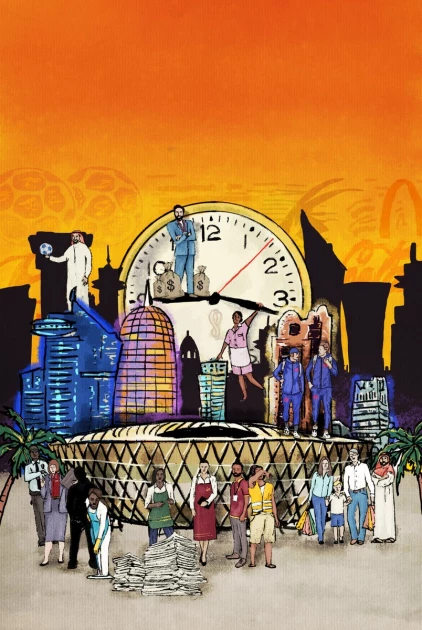
Migrant workers employed at Fifa World Cup Qatar 2022 hotels have been subjected to labour exploitation and human rights violations, a report shows. ILLUSTRATION/ EQUIDEM.ORG

Audio By Vocalize
The investigations conducted between February 2020 and July 2022 documented significant labour and human rights violations in 13 out of 17 of FIFA’s hospitality partners, with migrant workers from Africa and Asia being affected.
Citizen Digital reached out to the Qatar Embassy in Kenya for a response on the claims made by migrant workers and the findings in the Equidem and (GLJ-ILRF) report but there was no response by the time of publishing.
Kenyans were found to be among the migrant workers affected by sexual harassment, nationality- and gender-based discrimination, wage theft, health and safety risks, sudden loss of employment, and illegal recruitment charges they faced in their work.
The report released by Equidem and GLJ-ILRF on Thursday, July 28 showed that several migrant workers in the hotels are denied the fundamental right to associate, subjected to intensive surveillance and employer control, and fear retaliation—including employer-instigated deportation—for defending their rights and interests.
Eighty migrant workers were interviewed across 32 hotels, including 54 workers employed in hotels belonging to 13 of 17 of FIFA World Cup Qatar 2022 partner hotels.
Many are migrant workers from Kenya, Bangladesh, Ghana, India, Indonesia, Morocco, Nepal, the Philippines, Thailand, and Uganda.
Citizen Digital spoke with two Kenyans - who were migrant workers in Qatar- and they shared some of the labour and human rights violations they witnessed.
Their stories are based on personal experiences, observations and testimonies they received from migrant workers in the hotels and those that were construction workers in stadia that will host the 2022 Fifa World Cup.
Malcom Bidali worked as a security guard in Qatar, until 2021 when he was arrested, placed in solitary confinement and banned from leaving the country.
He was charged with misinformation, taken to a court of law and released after intervention by labour and humanitarian organisations such as Equidem and the International Labour Organisation.
“I was arrested and placed in solitary confinement. After a law firm took my case, I was made to pay a fine of $6,000-7,000, the labour organisations covered the legal fee and fine,” Bidali said.
Bidali confirmed availability of written labour laws and regulations that detail the rights of workers, but cited lack of education by migrant workers and opportunism by employers as the reason as to why the laws are not implemented.
“Education should begin right here in Kenya with recruitment agencies. Before leaving the country, people should know their rights, the hours they should be working in a day, salary they are going to get and in case of any problem, the avenues they are going to use before migrating to the gulf,” he said.
Bidali identified discrimination, poor living and working conditions, heat stress, racism and passport confiscation, freedom to change jobs as some of the challenges that migrant workers face in Qatar.
A year after his return to the country, Bidali continues with his quest to defend the rights of migrant workers through his own registered platform named migrantdefenders.org.
In March 2022 questions and concerns over Qatar’s treatment of migrant workers took centre stage at the 72nd FIFA Congress.
Whilst some of the speakers raised concerns about working conditions there, authorities referred them to various reforms including that in August 2020, landmark changes were made to the labour law, including scrapping the need for an NOC – employer’s permission to change jobs – that rights activists said tied workers’ presence in the country to their employers and led to abuse and exploitation.
Geoffrey Owino, an ex-migrant who also worked as a security officer in Qatar also took Citizen Digital through his journey that began in 2018, after his friend linked him to an agency in Kenya.
“This guy had worked in Kuwait and I saw he was doing well. He introduced me to an agency, I was told the requirements and in two weeks I flew out."
Owino says his labour rights were well documented on his contract, but his employer did not adhere to all of them.
“Like the medical thing (insurance). It is written there but I never benefited from that. I benefited from off and leave days because they calculated it in my final dues,” he said.
While working in Qatar, Owino created a social media platform where he highlighted challenges faced by migrant workers.
On his Facebook page – Labour laws initiative among African migrant workers- he would also share special announcements made by the country’s Ministry of Labour and organisations such as the International Labour Organisation (ILO).
On his mobile phone, he says receives many distress calls and messages from workers who seek his help to raise the alarm on what they are going through.
Before his return to Kenya in June 2022, Owino had been arrested and charged three times in the line of his advocacy duties.
“I knew it would continue… and there is nothing I did wrong, just encouraging Kenyan workers, updating them on the latest laws and connecting them with authorities. This was my only crime,” Otieno said.
He encourages Kenyans in the gulf and those planning to visit the Arabic world in search of greener pastures to be well aware of their rights.
With the ongoing preparations for the Qatar World Cup 2022, Owino highlights that a number of migrant workers in the construction sector have been exposed to occupational risks and some of their labour rights are not well attended to.
Through the report on July 28, Equidem and GLJ-ILRF highlighted that Qatar has made improvements in its labour regime following its 2010 selection as host of the 2022 FIFA World Cup.
FIFA’s local partner for delivery of the Qatar World Cup infrastructure, planning and operations, the Supreme Committee for Delivery and Legacy has been actively auditing the hospitality sector. A Kenyan worker employed at one of the hotels—a FIFA World Cup Qatar 2022 hospitality partner—described regular government inspections:
In June a Kenyan worker employed at a World Cup partner hotel in Doha, Qatar told investigators that there have been regular government inspections at the facility.
“They come frequently and unexpectedly without being identified as government officials until they have left. They will come and look at the rooms, the services offered, and working conditions and then leave,” she said.
FIFA established a Human Rights Advisory Board to help strengthen its efforts to ensure respect for human rights in 2017.
In 2020, the board advised FIFA on its continued efforts, together with its Qatari partners, “to improve respect for workers’ rights in connection with the FIFA World Cup (FWC) 2022 and the significant opportunity that exists for a meaningful legacy in Qatar that goes beyond changes in national law – as important as those are – to truly make a difference in migrant workers’ daily lives.”
In a report released in 2021, the board noted that FIFA had taken action on a majority of their recommendations, implementing 60% and the remaining 40% were in ongoing or advanced stages of implementation.
Join the Discussion
Share your perspective with the Citizen Digital community.
No comments yet
This discussion is waiting for your voice. Be the first to share your thoughts!