
Kenyan fashion industry turns to China for technology, manufacturing partnerships
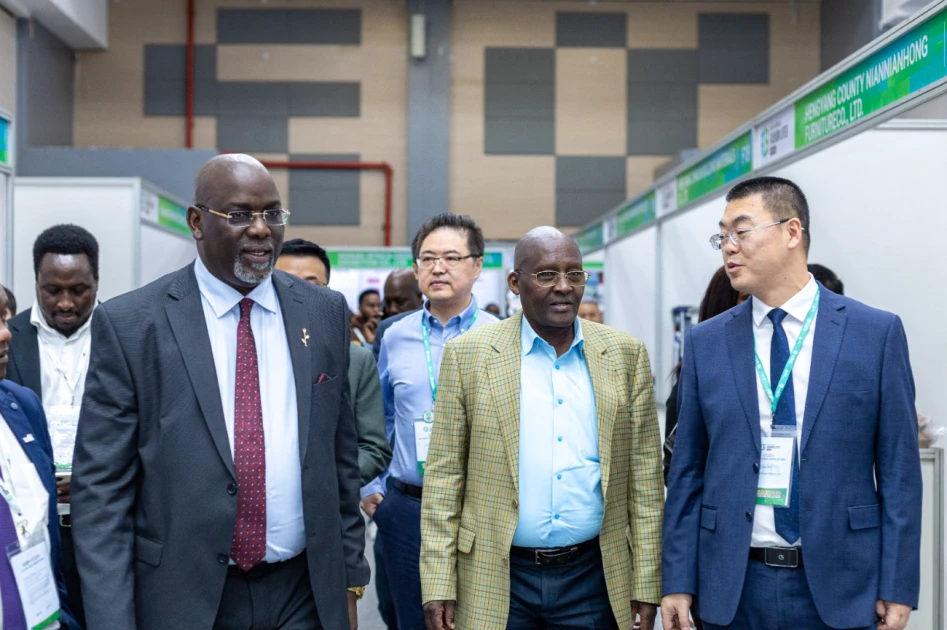
L-R: KNCCI National Director Ken Onditi, [Far Left] and Afripeak Expo Kenya Managing Director Gao Wei [Far Right] tour the exhibition hall during the official opening of the third edition of the East Africa (Kenya) Fashion Life Show Expo at Sarit Centre, Nairobi.

Audio By Vocalize
Kenya’s fashion industry is looking to China’s vast manufacturing and technology ecosystem to expand local production, improve competitiveness and open up new markets across Africa and beyond.
The push is at the centre of the third East Africa (Kenya)
Fashion Life Show, which opened at the Sarit Expo Centre in Nairobi on
Thursday, bringing together nearly 120 companies, including about 100 Chinese
exhibitors and 20 Kenyan businesses.
The three-day exhibition, running from August 13 to 15, has
created a platform for manufacturers, designers, retailers, distributors,
importers, exporters and professional buyers to explore potential business
partnerships.
The exhibitors are showcasing textiles and apparel,
footwear, fashion accessories, watches and clocks, beauty products, home and
lifestyle goods, appliances, electronics, lighting and packaging solutions.
Organisers say the event is also seeking to connect Kenyan
designers and fashion institutions with international suppliers of fabrics,
accessories, garment-production equipment and other inputs needed to scale up
production.
Afripeak Expo Kenya Managing Director Gao Wei said the
growing participation reflects increasing demand for direct engagement between
African businesses and international manufacturers.
“The growth of the Fashion Life Show reflects a clear demand
from businesses for direct and meaningful engagement with manufacturers,
suppliers and buyers,” Gao said.
He said the organisers expect engagements during the
exhibition to result in sourcing agreements, distribution partnerships,
investment and other forms of commercial cooperation.
The Kenya National Chamber of Commerce and Industry (KNCCI)
said Kenyan businesses should look beyond importing finished products and
instead use partnerships with Chinese firms to strengthen local manufacturing.
KNCCI National Director Ken Onditi said collaboration with
Chinese businesses could give Kenyan enterprises access to technology,
production expertise, international markets and investment.
“Kenyan fashion industry players should look beyond sourcing
finished products and tap into China’s rich fashion ecosystem through
technology transfer, manufacturing partnerships, design collaboration and
access to international markets,” Mr. Onditi said.
He said such partnerships could help local businesses move
up the value chain, strengthen production and develop Kenyan brands capable of
competing internationally.
“We should seek partnerships that are instrumental in
unlocking new markets for Kenyan enterprises,” Mr. Onditi added.
China’s apparel industry exported $151.18 billion worth of
clothing and apparel accessories in 2025, highlighting the scale of its
manufacturing and supply-chain ecosystem.
Kenyan industry players are being encouraged to selectively
adopt some of the technologies, production systems and business models used in
China while retaining the country’s own design identity, cultural influences
and access to the African market.
The strategy could help Kenya move beyond cut-make-and-trim
production towards greater value addition in areas such as design, branding,
fabric production, accessories, packaging, digital retail and the development
of African-focused fashion brands.
KNCCI President Dr. Erick Rutto said the exhibition gives
Kenyan enterprises an opportunity to showcase their products, establish
international business connections and identify new markets.
“The Fashion Life Show creates a valuable meeting point for
Kenyan enterprises and international buyers, manufacturers, distributors and
investors,” Dr. Rutto said.
He urged businesses in textiles, apparel, cosmetics, home
décor and consumer goods to use the platform to build international
relationships and explore opportunities for growth and exports.
A key feature of this year’s exhibition is a buyer-supplier
matchmaking programme connecting Chinese manufacturers with Kenyan and regional
importers, distributors, retailers and professional buyers.
The sessions are focusing on watches and clocks, home
appliances and consumer electronics, with discussions covering sourcing,
pricing, distribution, market access and long-term commercial partnerships.
Chinese manufacturers can provide machinery, fabrics,
production technologies and supply-chain expertise, while Kenyan businesses
bring local design capabilities, market knowledge and access to the growing
African consumer market.
Nairobi's position as a commercial hub also gives Kenya an
opportunity to use such partnerships to strengthen its role as a gateway into
the East African Community and the wider African Continental Free Trade Area.
The exhibition is therefore placing a broader question
before Kenya’s fashion industry: whether the country can shift its relationship
with China from one largely centred on importing finished consumer goods
towards co-production, technology transfer, investment, branding and exports.
For local fashion entrepreneurs, the opportunity lies not
only in sourcing products from China but in learning from the manufacturing
systems behind them and adapting those capabilities to build a stronger Kenyan
fashion industry.
If successfully harnessed, the partnerships could help local
designers and manufacturers scale production, create jobs, serve the African
market and develop Kenyan brands with the potential to compete internationally.
Join the Discussion
Share your perspective with the Citizen Digital community.
No comments yet
This discussion is waiting for your voice. Be the first to share your thoughts!