
Kenya targets 200,000 German job opportunities in new deal
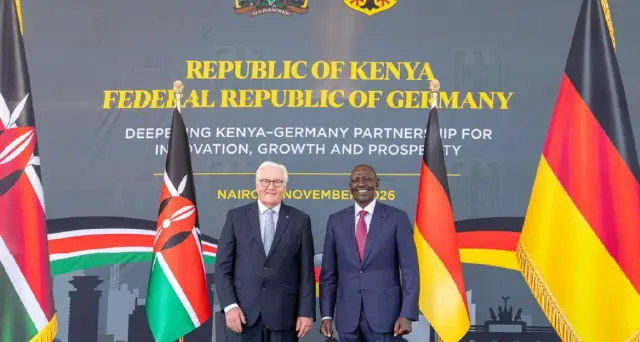
President William Ruto holds talks with President Frank-Walter Steinmeier of the Federal Republic of Germany, who is in Kenya on an Official Visit, at State House Nairobi on November 25, 2026. Photo/PCS

Audio By Vocalize
President William Ruto and President Frank-Walter Steinmeier of the Federal Republic of Germany witnessed the signing of the agreement between Kenya and telc, at State House, Nairobi, on Wednesday during the German leader's Official Visit to Kenya.
Telc is a German language examination and certification institution that will facilitate access to internationally recognised language certification.
The agreement seeks to address the language barrier facing Kenyans seeking employment in Germany by enabling them to sit language examinations locally and consequently obtain internationally recognised certification.
It also provides for the introduction of German language textbooks and vocational training materials in Kenyan learning institutions as well as curriculum development and access to affordable language training.
Additionally, the partnership will strengthen the capacity of German language teachers in Kenya and ensure transparency and impartiality in the examination process.
During a press conference with President Steinmeier, President Ruto welcomed progress made in expanding overseas employment opportunities for Kenyans under the Comprehensive Migration and Mobility Partnership signed in September 2024.
He noted that between March 2024 and March 2026, the number of Kenyans employed in Germany increased from 7,170 to 9,500 while the number of trainees contributing to Germany’s social security system rose from 820 to 1,260.
To sustain this progress, the two leaders discussed measures to streamline visa and recruitment procedures, facilitate language training and accelerate the recognition of professional qualifications.
President Ruto said the Government was committed to securing as many of the 200,000 job opportunities available in Germany as possible for Kenyans.
“These 200,000 opportunities are not just for Kenyans but we can take all of them if we are organised,” he said.
He also explained that they had also identified opportunities to strengthen partnerships between Kenyan technical and vocational education institutions and German industry to equip young people with skills that respond to the needs of the German economy.
“We explored further employment opportunities for Kenyan seafarers through structured training, sea-time placements and partnerships with German shipping companies,” he added.
The President said their discussions also covered port modernisation, sustainable shipping and investment in maritime logistics, drawing on Germany’s maritime expertise and the strategic location of the ports of Mombasa and Lamu.
President Ruto also invited greater German investment in manufacturing, agro-processing, infrastructure, healthcare, renewable energy and digital technology, urging German investors to take advantage of Kenya’s strategic position as a gateway to the African market under the African Continental Free Trade Area.
He noted that with more than 120 German companies operating in Kenya, there was considerable scope to expand investment and deepen partnerships between German and Kenyan enterprises, including micro, small and medium enterprises, through joint ventures, local manufacturing and integration into global value chains.
“Kenya remains committed to fostering a favourable business environment for German enterprises,” he said.
President Ruto said the Government had put in place robust policies and infrastructure to attract investors into the country.
“Kenya is a safe destination for investment and presents them with good returns,” he stated.
He cited the National Infrastructure Fund as one of the instruments for leveraging resources and attracting investors.
The President welcomed the opportunities presented by the Economic Partnership Agreement (EPA) between Kenya and the European Union to expand and diversify Kenya’s exports, including cut flowers, avocados and fresh vegetables, to the German and wider European market.
“We discussed the need to address market access barriers, facilitate compliance with international quality standards and promote value-added exports,” he said.
President Ruto also welcomed Germany’s commitment of €52.5 million (Ksh.7.8 billion) in development cooperation for the 2026-2028 period, following intergovernmental negotiations held in Berlin in June 2026.
He said the two countries had identified opportunities to strengthen cooperation in agricultural mechanisation, irrigation, climate-smart agriculture, post-harvest management and cold-chain infrastructure.
“Our objective is to build competitive agricultural value chains that raise farmers’ incomes, create jobs and strengthen food security,” he added.
Beyond overseas employment, President Ruto said Kenya was keen on connecting its citizens to global job opportunities through the digital economy.
He commended the conclusion of technical negotiations on a mutual data adequacy arrangement with the European Union and sought Germany’s support in the adoption and implementation of the decisions to facilitate secure cross-border data flows, expand digital trade and strengthen Kenya’s competitiveness in business process outsourcing and digital services exports.
He noted that Kenya was the first country to conclude technical negotiations on a mutual data adequacy arrangement with the European Union and the only East African country to have signed an Economic Partnership Agreement with the EU.
Kenya and Germany, the President added, had identified opportunities to deepen cooperation in digital public infrastructure, artificial intelligence, cybersecurity and scientific research, alongside investment in data centres and cloud computing.
He said partnerships between universities, research institutions and technology enterprises in the two countries would be instrumental in advancing innovation and positioning Kenya as a regional technology hub.
President Ruto also expressed Kenya’s appreciation for Germany’s support for the Shirika Plan, through which the country is transitioning from prolonged refugee encampment and humanitarian dependency towards integrated settlements and self-reliance.
“We look forward to continued cooperation in creating sustainable economic opportunities for refugees and host communities,” he said.
The President acknowledged Germany’s contribution to peace and security in Africa and expressed optimism over the speedy conclusion of a Defence Cooperation Agreement between the two countries to enhance collaboration in counter-terrorism, maritime security, military training and peace support operations.
At the multilateral level, President Ruto said the two leaders had reaffirmed their commitment to a rules-based international order governed, as President Steinmeier had articulated, by the strength of the law rather than the law of the strongest.
He said they had underscored the urgent need to reform the United Nations Security Council to address Africa’s historical under-representation and establish a fairer international financial architecture that makes credit available at scale and on equitable terms.
On his part, President Steinmeier said Germany was keen on strengthening its partnership with Kenya.
He noted that German companies had tremendous opportunities in Kenya and could make a significant contribution to the country’s economic development through investment, technology and expertise.
He said Germany was keen on strengthening trade and investment ties with Kenya, including cooperation in the training and qualification of skilled workers.
“We want to offer young people opportunities and want to have orderly pathways of labour migration,” he said.
President Steinmeier added that Germany was keen on promoting the use of renewable energy to enhance energy security and advance climate action.
Later, at a business forum bringing together Kenyan and German business delegations, the two leaders proposed the establishment of a German Business Forum to explore ways of enhancing trade and investment between the two countries.
President Ruto said Africa’s growing youthful population and increasingly sophisticated market presented German businesses with vast investment opportunities in energy, pharmaceuticals, agriculture, manufacturing and services.
He pointed out Kenya’s strategic position as a gateway to the African market, saying the country was committed to fostering a favourable business environment and strengthening partnerships between Kenyan and German enterprises for mutual growth.
Join the Discussion
Share your perspective with the Citizen Digital community.
No comments yet
This discussion is waiting for your voice. Be the first to share your thoughts!