
Kenya strengthens position as Africa's tech powerhouse with Google startup cohort success
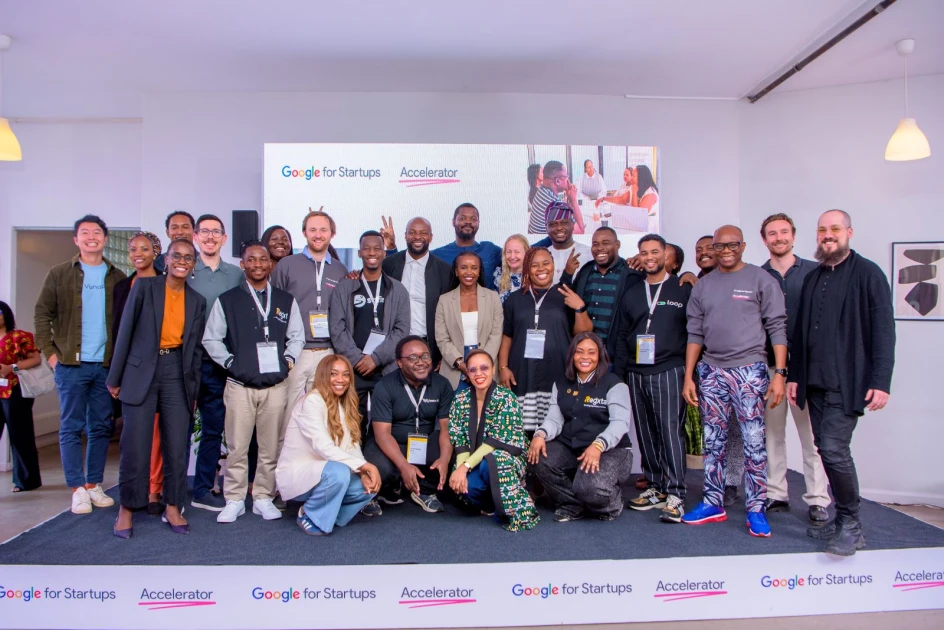
Founders of the 15 AI-focused startups from eight African nations that were selected from the Accelerator programme as well as Google Africa officials during the Close-out week and Demo Day event in Nairobi on June 18, 2026. PHOTO | COURTESY

Audio By Vocalize
Kenya's position
as one of Africa's leading technology hubs received another boost last week
after four local startups graduated from the 10th cohort of the Google for
Startups Accelerator Africa programme, highlighting the country's growing
influence in the continent's rapidly evolving Artificial Intelligence (AI)
ecosystem.
The four Kenyan
startups - Coamana, Duck, ReportsAI and VunaPay - were among 15 AI-focused
companies from eight African countries that completed the three-month
accelerator programme and graduated during Google's Close-out Week and Demo Day
held in Nairobi on June 18, 2026.
The cohort was
selected from nearly 2,600 applications submitted across the continent,
translating to an acceptance rate of less than one percent.
Their graduation
comes at a time when AI is increasingly being viewed as a key driver of
Africa's digital transformation, with startups applying the technology to solve
challenges in agriculture, financial services, healthcare, mobility and
enterprise software.
Speaking to
Citizen Digital on the sidelines of the event, Google’s Head of Startup
Ecosystem for Africa Folarin Aiyegbusi said the selected startups stood out not
because they merely incorporated AI into their products, but because they were
using the technology to solve pressing and often overlooked local problems.
"What
separated these 15 from the 2,600 that applied was three things especially:
product-market fit, programme fit and founder potential," he said.
"We saw that
these startups were addressing critical challenges in their respective markets
with artificial intelligence and machine learning. It wasn't a token addition
of AI because of a global conversation, but rather an inclusion of AI because of
the peculiar challenges they were solving."
The four Kenyan
startups exemplify that approach. Coamana is digitising informal food markets
through an AI-powered platform known as MarketView, helping governments and
businesses gain visibility into traditionally undocumented food supply chains.
Duck is tackling
retail stock shortages by providing consumer brands with real-time data
intelligence and instant visibility into shop-floor operations.
ReportsAI uses Artificial
Intelligence to convert raw and unstructured information into institutional
knowledge and compliance-ready reports for impact organisations.
VunaPay is focused
on financial infrastructure for agricultural cooperatives, enabling instant
payments and financial services for smallholder farmers.
The graduation
ceremony also reflected a broader shift within Africa's startup ecosystem.
According to
Google, 60 per cent of this year's cohort are already profitable businesses,
generating an average monthly revenue of $60,000 (Ksh.7.8 million) and having
collectively raised approximately $1.1 million (Ksh.142 million).
The companies
represent sectors including fintech, agritech, mobility, healthtech and
software-as-a-service.
The broader cohort
included startups from Nigeria (Bani, MasteryHiveAI, Regxta, Termii), South
Africa (Loop, VamboAI), Uganda (Emaisha Pay), Tanzania (Safiri), Senegal (Maad),
Côte d'Ivoire (Meditect) and Angola (Anda Africa).
They presented solutions
ranging from AI-powered credit scoring and cross-border payments to
multilingual AI infrastructure and pharmacy digitisation.
For Kenya,
however, the standout statistic goes beyond this year's four successful
startups.
Aiyegbusi revealed
that of the nearly 200 startups supported by the accelerator since its launch
in 2018, about 50 have come from Kenya.
"That's a
quarter of our startups. When you think about the wider conversation of 17
countries that we've supported, that's a major chunk. The only country that
exceeds Kenya is Nigeria," he said.
"We’ve seen the
Kenyan ecosystem mature over the years from the early days when we supported
the likes of Twiga, OKHi and BuuPass to now where we see the likes of Coamana,
VunaPay, ReportsAI and Duck."
He attributed
Kenya's strong representation to the growing maturity of local founders and
their focus on solving problems that extend beyond the country's borders.
"What we're
seeing is a maturity in founders. Some have come from corporate backgrounds,
some from academic backgrounds. They're taking the knowledge and skills they've
accumulated and applying them to solve challenges not just for Kenya but for
the rest of Africa and potentially the world," he said.
While Artificial Intelligence
has become one of the hottest topics in global technology, Aiyegbusi cautioned
that Africa remains in the early stages of adoption, much like the rest of the
world.
"The AI
conversation is barely two years old for the everyday consumer. Africa is no
different from the rest of the world. We are just as new to the
conversation," he said.
"However, our
developers and startup founders are continuing to upskill themselves and ensure
they are not left behind. They're using AI training, computer vision and
machine learning skills to solve the peculiar challenges of the African
continent."
Google's Accelerator
programme seeks to enhance that process by connecting startups with engineering
expertise, business mentorship, technical workshops, investor networks and
cloud infrastructure support.
Since March, the
participating startups have worked closely with Google engineers and global
experts to address technical bottlenecks and prepare their businesses for
growth.
Google also
piloted a new placement programme this year that embedded mentors and business
experts within participating startups for a week to help tackle specific
operational and technical challenges.
"The
relationships persist beyond the programme," Aiyegbusi said. "The
conversation never ends while we're in the programme."
The Accelerator programme
itself has evolved significantly since its inception nearly a decade ago.
In its early
years, Google focused largely on early-stage startups and offered non-dilutive
funding of around $10,000 (Ksh.1.3 million) to participating companies. Today,
the programme increasingly targets growth-stage startups and places greater
emphasis on helping companies scale.
"The content
has evolved over the years. It's no longer content on survival; it's now
content on scale," Aiyegbusi noted.
Google says the initiative
has supported nearly 200 startups across 17 African countries since 2018.
Collectively, those companies have raised more than $400 million (Ksh.52
billion) in funding and created over 3,500 jobs, with Google providing over $11
million (Ksh.1.4 billion) in equity-free funding and product credits.
Looking ahead,
Aiyegbusi believes Africa's AI future will depend not just on the resilience of
founders but on whether the continent can attract significantly more investment
into innovation.
"The current
state of things is limited funding. Every time we speak, we say despite the
infrastructural gaps, despite limited funding, despite the macroeconomic
landscape, African founders remain resilient,” he said.
"The hope is
that the successes and even the learnings from these startups will catalyse
true investment into the continent and inspire future generations of
innovators. The solutions won't be brought to us. We will develop those
solutions and the world will help us scale."
Speaking at the
Demo day event, Google’s Africa Managing Director Alex Okosi said: “We are proud to see
how these startups are innovatively using AI to tackle real world challenges
across the continent. Through our equity-free support and connection to Google
services, we are providing founders with a blended model that offers the much-needed
support and mentorship that founders need to thrive.”
Join the Discussion
Share your perspective with the Citizen Digital community.
No comments yet
This discussion is waiting for your voice. Be the first to share your thoughts!