
Kenya rewrites EV charging tariff amid surge in electric mobility
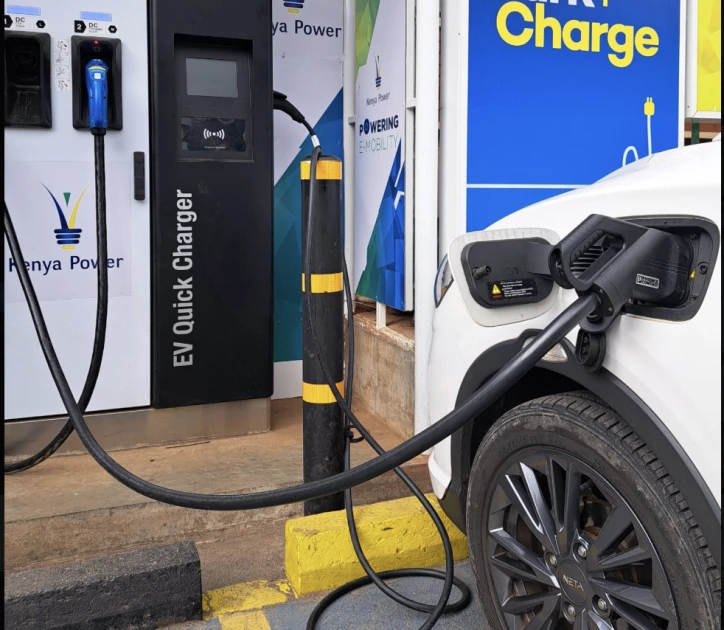
An electric vehicle at an EV charging station in Nairobi. Photo I File

Audio By Vocalize
Kenya's electric mobility sector has moved from a policy experiment to a measurable drain and driver of the national grid, and the numbers explain why regulators just rewrote the rulebook.
Kenya Power's
own tracking shows e-mobility electricity sales have increased by over 113-fold
in less than three years, with consumption rising from 13,500 kWh in July 2023
to more than 1.5 million kWh in April 2026.
On the vehicle side, the underlying fleet growth is just as steep: registered EVs have risen to 24,754 in 2025 from 796 in 2022, a roughly 31-fold increase largely driven by electric motorcycles, buses and fleet vehicles in urban areas.
By early 2026, Kenya Power reported the sector's annual electricity consumption jumped 188% in 2025, rising to 8,433,437 kWh from 2,922,692 kWh in 2024, generating Ksh.125.9 million in EV charging revenue compared with Ksh.64.8 million the previous year.
EPRA's own six-month statistics tell the same story from a
different angle: e-mobility consumption grew 152.49 per cent in the
July–December 2025 period compared with a year earlier, from 1.81 GWh to 4.57
GWh, still just 0.08 per cent of Kenya's total electricity consumption but the
fastest-growing customer category the regulator tracks.
Why EPRA
Scrapped the 15,000 kWh Ceiling
That trajectory is what pushed the Energy and Petroleum Regulatory Authority to act. A gazette notice dated September 18, 2026, and signed by Acting Director-General Dr. Joseph Oketch, amended the 2023 electricity tariff schedule to introduce additional provisions for e-mobility consumers supplied and metered at 240 or 415 volts.
Under the original 2023 design, e-mobility customers paid Ksh.16 per kWh during peak hours and Ksh.8 per kWh off-peak, capped at 15,000 kWh a month, with higher tariffs applying beyond that threshold.
Operators had been lobbying
against the cap for months, citing demand that was already exceeding the
monthly limit, and EPRA had signaled the restriction could be removed by the
end of the current tariff control period in June 2026.
The September notice delivers that flexibility, but through a mechanism rather than an outright removal.
Instead of a hard ceiling, EPRA now applies an Energy Consumption Threshold: SC3, e-mobility and CI customers must meet a monthly threshold, with units consumed above it billed under the discounted Time-of-Use tariff, subject to applicable conditions.
For existing customers, the threshold is calculated from their average consumption over the previous six consecutive months, while new customers use their first three consecutive months.
In
effect, EPRA has replaced a fixed number with a moving baseline tied to each
operator's own growth, a structure that lets charging networks,
battery-swapping firms and bus fleets scale consumption without being pushed
into a costlier commercial-and-industrial tariff band once they cross 15,000
kWh.
Why This
Favors Further EV Uptake, and Kenya Power
For operators, the change removes a ceiling that was becoming a real constraint on business planning: a fast-charging hub or growing bus depot could previously see its most valuable off-peak kWh blocks reclassified into a pricier category the moment monthly usage crossed 15,000 units.
By tying the threshold to a rolling
average, EPRA lets consumption grow in step with fleet size while preserving access
to the Ksh.8 off-peak rate, the same discount structure that has underpinned
adoption since 2023, when the Time-of-Use tariff extended a 50 per cent
discount on energy charges during off-peak hours, generally 10 pm to 6 am on
weekdays with longer windows on weekends.
For Kenya Power, the calculus is more straightforward: more predictable, unconstrained e-mobility demand means more overnight load absorbed onto a grid that already curtails significant surplus generation, plus a growing, high-margin revenue line.
The utility's e-mobility sales report put cumulative revenue from the category at Ksh.382 million over 34 months, with Nairobi accounting for 71 per cent of that total and other regions gradually catching up.
Removing the
disincentive to scale beyond 15,000 kWh should push more of that growth toward
Kenya Power's own metered network rather than private generation or informal
charging arrangements.
Infrastructure
and Fleet Composition
Charging infrastructure remains the visible bottleneck. As of June 2025, EPRA data showed 6,442 registered EVs and an estimated 300 charging points nationally, according to the Electric Mobility Association of Kenya.
Kenya Power has been adding to that base incrementally, a 45-station rollout across six counties, plus recent additions in Voi, Sabaki and other corridor towns, but public charging remains thin relative to fleet growth.
By comparison, the vehicle count itself has moved faster than the chargers meant to serve it: Kenya now has well over 14,700 electric buses, cars, tuk-tuks, motorcycles and bikes, up from fewer than 100 five years ago.
Two-wheelers dominate that fleet; an
earlier Kenya Power e-mobility report found motorcycles constituted 62 per cent
of the roughly 1,350 electric vehicles then on Kenyan roads, a share industry
figures suggest has held or grown as boda boda conversions accelerate alongside
bus and car adoption.
Incentives
and a Looming Contradiction
Government support has layered several fiscal tools onto the tariff changes: zero-rated VAT on electric buses, bicycles, motorcycles and lithium-ion batteries, and lower excise duties on selected EVs, with further VAT and excise exemptions beginning in July and a reduced stamp tax for charging stations from 2027.
President Ruto has gone further on the import side, announcing that the first
100,000 electric vehicles imported into Kenya will be exempt from import duty,
covering both public service and private vehicles.
That pledge, however, was in limbo following the Finance Bill 2026’s Proposal to change e-mobility components and solar technologies from VAT zero-rated to VAT exempt status.
This reversal, analysts warned, would roll back the incentives that had driven EV growth on Kenyan roads.
However, Parliament rejected the proposal, retaining
the zero-rated status in the Finance Act 2026, hence allowing local assemblers
and manufacturers to reclaim input VAT on production.
Join the Discussion
Share your perspective with the Citizen Digital community.
No comments yet
This discussion is waiting for your voice. Be the first to share your thoughts!