
Kenya faces IMF pressure to cut debt amid talks on new deal
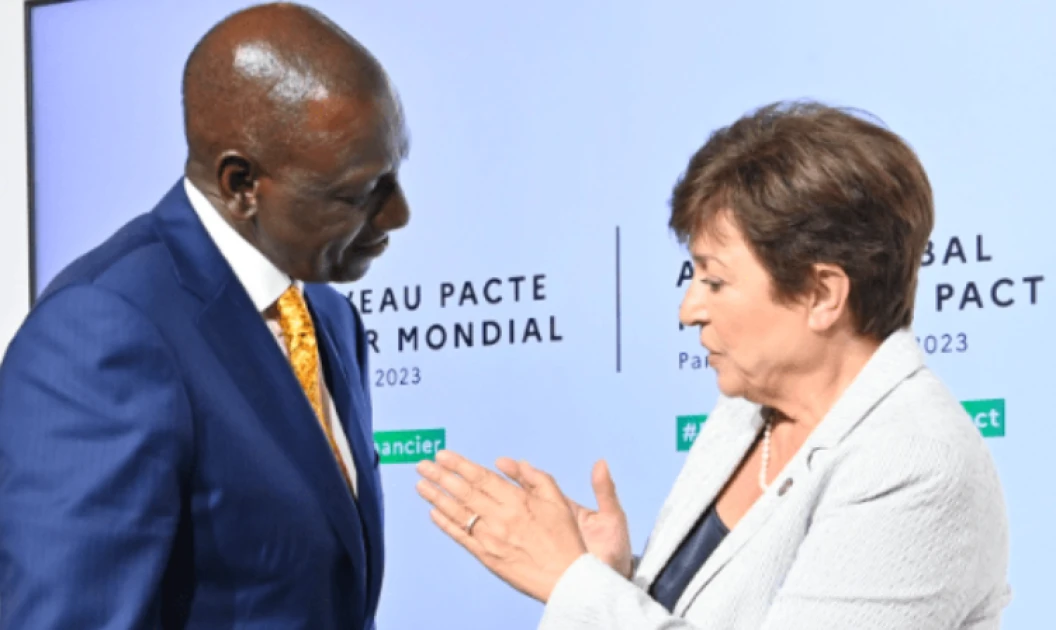
President William Ruto and Kristalina Georgieva, Managing Director of the International Monetary Fund (IMF), at the "New Global Financing Compact" summit in Paris on 22 June 2023. PHOTO| FILE

Audio By Vocalize
IMF Africa Department Director Abebe Aemro Selassie pointed out that no final agreement has been reached, noting that the talks reflect broader financing pressures facing several emerging market economies.
He stated that Kenya is currently in a transitional position, balancing between reliance on international capital markets and potential support from the IMF.
"Kenya is, of course, a market access country or shifting towards a market access country. And you know, the market access these days has become very, very volatile. And so, the government is continuously thinking about how to best address its financing needs," Selassie highlighted.
"IMF, of course, is an option, but in the long run, of course, it wants to be a market access country."
He noted that while Kenya has made progress in strengthening its external buffers, the Fund is insisting on a clear fiscal policy direction before any programme can advance.
Fiscal consolidation in this case would require President Ruto's administration to introduce government policies aimed at reducing public debt accumulation through budget cuts and widening the tax base. Such policies enhance debt sustainability, boost investor confidence and create resilience for economic shocks.
“What we would like to see for programme discussions to advance is a path towards credible fiscal consolidation,” he said.
Selassie explained that discussions are continuing in a cordial environment, but emphasised that Kenya’s decision-making on whether to proceed with a new IMF-backed programme remains open.
The IMF official said Kenya has been pursuing a mix of liability management operations aimed at smoothing repayment pressures while also assessing whether to rely on IMF resources in the face of tightening market access conditions.
The Fund maintained that it is not pushing a one-size-fits-all approach but is instead assessing country-specific financing needs as governments across the region reassess their fiscal positions.
Selassie added that while discussions remain active, progress will depend on Kenya outlining a sustainable fiscal adjustment framework that can anchor long-term stability and support any potential programme arrangement.
Responding to reports about hidden debt in Kenya, Selassie dismissed the claims, saying there is no evidence of undisclosed debt. He said recent discussions were only about how certain government transactions and arrears are recorded in official statistics.
He added that these obligations are already known to the IMF and are only included in official debt figures once they are confirmed, following standard reporting rules.
Kenya's past agreement with IMF
In April 2021, the IMF entered into an agreement with Kenya to disburse Ksh.467.5 billion under the Extended Fund Facility (EFF) and Extended Credit Facility (ECF) arrangement.
The EFF and ECF programs were incorporated to provide financial assistance to countries facing problems in reducing inflation levels because of structural issues, and hence would require time to rebuild.
The EFF program provides a country four years to restructure, while ECF can be extended to five years.
By March 2025, Kenya had accessed Ksh.404 billion before terminating the program, leaving out a gap of Ksh.63.4 billion.
Join the Discussion
Share your perspective with the Citizen Digital community.
No comments yet
This discussion is waiting for your voice. Be the first to share your thoughts!