
Kazakhstan leader orders security forces to 'kill without warning' to quell violent protests
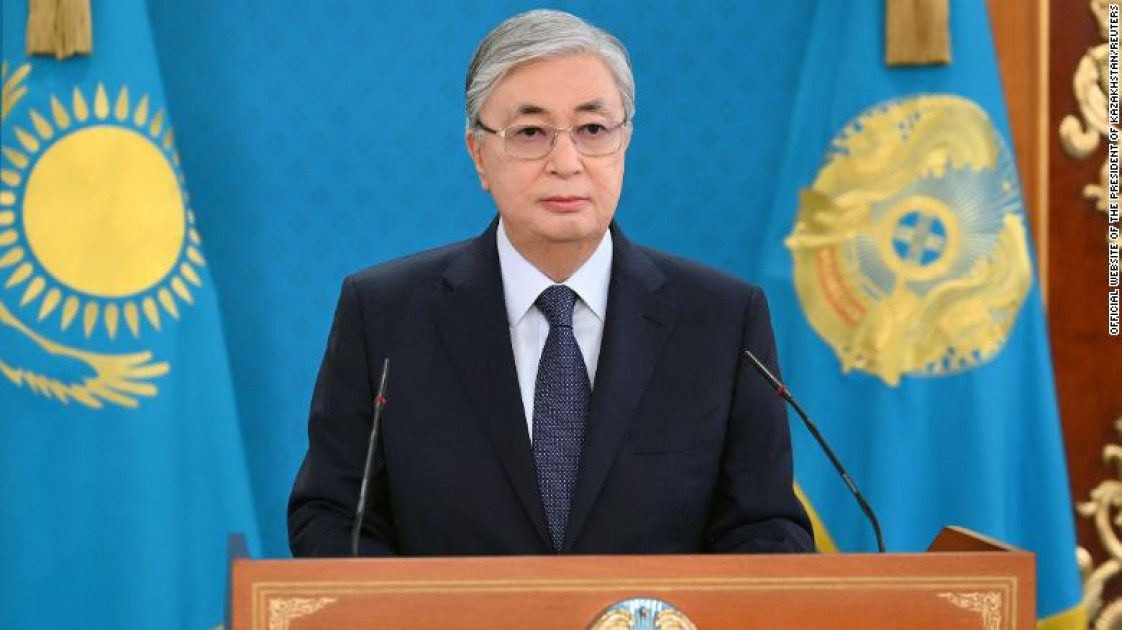
Kazakhstan President Kassym-Jomart Tokayev speaks during a televised address to the nation following the protests triggered by fuel prices increase in Nur-Sultan, Kazakhstan on January 7, 2022.

Audio By Vocalize
Kazakhstan
President Kassym-Jomart Tokayev has ordered security forces to "kill
without warning" to crush the violent protests that have paralyzed
the former Soviet republic and reportedly left dozens dead.
In a defiant public address Friday, Tokayev said the unrest that began earlier this week as protests against rising fuel prices had been masterminded by well-trained "terrorist bandits" from both inside and outside the country.
Kazakh state media reported Friday that 18 security personnel and 26
"armed criminals" had been killed in violent protests. More than
3,000 people have been detained.
Tokayev
said the situation had "stabilized" in Kazakhstan's largest city,
Almaty, and that the "introduction of a state of emergency is yielding
results."
"But
terrorists continue to damage state and private property and use weapons
against citizens," he said. "I gave the order to law enforcement
agencies and the army to open fire to kill without warning."
The
speech attempted to undermine the narrative that the demonstrations were a
product of popular unrest that turned increasingly destructive and deadly.
Tokayev said the violence was the product of a well-organized enemy, armed with
sleeper cells carrying out "terrorist attacks" and "specialists
trained in ideological sabotage, skillfully using disinformation or 'fakes' and
capable of manipulating people's moods."
"Their
actions showed the presence of a clear plan of attacks on military,
administrative and social facilities in almost all areas, coherent coordination
of actions, high combat readiness and bestial cruelty," Tokayev said.
"They need to be destroyed."
However,
several protesters who spoke to international media rejected that
characterization.
"We
are neither thugs nor terrorists," one woman said. "The only thing
flourishing here is corruption"
Another
man told CNN that people "want the truth."
"The
government is rich, but all of these people here have loans to pay. We have our
pain, and we want to share it," he said.
The
demonstrations are the biggest challenge yet to the autocrat's rule, with
initial public anger over a rise in fuel prices expanding to wider discontent
with the government over corruption, living standards, poverty and unemployment
in the oil-rich nation -- all of which has been exacerbated by the Covid-19
pandemic, experts say.
"This
is a government that is highly detached from the reality of what happens on the
ground. It's a country where there are no institutions through which to
protest; the only route is on the streets," Paul Stronski of the Carnegie
Endowment for International Peace
Protesters
in Almaty reportedly stormed the airport, forcibly entered government
buildings, and set fire to the city's main administration office, local media
reported. Dozens were reported killed and hundreds more injured in clashes
there Thursday. There were also reports of a nationwide internet blackout
and damage in other major cities, though Tokayev said internet was gradually
being restored as the situation stabilizes. Authorities had previously declared
a nationwide state of emergency with a curfew and movement restrictions until
January 19, according to local media.
In
his address, Tokayev highlighted that peaceful assembly was legalized in 2020
to promote democracy. However he said calls from abroad to find a peaceful
solution were "nonsense."
"What
kind of negotiations can there be with criminals, murderers?" Tokayev
added.
Tokayev
said a contingent of the Collective Security Treaty Organization (CSTO), a
Russian-led military alliance made up of former Soviet states, has arrived in
the country "for a short period of time" to carry out the functions
of defense and support. The organization's secretary-general,
Stanislav Zas, told Russia's state-run English language Sputnik news agency
that about 3,600 CSTO personnel would be deployed to Kazakhstan to protect
government and strategic facilities and help maintain public order. Russian
state news agency TASS reported that a brigade of airborne forces had arrived
in Kazakhstan.
A
contingent of 70 IL-76 and five AN-124 transport aircraft have been delivering
military personnel and equipment to CSTO forces "around the clock,"
the Russian Defense ministry said in a statement Friday.
Tokayev thanked
the heads of CSTO countries for their support and expressed "special
gratitude" to Russian President Vladimir Putin for "very promptly
and, most importantly, in a friendly manner reacted warmly to my appeal"
for a CSTO contingent.
The
Kazakh leader also thanked Chinese President Xi Jinping, the presidents of the
other CSTO member countries, the presidents of Uzbekistan, Turkey and "the
leaders of the UN and other international organizations for their words of
support."
Putin
spoke by phone with CSTO leaders Thursday and Friday, Kremlin spokesperson
Dmitry Peskov told journalists on Friday, according to Russian state media.
Kazakhstan,
the world's ninth-largest nation by landmass and Central Asia's the largest
economy, has often boasted of its stability in a region that has seen its share
of conflict.
Even
before its independence in 1991, the country's political scene was dominated by
one man -- Nursultan Nazarbayev. The longtime president and former Communist
Party official ruled for almost three decades before stepping down in 2019. His
autocratic method of governance sparked international concern and saw authorities
harshly crack down on protests, jail critics and stifle press freedoms,
according to global rights groups. Critics accused Nazarbayev of appointing
family members and allies to key jobs in government and his family is believed
to control much of the Kazakh economy, Reuters reported.
Nazarbayev
was best known in the West for renouncing nuclear weaponry and his relocation
of the capital to the futuristic city of Astana --
which was later renamed Nur-Sultan, after himself.
Amnesty
International said the protests are "a direct consequence of the
authorities' widespread repression of basic human rights."
"For
years, the government has relentlessly persecuted peaceful dissent, leaving the
Kazakhstani people in a state of agitation and despair," said Marie
Struthers, Amnesty's director for Eastern Europe and Central Asia in a
statement.
Join the Discussion
Share your perspective with the Citizen Digital community.
No comments yet
This discussion is waiting for your voice. Be the first to share your thoughts!