
Insight: Spain thought it had the 2030 World Cup final. Morocco had other plans
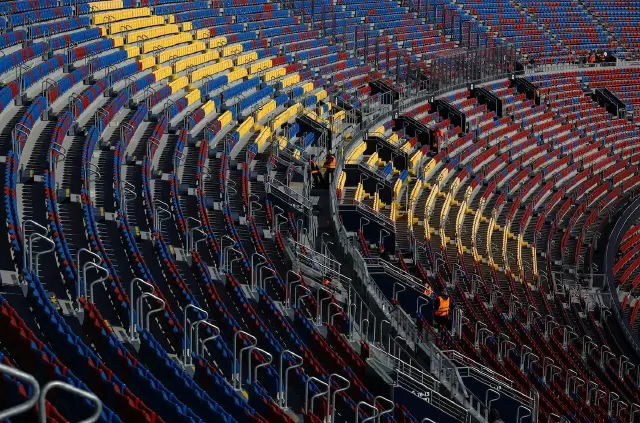
Spotify Camp Nou stadium is partially under construction, with work underway on the third tier and roof supports, in Barcelona, Spain November 22, 2026. REUTERS/ Albert Gea

Audio By Vocalize
When Spain won a joint bid to host the 2030 World
Cup, officials at the national football association took it as given that the
final would be held on their soil.
As former world champions – a feat since repeated –
and the world's second-most visited country, Spain had the sporting pedigree
and tourism know-how to welcome large crowds, so it was widely assumed the
final would come to them.
Co-host Portugal was not interested, while Spanish
officials thought that Morocco, as a late addition to the bid, surely would not
agitate for the final.
But in recent months Spain has begun to fear that
the North African nation, an emerging football power, could
snatch the game's biggest showpiece from under its nose.
The battle to stage the final has become a bitter
contest between Real Madrid's Bernabeu, Barcelona's Camp Nou and the $1 billion
Hassan II stadium under construction near the fabled Atlantic city of
Casablanca.
The race has become entangled with both FIFA
President Gianni Infantino's fight for survival and frictions between Spain and
Morocco over migration.
It has also spilt over into Spain's internal
politics, with Alberto Núñez Feijóo, frontrunner to become prime minister after
Sunday's election, saying Spain should withdraw from hosting the tournament if
it cannot stage the final.
Javier Tebas, who heads the top-flight LaLiga, and
José Luis Martínez-Almeida, the conservative mayor of Madrid, have also
expressed fears, the latter saying he "wasn't optimistic" given he
had seen no evidence of the Spanish government matching Morocco's ambition.
World governing body FIFA's inspectors are visiting
host cities this month and next but it has not said when it will announce the
final venue. For the 2026 World Cup final, the venue just outside New York was
known two years before.
With its team bankrolled by the state fertilizer
behemoth, Morocco has united behind bringing the
final to its new stadium, named after its former king, which with a
115,000-seat capacity will be the world's largest soccer arena.
By contrast, Spain's campaign is divided along
familiar lines between Madrid and Barcelona and their
two biggest clubs.
Morocco deserves the final as much as Spain, fan
Bilal Jouhari, 39, said in Rabat, pointing out that Morocco is fifth in FIFA's
world rankings.
"Those who threaten to walk out if FIFA chooses
Morocco as the final's host are just like those who abandon the game because
they don't like the referee's decisions," said
Jouhari, who runs a platform promoting cultural events.
Ricardo Trade, former CEO of the FIFA World Cup
Organising Committee for Brazil 2014, said Spain should have settled which city
got the final as part of the original bid.
"Spain is terrified of losing the final, a
final they were absolutely certain they’d be hosting," said Trade, also
CEO for the 2016 Olympics and deputy CEO for operations at the 2022 World Cup.
"You have Barcelona on one side saying what
they want, and Real Madrid on the other also saying what they want, whilst
Morocco seems to be very united on this World Cup project and has a stadium for
115,000 people."
After Barcelona's president, Joan Laporta, lobbied
in September for the final to go to the Camp Nou, arguing that the Bernabeu had
already hosted the 1982 final, some sources in the Spanish football federation
(RFEF) expressed frustration at him for undermining the unity needed to counter
Morocco.
A senior Portuguese official involved in the bidding
process said Spain was caught off guard, wrongly assuming that since Morocco
was not part of the original bid then the final
was guaranteed for Spain. "They should have seen it coming," the
person said.
Alvaro de Miguel, the RFEF secretary general, denied
there were divisions in the Spanish camp and said presenting two options
against Morocco's one gave Spain better odds of success.
He noted that the bid to host the tournament was put
together during a moment of instability at the
Spanish FA when former president Luis Rubiales was embroiled in scandal over
kissing player Jenni Hermoso on the lips at the 2023 Women's World Cup.
The atmosphere at the RFEF at the time "was not
the most conducive to a project of this scale, involving a range of complex
interests," he told Reuters.
It also coincided with a testy time between
Spain and Morocco over migration,
including a 2021 attempt by thousands of people to enter Spain's African
enclave of Ceuta.
Prime Minister Pedro Sanchez overruled the RFEF's
plans to announce the invitation to Morocco to join the bid, insisting on
delivering the message himself during a bilateral visit to Rabat in 2018,
according to an RFEF source.
His government was heavily involved in the creation
of the bid and the RFEF ended up agreeing to a request from the government and
FIFA to include Casablanca as an option for the final, according to three RFEF
sources.
INFANTINO FACTOR
FIFA's Infantino has been locked in a power struggle
with UEFA since Europe's governing football body demanded he step down over his
plan to sell a 20% stake in the World Cup.
Tebas said Infantino would favour Morocco because it
was backing his reelection bid. "If Infantino stays on, Spain’s chances of
getting that final are negligible or non-existent," Tebas said in
September.
Morocco's football association has been one of his
staunchest supporters and Infantino has spent long periods at FIFA's newly
opened regional
headquarters in Rabat since the selloff plan was revealed. Infantino is the
favourite to win reelection at FIFA's March
congress –
in Morocco.
However, Real Madrid President Florentino
Perez, who has a close relationship with Infantino, could help persuade him to
choose Spain for the final, a LaLiga source said.
De Miguel said the fact that FIFA's governance was
under such scrutiny played in Spain's favour, since he expected it to be
awarded to the "natural" candidate.
FIFA said in a statement it has no standard
procedure for selecting the venue and that the decision would follow
consultations with host cities, countries and governments.
Spanish officials say Madrid has experience in
handling high-octane matches such as
the 2018 final of South America's Copa Libertadores between River Plate and
Boca Juniors, switched there due to fan violence.
They also point to the debacle in Rabat during the
2025 Africa Cup of Nations final, when Senegal's coach ordered his players
off the pitch over a penalty awarded to
Morocco, footballers fought each other, and the ball boys stole the Senegal
goalkeeper's equipment.
De Miguel said that if size is a factor, then the
Camp Nou will hold 105,000 by the 2028-2029 season after a $2 billion
refurbishment, compared to the Bernabeu's 84,000 after its $1.5 billion
makeover.
Moroccan FA President Fouzi Lekjaa said construction
of the Hassan II will be completed in early 2028. According to the IMF, Morocco
plans to spend about $19 billion between 2024 and 2030 building airports,
stadiums, hotels and a high-speed rail network, as well as a train station and
highway to connect the stadium with Casablanca 45 km (28 miles) away.
Casablanca will need to work on its hotels to
compete with Madrid and Barcelona after a FIFA
technical report rated its accommodation
offering for the general public at 3.1 compared to 5 for Spain.
But a successful bid is not just about who has the
best stadium, hotels and transport. Often bids go to the
country that would receive the greater benefit, Trade said.
In Morocco, the World Cup was an opportunity to
expand railways and develop the whole Casablanca area, Lekjaa told state
broadcaster 2M. A Moroccan source familiar with the discussions said the final
should go to the stadium with the largest capacity — and to an African country.
"It would be awkward – embarrassing, even – and
would send the wrong message to Africa, one
of the world's biggest producers of raw football talent, if the World Cup final
were ultimately awarded to a non-African country with a smaller stadium,"
the person said.
Join the Discussion
Share your perspective with the Citizen Digital community.
No comments yet
This discussion is waiting for your voice. Be the first to share your thoughts!