
Infantino looks set to stay, but FIFA faces a new war over power
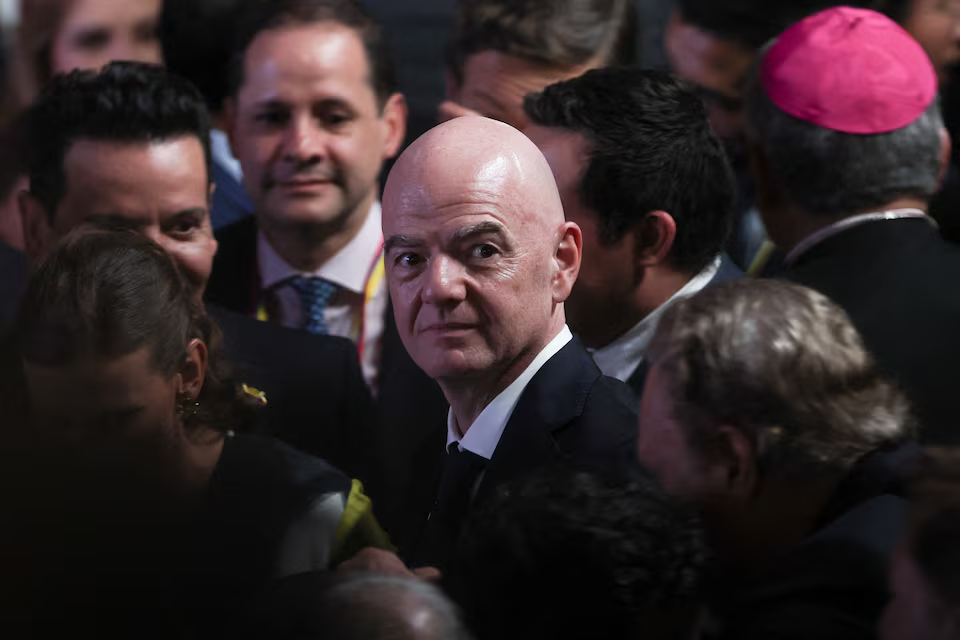
FIFA President Gianni Infantino attends the inauguration of Abelardo De La Espriella as Colombia's president, in Cali, Colombia, August 7, 2026. REUTERS/Luisa Gonzalez/File Photo

Audio By Vocalize
The battle to force Gianni Infantino out of FIFA may
be nearly all over just a few weeks after his opponents thought they would
dethrone the president of world soccer's governing body, but the war over how
much power he can exercise may only be beginning.
Senior figures in world football increasingly see
the crisis triggered by Infantino's abandoned private-investment plan
shifting away from the question of succession and towards a struggle over the
terms of his continued presidency.
One outcome could be a governance compromise under
which Infantino remains in office but gives up some power.
The other possibility is a
prolonged “hot-cold
war” in which clubs,
confederations, player representatives and national associations challenge FIFA
repeatedly over competitions, money and control of the international calendar.
“What is clear now ... is that he’s going nowhere,”
a senior world football executive told Reuters. “A hot-cold war is a very real
problem for FIFA and for world football.”
A veteran international sports executive, who has
spent decades working with governing bodies, offered a similar assessment,
saying Infantino was “hanging on” but questioning how FIFA could operate if
many of the game’s most powerful countries and institutions remained opposed to
him.
“You would have effectively a civil war within the
governance which I cannot recall in a sports body before,” the executive said. “Unprecedented.”
That possible scenario of a prolonged and
potentially damaging cold war within world football was independently
corroborated to Reuters by two other senior football officials.
The prospect points to
a potentially paradoxical outcome to a crisis that at its height threatened
Infantino’s
position: he could survive politically while presiding over a governing body in
which some of football’s biggest stakeholders seek
to constrain what he can actually do.
“Does he become a lame duck?” the veteran executive
asked.
There is little indication that Infantino’s attempt
this week to draw a line under the crisis has repaired the rupture.
In a letter to the FIFA Council and
the presidents of all 211 member associations, Infantino proposed that the
Council consider commissioning an independent external review of FIFA’s governance framework
for major strategic initiatives.
He also proposed consultations with confederations,
associations and other stakeholders over strengthening decision-making and said
he remained fully committed to leading FIFA.
Several European federations quickly dismissed the move,
and UEFA President Aleksander Ceferin issued a stern assessment on Wednesday.
“The project that shattered the unity of world
football may be abolished, but the trust it broke has not returned,” Ceferin
said in a video address to the Portugal Football Summit.
“Trust in our sport rests on three pillars: unity,
transparency, and governance that serves the many, not the few.”
Ceferin did not name Infantino but his remarks were
a clear reference to the proposal to sell a 20% stake in FIFA’s commercial
rights, including rights linked to the World Cup,
to private investors.
The project was dropped in July after opposition
from European soccer's governing body UEFA, the Asian Football Confederation
and North American confederation CONCACAF.
For 56-year-old Swiss-Italian Infantino, that leaves
one route to a less confrontational settlement, which is a reform substantial
enough to
persuade his opponents that power inside FIFA has genuinely shifted.
The senior world football executive said one
possible outcome could be the creation of a new body or structure that diluted
the authority of the president.
Infantino’s governance proposals were the “bare
minimum” needed to give him room to remain in
office, the executive said, adding that the question
was whether he would accept meaningful changes.
How far any compromise could go would depend on “how
much Infantino is willing to cede” and how much his opponents were willing to
fight to take away, the world football executive said.
Reforms introduced after the downfall of former FIFA
chief Sepp Blatter were intended in part to reduce the power concentrated in
the presidency.
Yet senior figures now see another battle developing
over how much authority the FIFA president should wield.
If no settlement is reached, the alternative could
be attritional rather than spectacular.
The world football executive said clubs could fight
FIFA over the Club World Cup, financial distributions and player release;
player representatives could challenge the calendar; national associations
could obstruct initiatives; and major confederations could contest attempts
to expand or reshape FIFA competitions.
“Maybe it seems like we’re boiling
down to two options now,” the executive said.
“One, a
compromise where Gianni gives up some of his power and there are some new
bodies that are created or, two, a permanent hot-cold war where all the
stakeholders just fight every issue.”
That could include expanded World Cups, bigger or
more frequent Club World Cups and commercial distribution decisions, the
executive said.
The result would not necessarily be a formal break
with FIFA. Instead, opponents could make every major
initiative harder to deliver.
The veteran sports executive said the challenge went
to the heart of how global governing bodies function.
“The importance of unity. Keeping these monster
sports organisations together, they are
not political parties,”
the executive said. “This will be new territory.”
There is another reason the focus is shifting
towards life with Infantino rather than replacing him: his position appears to
have strengthened since the crisis first erupted.
A national association president, who spoke to
Reuters on condition of anonymity, believes Infantino’s opponents missed their
best opportunity when the backlash was at its peak and that he is now
rebuilding support ahead of the March election.
The FIFA president has a succession of opportunities
in the coming months to meet national association leaders at tournaments,
congresses and confederation events, including several gatherings in Africa.
The association president expects
Infantino to use those meetings to maintain support among football leaders
through to the FIFA presidential election in March 2027.
The political significance of smaller associations has
also been highlighted by a proposal from Ceferin and CONCACAF President Victor
Montagliani for FIFA to distribute at least $10 million from its reserves to
each of its 211 member associations during the next financial cycle.
For many associations heavily reliant on FIFA
funding, such sums could be transformative.
If Infantino is reelected, the association president
believes some federations that have opposed him
may eventually become less hostile, concluding there is little to gain from
four years of permanent confrontation.
That possibility means a "cold war" is not
inevitable.
Join the Discussion
Share your perspective with the Citizen Digital community.
No comments yet
This discussion is waiting for your voice. Be the first to share your thoughts!