
How Kenya went from obscurity to Africa’s rising curling contender

Audio By Vocalize
As far as
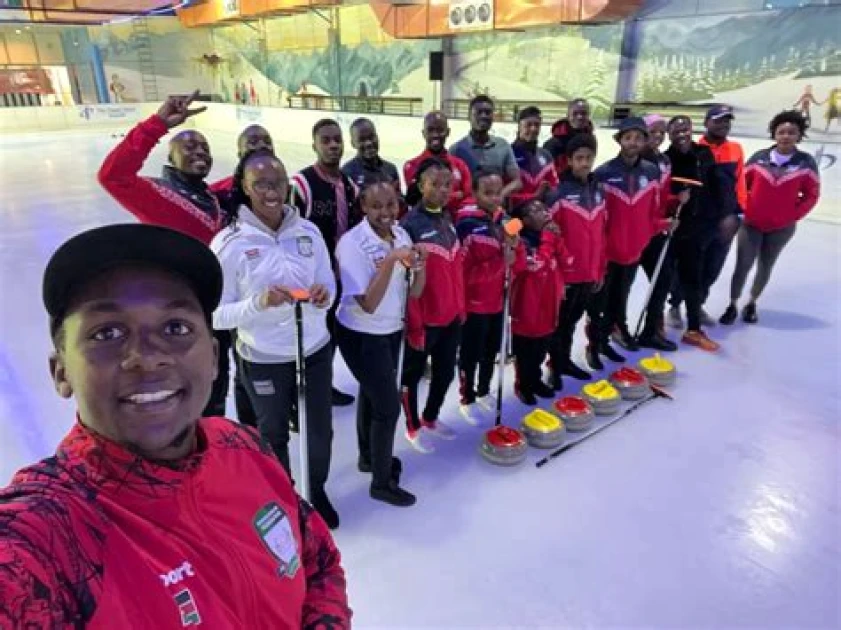
elite sports go, few are as unique or as captivating as curling. In Kenya, the
sport is barely six years old, yet it has already carved a niche for itself on
the continent.
Curling was
first introduced in the country in 2020, when Laventa Oguta, then president of
the Kenya Curling Federation (KCF), became inspired after watching the 2018
Winter Olympics in PyeongChang, South Korea.
Oguta, driven
by a vision to bring the sport to Kenya, secured a curling center in Nairobi
and launched initiatives to engage schools and local organizations.
This
grassroots strategy laid the foundation for the sport’s growth, giving Kenyan
athletes a platform to practice, compete, and develop their skills.
By 2021, the
Kenya Curling Federation had received official recognition from the World
Curling Federation, making Kenya only the second African nation after Nigeria
to join the international curling community.
Since then,
Kenya has participated in six international competitions, including the 2025
World Junior Mixed Doubles Curling Championship, the 2024 World Mixed Curling
Championship, and the 2024 Pan Continental Curling Championships.
Despite
limited resources, the sport has grown steadily, fueled by public
demonstrations, school outreach programs, social media campaigns, and regular
practice sessions.
“We are
continuously training both current and new athletes, as well as officials,”
says Peter Owino, CEO of the KCF.
“Our goal is
to maximize the number of Kenyan athletes competing internationally and to
spark local interest in curling.”
Kenya’s
curling stars include Kyra Sheri Kemu and Hassnein Ali Shah, both of whom have
represented the nation at multiple global events.
As the sport
gains traction, Kenya is positioning itself as a continental ambassador,
helping raise curling’s profile across Africa.
“Through our
participation in international events, we contribute to growing visibility and
interest in curling across the continent,” Owino explains.
On the
competitive front, Kenya has already begun to make a mark. While Nigeria was
the first African nation to enter the World Curling Federation, Kenya has
quickly closed the gap.
“The Nigerian
team represented Africa first, but we have undoubtedly overtaken them based on
recent performances,” KCF President Robert Mutai declares.
In terms of
results, the men’s B-Division team secured a notable win in 2022 against
Nigeria.
The women’s
team has achieved two international wins and earned a bronze medal, while the
mixed and mixed doubles teams are still seeking their first victories.
Most
recently, Kenya competed in the World Junior Curling Championships in Edmonton,
Canada, which concluded on May 11, and the federation eagerly awaits the next
set of competitions from the World Curling Federation.
Despite these
successes, the federation faces several challenges. Funding remains a
persistent issue, with athletes, coaches, and families often contributing
out-of-pocket to support travel and competition expenses.
Mutai
emphasizes, “We sometimes fundraise ourselves, parents chip in, and players do
their best. We survive on patronage and resilience.”
Training
facilities are another major hurdle. Kenya’s only ice rink at Panari was
designed for recreational use and is unsuitable for intensive professional
training.
“We lack a
proper facility for heavy, consistent training, which limits our ability to
compete at the highest level,” Mutai notes.
Geopolitical
conflicts around the world also pose scheduling risks, with events in certain
regions uncertain due to ongoing conflicts, such as the war in Iran.
Nevertheless,
the federation remains optimistic about the future. With more investment in
early development, infrastructure, and funding, Kenya has the potential to
cement its position as a leading curling nation in Africa and perhaps influence
world rankings.
The
federation’s approach blends grassroots growth with high-performance ambitions,
aiming to produce skilled athletes while expanding public interest in the
sport.
Curling’s
rise in Kenya is as much about perseverance as it is about sport. It’s a story
of vision, resilience, and community support.
From its
introduction by a passionate group of pioneers to international representation,
Kenya has steadily built a competitive presence on the global curling scene.
Mutai
reflects on the federation’s journey: “Six years ago, curling in Kenya was
barely known. Today, we have athletes competing internationally, raising
Africa’s profile in this unique sport.
Our focus is
to grow, train, and compete, showing that with determination, even less-known
sports can thrive here.”
For those
seeking a new sport to watch or participate in, Kenyan curling offers
excitement, strategy, and a growing community.
It’s a
testament to what can be achieved with dedication and vision, even in a sport
that seems far removed from Kenya’s traditional athletic pursuits.
“Don’t know
me? You better get to know me,” Mutai says, reflecting the federation’s spirit
and ambition.
As Kenyan
curling continues to expand, both on the ice and in public imagination, it is
clear that the country is carving a unique place for itself in the sport, one
stone at a time.
Join the Discussion
Share your perspective with the Citizen Digital community.
No comments yet
This discussion is waiting for your voice. Be the first to share your thoughts!