
High competition for medicine courses as KUCCPS releases 2026 placement results
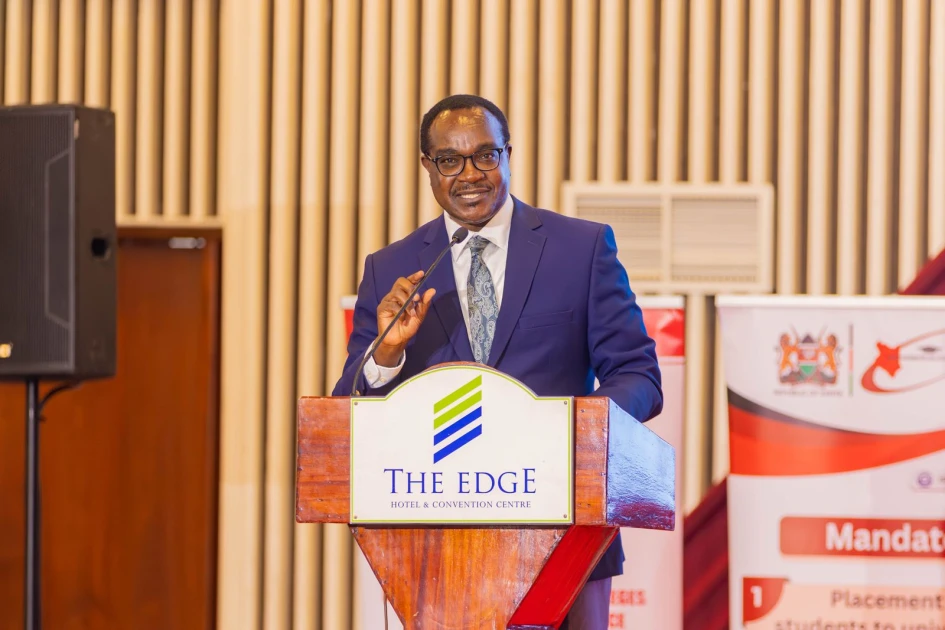
Education CS Julius Ogamba speaks during the release of 2026 placement results. Photo: Education Ministry.

Audio By Vocalize
According to KUCCPS, the Bachelor of Medicine course was a highly competitive one in the 2026/2027 placements.
KUCCPS Chief Executive Officer Agnes Wahome noted that out of the 6500 students who had applied for medicine as a course, there was space for only 702 of them in all public and private universities in Kenya, making the process very competitive.
Therefore, many students who had applied for medicine courses in various universities were not accepted.
While giving out his remarks, the Cabinet Secretary for Education, Julius Ogamba, said that a total of 293,869 students have been placed in degree, diploma (level 6), craft certificate (level 5) and artisan certificate level 4 programs across tertiary and higher education institutions.
Out of them, Ogamba elaborated that 202,133 applicants have been placed in degree programs while 28,246 have been placed in Kenya Medical Training Colleges.
8915 students who had qualified for degree programs opted for non-degree programs in tertiary institutions and were successfully placed.
Wahome maintained that 81 per cent of students who had applied for courses have been accounted for as they were ranked based on the performance index in terms of their cluster weights.
Further, she argued that each individual student was evaluated based on the key subject requirements for medicine, which were Chemistry, Biology, Maths and a language.
“We look at the cluster subjects. The cluster subjects are Mathematics, Chemistry, Biology, and a language, and then the students compete in those four subjects. Those form the cluster subjects, the students get a cluster weight, and then now the weight is what is ranked from the first to the last student, who is now student number 6500; then we cut it off per university,” she said.
Additionally, she raised concerns about the number of students who can pursue STEM courses at the university level, saying that out of the 300,000-capacity available, most of them focus on the science subjects, yet a few qualify.
"Some capacities will remain unfilled, and a good number of these capacities are in the science subjects, so it's a challenge that we need to see some improvements in the performance of our sciences,” added Wahome.
KUCCPS CEO observed that even though technical subjects such as Aviation Technology, Drawing and Design and Electricity had recorded significant performances, universities have not yet listed them as major course requirements.
She acknowledged that the highly performed subjects align well with the competency-based curriculum, but stakeholders should also put more effort into science courses to open up opportunities in the science sector.
Join the Discussion
Share your perspective with the Citizen Digital community.
No comments yet
This discussion is waiting for your voice. Be the first to share your thoughts!