
Gov't urged to lower revenue expectations in proposed 2027/28 budget
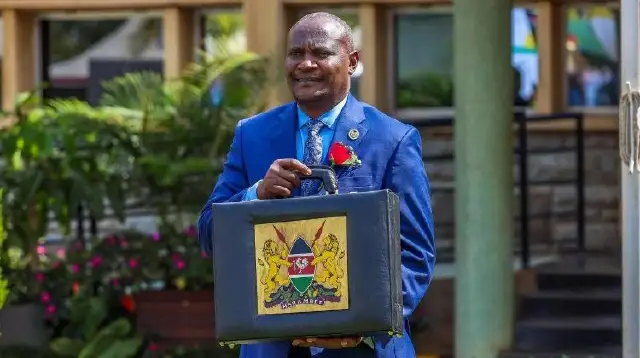
Treasury CS John Mbadi displays the budget briefcase at Parliament Building in Nairobi on June 11,2026. Photo/Courtesy

Audio By Vocalize
The Institute of Public Finance (IPF) said the National Treasury should lower its revenue expectations, protect funding for education and prioritise completing stalled projects before embarking on new ones.
In its latest Annual National Shadow Budget, IPF recommends that Parliament revises the government's 5.1 per cent economic growth projection to between 4.4 and 4.7 per cent, while lowering the tax revenue target from Ksh.3.1 trillion to approximately Ksh.2.9 trillion.
Research Analyst Gladys Wachira said the Treasury's economic projections have consistently been higher than the actual growth recorded, urging the government to align its estimates with projections from international financial institutions.
"The National Treasury's projections are always higher than what actually is the outturn. If you compare them with other projections, like from the African Development Bank, it is at 4.7 per cent, while the World Bank has projected about 4.4 per cent. From past trends, it is more likely to align with what the World Bank has projected," Wachira stated.
IPF Chief Executive Officer Daniel Ndirangu noted that revenue projections are directly linked to economic growth estimates, warning that unrealistic growth expectations could inflate revenue targets.
"Money generated for our revenue comes from the economy, and if our economic projection is unrealistic, then it means our revenue projections are also unrealistic. Based on our estimates over the last 10 years, unless something fundamentally changes, our economy will grow at the same average of 9 per cent," Ndirangu stated.
The institute also wants education funding adjusted for inflation, with bursary allocations consolidated into school capitation to better support needy learners.
Wachira warned that the current allocations remain insufficient to meet the sector's funding requirements, noting that the government is only meeting approximately 75 per cent of capitation needs.
"At the risk of sounding like a broken record, we are not allocating enough towards education. Only about 75 per cent of capitation needs are being met," she stated.
On development spending, IPF wants the government to prioritise completing existing projects before starting new ones.
The institute's review identified 219 stalled, incomplete or delayed projects worth Ksh.291 billion in the 2024/25 financial year, raising concerns over the implementation of development programmes.
Join the Discussion
Share your perspective with the Citizen Digital community.
No comments yet
This discussion is waiting for your voice. Be the first to share your thoughts!