
Gov't turns to smart technology to protect Ksh.54B annual road maintenance budget
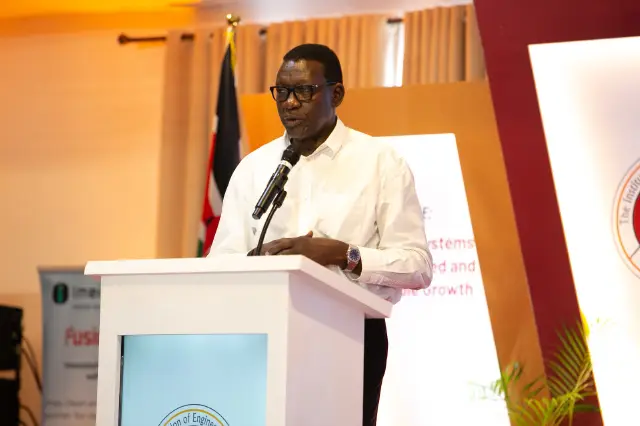
Roads and Transport Cabinet Secretary (CS) Davis Chirchir speaking during the 33rd IEK International Convention in Mombasa on November 25, 2026.

Audio By Vocalize
Roads and Transport Cabinet Secretary (CS) Davis Chirchir has announced that the Kenya Roads Board is moving to acquire a Traffic Speed Deflectometer that will allow engineers to assess pavement strength continuously while travelling at normal traffic speeds.
Speaking during the 33rd Institution of Engineers of Kenya (IEK) International Convention in Mombasa, he intimated that the technology is expected to improve how the government determines road conditions, estimates the remaining lifespan of pavements and prioritises maintenance interventions.
Chirchir said Kenya's classified road network covers 239,122 kilometres, with the Government spending more than Ksh.54 billion annually on maintenance.
However, he noted that maintenance programmes still rely largely on visual condition surveys covering only a sample of the network, limiting the ability to establish the actual structural condition of roads.
He said conventional testing methods assess pavement conditions at isolated points and require lane closures, while the new equipment would provide continuous measurements across paved roads.
With improved data, engineers will be able to identify roads requiring structural strengthening instead of spending money on routine maintenance that may not address underlying problems.
The investment forms part of a broader Government strategy to introduce intelligent systems into infrastructure planning, delivery and management.
The Government is also implementing a Ksh44.8 billion Intelligent Transport Systems programme in Nairobi through the Kenya Urban Roads Authority (KURA).
The first phase, valued at Ksh.7.8 billion, involves establishing a modern Traffic Management Centre and installing intelligent transport infrastructure at least 25 major junctions.
The second phase will cover 80 additional junctions at Ksh.13 billion, while the third phase will extend the technology to another 125 junctions at a cost of Ksh.24 billion.
The first two phases are financed by South Korea, while the third is financed through China Exim Bank.
The investments are intended to improve traffic management through real-time monitoring, advanced analytics and better coordination of urban transport networks.
Join the Discussion
Share your perspective with the Citizen Digital community.
No comments yet
This discussion is waiting for your voice. Be the first to share your thoughts!