
Gov't moves to clear 557,000 uncollected IDs ahead of 2027 elections
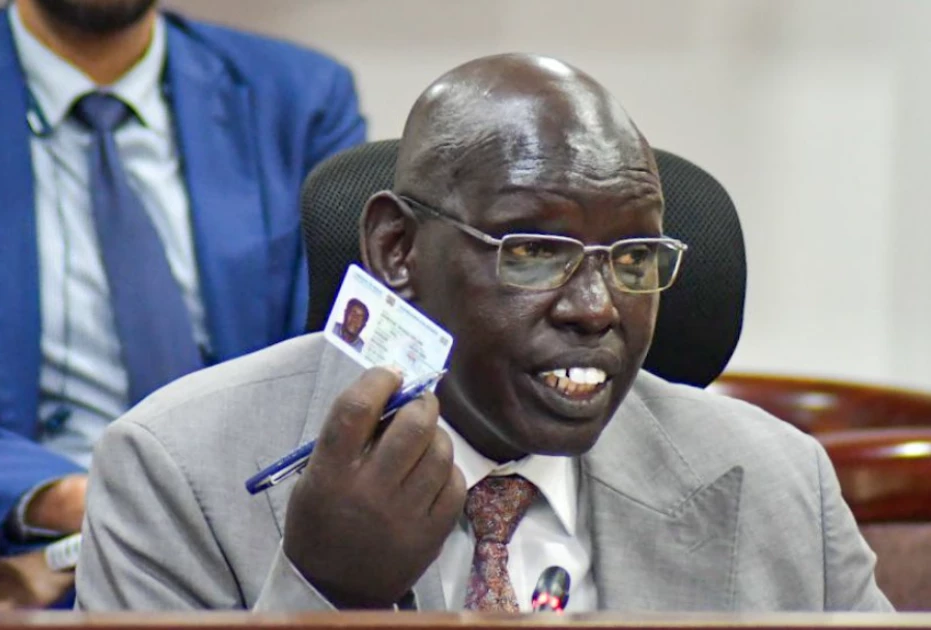
Immigration & Citizen Services PS Belio Kipsang appears before the Parliamentary Committee on Diaspora Affairs & Migrant Workers to update on the issuance of Seafarers’ Identity Documents (SIDs) on August 12, 2025. PHOTO | COURTESY

Audio By Vocalize
The government is racing to clear a backlog of more than 557,000 uncollected national identity cards ahead of the 2027 General Election, amid concerns that thousands of eligible Kenyans could be locked out of voter registration.
Principal Secretary for Immigration and Citizen Services Dr. Belio Kipsang says the government has intensified efforts to ensure all eligible citizens obtain their identification documents before voter registration begins in January 2027.
Speaking before the National Assembly Departmental Committee on Administration and Internal Security on Thursday, Kipsang said the backlog, which includes nearly 400,000 identity cards that have remained uncollected for more than 10 years, was being addressed through administrative interventions and improved technology.
He said the government had abolished fees previously charged for obtaining and replacing national identity cards to eliminate financial barriers to accessing the documents.
“We have removed all payments, including the Sh300 that used to be charged for new IDs and the Sh1,000 for replacements, so that it becomes easy for every Kenyan to acquire these documents and prepare to play their civic duty when the time comes next year for the elections,” he said.
The department is also working with chiefs and assistant chiefs to trace individuals whose identity cards have been processed but remain uncollected at registration offices.
Under the arrangement, National Government Administration Officers will receive lists of uncollected cards in their respective areas and help locate their owners.
Kipsang said the government was additionally considering allowing parents, guardians and other authorised persons to collect identity cards on behalf of applicants, subject to proper verification.
The department is also finalising an electronic notification system through the e-Citizen platform that will alert applicants through SMS when their identity cards are ready for collection.
“We are finalising the system to ensure that applicants are notified through SMS when their IDs are ready. This will help us fast-track the collection of these documents,” he said.
The PS said the department had invested in live-capture equipment to improve registration and processing while minimising the risk of identity documents being issued to the wrong individuals.
However, he acknowledged that dealing with identity cards that have remained uncollected for more than a decade presented legal and administrative challenges.
He cited Section 17 of the Registration of Persons Act, which provides for the Cabinet Secretary to invalidate identity cards, but said the government would exercise caution before making such a decision.
Meanwhile, MPs raised concerns over delays in processing and distributing identity cards, particularly in remote areas, despite investments in modern registration technology.
Teso South MP Uku Kaunya told the committee that more than 5,000 identity cards in Amagoro had reportedly taken between two and three months to reach registration stations after processing.
He urged the department to investigate the delays and proposed involving village elders in tracing applicants and facilitating the distribution of the documents.
Saku MP Dido Raso, who is the committee's vice-chairperson, called for the introduction of SMS notifications similar to those used in passport collection, saying many applicants failed to collect their identity cards because they were unaware that the documents were ready.
Raso also raised concerns over expiry dates printed on new-generation identity cards, saying the government needed to educate the public to avoid confusion between the expiry of identification documents and the loss of citizenship.
Responding to the concerns, Kipsang said the department had the capacity to print up to 20,000 identity cards daily and was working towards ensuring applications were processed and delivered within seven to 10 days.
He cited Busia County, where 11,000 identity cards had been processed over the preceding 30 days and were at various stages of completion.
In Kericho County, he said 17,000 cards were being processed and would be delivered to applicants within seven to 10 days.
“Any ID application that reaches us should be processed and delivered within seven to 10 days. It is a rolling system because as we receive new applications, we continue processing and dispatching those already received,” he said.
Sotik MP Francis Sigei also questioned delays in delivering processed identity cards, while raising concerns over the issuance of documents to people married to Kenyan citizens across the country's borders, particularly in Uganda and South Sudan.
Committee chairman and Narok West MP Gabriel Tongoyo directed the PS to investigate the concerns raised by legislators and establish the causes of delays in specific regions.
Kipsang assured the committee that he would provide Kaunya with a detailed update on pending applications in Teso South and the wider Busia County.
On concerns about identity card expiry dates, the PS clarified that the dates relate to the validity of the technology and information stored in the identification chip rather than the citizenship of the holder.
He said Kenyans would be notified in advance when their cards required replacement to allow for updates to the information stored in the chips.
“When your passport expires, you do not lose your citizenship. It is the same with an identity card. It is about updating the information contained in the chip and not the expiry of your citizenship,” he said.
Kipsang further dismissed concerns over shortages of passport printing materials, saying the department had adequate supplies as it transitions to the third generation of passports.
He said the government had more than one million booklets of the previous passport generation as it phased out the old system.
The PS also pledged to review staffing levels across the country to address unequal distribution of personnel and improve access to immigration and civil registration services.
He added that the government was harmonising national registration and civil registration services, which have traditionally operated through separate offices, to allow Kenyans to access both services at a single point.
“We are harmonising these offices so that Kenyans can get both civil registration and national registration services at one point,” he said.
Join the Discussion
Share your perspective with the Citizen Digital community.
No comments yet
This discussion is waiting for your voice. Be the first to share your thoughts!