
Goldstuck challenges Africa to turn AI adoption into competitive advantage
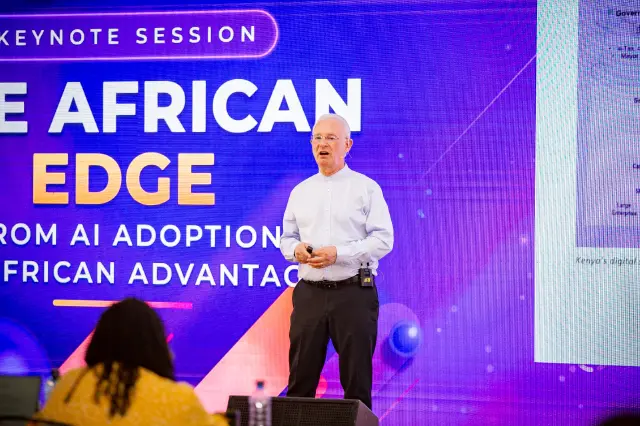
Arthur Goldstuck, CEO, World Wide Worx, delivering a keynote at the CIO100 Symposium $ Awards 2026 in Diani on November 25, 2026. PHOTO | COURTESY

Audio By Vocalize
Goldstuck said the continent's experience solving local challenges with limited resources gave it an opportunity to develop innovations that could influence the global technology industry.
Speaking during the opening keynote of the CIO100 Symposium and Awards 2026 in Diani on Wednesday, Goldstuck cited M-Pesa, agricultural technology and local-language AI as examples of areas where African innovation could create a competitive edge.
“On this continent we face constraints and challenges. And we use technology within those constraints to address those challenges,” he said.
However, Goldstuck cautioned that investing in AI does not automatically translate into improved business performance, saying organisations must build trust and prepare employees to integrate the technology into their operations.
He cited the South African AI Index 2026, which he said showed that 96 per cent of companies were using generative AI, but only 51 per cent were reporting productivity results.
Goldstuck argued that the gap pointed to challenges in embedding AI into organisational culture, urging technology leaders to focus on measurable business outcomes rather than adoption figures.
“The real secret of that victory was trust. It wasn't tech, it was trust,” he said, drawing lessons from technology adoption in professional sport.
He also warned that AI was making it easier to forge documents, identities and videos, increasing the need for businesses to verify information.
“Verification becomes part of your product,” Goldstuck said.
The World Wide Worx CEO further cautioned that the rise of agentic AI, which can take actions rather than simply provide recommendations, would introduce new accountability questions for organisations.
“Until now, AI advised and investors decided. But agentic AI acts for itself and you have to decide who authorised its action,” he said.
Goldstuck said AI-driven actions should be traceable, explainable and reversible, maintaining that human judgement must remain central as organisations give automated systems greater responsibility.
Earlier, CIO Africa by dx5 Chairman and Co-Founder Harry Hare challenged technology leaders to consider expanding their careers beyond the chief information officer (CIO) role, arguing that their growing involvement in business strategy positioned them for top executive positions.
Hare said CIOs were increasingly responsible for cybersecurity, talent, technology costs and decisions that shape organisational performance.
“Businesses are run on systems. And who runs the system?” he asked.
He cited the progression of Kenyan technology executives into senior leadership as evidence of the changing role of CIOs, challenging delegates to consider whether they could eventually become chief executive officers.
“Should I be planning my exit from the CIO into CEO? Just a thought,” he said.
The CIO100 Symposium and Awards 2026 is being held at Diamonds Leisure Beach and Golf Resort in Diani from November 25 to 27, bringing together technology leaders from across Africa to discuss innovation, cybersecurity, digital infrastructure and enterprise transformation.
The event will conclude with the CIO of the Year Gala Awards Dinner on Friday, where regional CIO of the Year recipients and the overall winner will be announced.
Join the Discussion
Share your perspective with the Citizen Digital community.
No comments yet
This discussion is waiting for your voice. Be the first to share your thoughts!