
Global demand pushes South African artists’ Spotify royalties to Ksh.3.9 billion
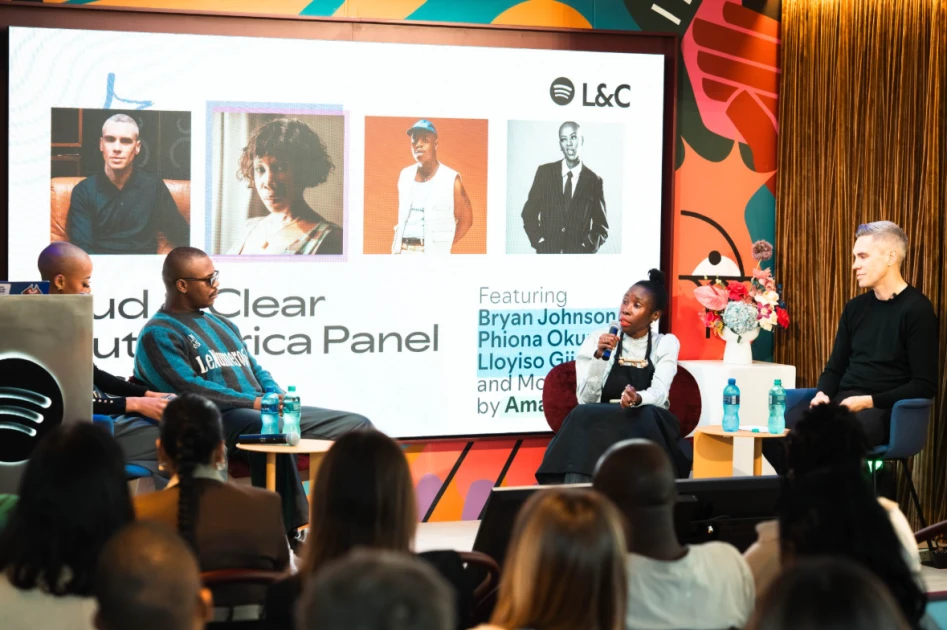
South African artist Loyiso Gijana, Spotify Sub-Saharan Africa Head of Music Phiona Okumu, and Spotify Head of Artist & Industry Partnerships Bryan Johnson take part in a panel discussion during the Spotify Loud & Clear event held in South Africa on May 13, 2026. PHOTO | COURTESY | SPOTIFY

Audio By Vocalize
South African artists generated more than Ksh.3.9 billion (ZAR
504 million) in royalties from Spotify in 2025, marking a 28 per cent
year-on-year increase as the country’s music industry continues to cement its
influence on the global streaming stage.
The figures were unveiled on Wednesday last week during
Spotify’s annual Loud & Clear event held at the platform’s new offices in
Rosebank, Johannesburg, where the streaming giant released its latest report on
music streaming economics, artist royalties and audience trends.
Spotify’s Loud & Clear initiative, launched in 2021,
seeks to improve transparency around how streaming revenue is generated and
distributed within the music industry.
According to the report, South African artists have nearly
doubled their Spotify earnings since 2023, with independent artists and labels
accounting for more than half of all royalties generated in 2025.
The report also highlighted the growing international
appetite for South African music, with nearly 74 per cent of royalties
generated by South African artists coming from listeners outside the country.
In 2025 alone, South African artists were discovered by
first-time listeners more than 1.6 billion times on Spotify, representing a 40
per cent increase from 2024. Additionally, nearly 3,550 South African artists
were added to Spotify editorial playlists during the year.
Speaking during the event, Spotify Sub-Saharan Africa
Managing Director Jocelyne Muhutu-Remy said the report demonstrates the
increasing global influence of South African talent.
“Loud & Clear’s report this year proves that South
African artists are not only experiencing explosive growth but have solidified
their position as a globally dominant creative force. Their success is driven
by worldwide demand, ensuring that independent and local talent alike are being
discovered by billions of listeners and taking the international stage by
storm,” she said.
Locally, South African artists accounted for more than
two-thirds, or 67 per cent, of tracks featured on Spotify South Africa’s Daily
Top 50 playlist in 2025, underscoring strong domestic support for homegrown
music.
Spotify also noted significant growth across several genres
over the past five years, including cloud rap, pop country, acoustic country,
pop rap and worship music.
The report further revealed that local streams of South
African female artists grew by 22 per cent year-on-year, while international
streams of female artists from the country increased by 20 per cent over the
same period.
Music performed in Zulu also registered major growth, with
royalties generated globally increasing by 37 per cent year-on-year and more
than 120 per cent over the last two years.
Although Communications and Digital Technologies Minister
Solly Malatsi did not attend the event physically, his statement was shared
during the gathering.
In his remarks, the minister thanked Spotify for positioning
South Africa as a continental hub and urged the platform to deepen investment
in African talent and languages.
He also challenged Spotify to promote greater transparency,
strengthen skills development across the music ecosystem and support the growth
of African languages on the platform.
Responding during a panel discussion, Spotify’s Head of
Music for Sub-Saharan Africa Phiona Okumu said: “This is a challenge we accept
as Spotify.”
Spotify said the growth of African music reflects a broader
shift in global culture, with cities such as Johannesburg, Lagos, Accra and
Nairobi increasingly shaping worldwide audio consumption and entertainment
trends.
The company added that its expanding presence on the
continent comes with a responsibility to support African creators and amplify
African voices globally.
Join the Discussion
Share your perspective with the Citizen Digital community.
No comments yet
This discussion is waiting for your voice. Be the first to share your thoughts!