
Game-Changer for Nyanza: New power line ends outages, powers economic rise
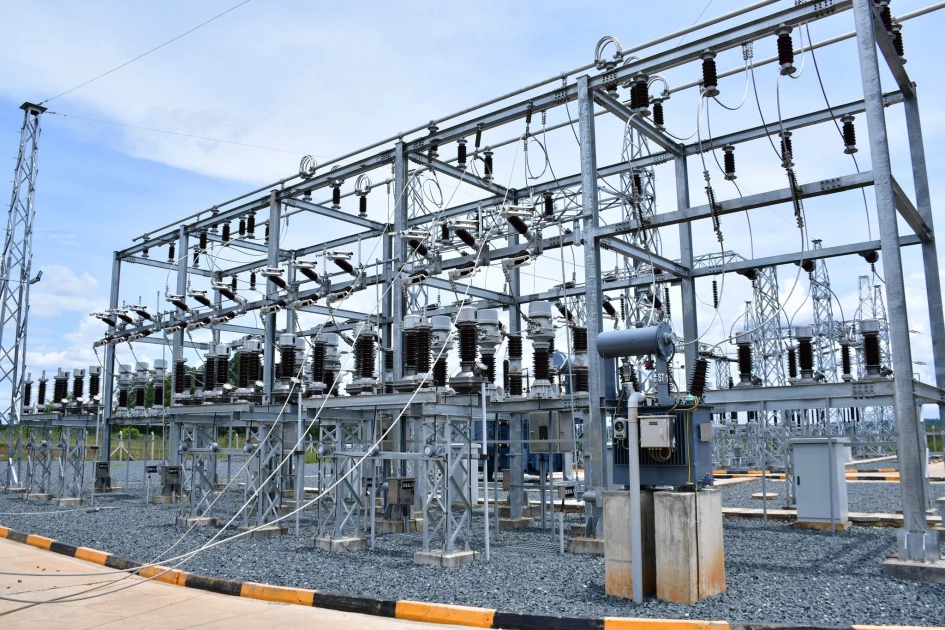
The Sondu–Ndhiwa–Homa Bay–Awendo 132kV transmission line.

Audio By Vocalize
A major boost to electricity reliability has arrived for Nyanza and the wider Western Kenya following the successful energisation of the Sondu–Ndhiwa–Homa Bay–Awendo 132kV transmission line and its associated substations.
The line can deliver approximately 70MW of additional capacity through the Kisumu–Sondu–Ndhiwa path, enough to power around 70,000 additional households across Homa Bay, Migori and beyond.
It also serves as an alternative supply path to neighbouring areas, enhancing power quality and redundancy. With ongoing and upcoming connection programmes, electrification coverage in South Nyanza and it’s surrounding areas of the South Rift supplied by the line is improving by 15% - from an average of about 40% to roughly 55% - marking a significant expansion in access alongside reliability gains.
This is a celebrated achievement as it closes on the gap to
leading regions such as Kiambu where 91% of households have access to
electricity as per indicated reports.
The
Government has framed this as a major milestone in strengthening regional grid
reliability and correcting long-standing supply constraints that previously
limited economic growth in parts of western Kenya. The new capacity is expected
to significantly reduce outages, support industry and unlock new economic
activity across the region.
The
intervention was spearheaded by PS State Department of Energy Alex Kamau
Wachira in partnership with Kenya Electricity Transmission Company Limited,
with critical administrative support from the National Government
Administration Officers (NGAO) to ensure seamless implementation and system
stability.
The
coordination support was led by PS Raymond Omollo of the State Department of
Internal Security and National Administration, who deployed NGAO officers on
the ground, noting that multi-agency collaboration was essential in delivering
the project efficiently.
Power began
flowing through the line at approximately 4:07 p.m. (1607hrs), marking the
operational start of a project long viewed as critical to stabilising
electricity supply in a region that has historically faced periodic load
shedding and infrastructure-related disruptions.
The impact
has been immediate and measurable. Persistent load shedding that previously
affected the region has now been eliminated,
while the
new line has decongested the Muhoroni–Chemosit corridor that had been operating
under heavy strain.
Before
energisation, Sondu supplied no power to Ndhiwa while the Muhoroni–Chemosit
line carried loads as high as 68MW - levels considered stressful for system
stability. After energisation, Sondu now supplies 27MW to Ndhiwa, while the
load on Muhoroni–Chemosit has reduced to 40MW and flows between Muhoroni and
Kisumu have dropped significantly, allowing electricity to be distributed more
efficiently across the network.
Engineers
note that such rebalancing reduces the risk of overloads and cascading outages,
strengthening grid resilience. Energy planners anticipate a potential rise in
national peak electricity demand as previously suppressed demand in Nyanza is
unlocked, signalling renewed economic activity and growth.
Reliable
electricity is widely recognised as a foundational driver of economic growth,
and the new line is expected to directly benefit several productive sectors in
the region. Agro-processing industries including sugar, cotton, maize and dairy
value chains are poised to gain from more stable supply. For fishing
communities around Lake Victoria, improved reliability will support cold
storage and fish processing facilities, reducing post-harvest losses and
increasing incomes.
The
strengthened grid also supports County Aggregation and Industrial Parks, which
depend on reliable electricity to attract investors and operate competitively.
Local SMEs in manufacturing, hospitality and retail are expected to experience
improved business continuity with fewer power interruptions.
Officials
note that the new infrastructure aligns with Kenya’s push toward a 24-hour
economy, enabling businesses, markets and service providers to operate beyond
daylight hours with greater confidence in electricity availability. Reliable
evening power particularly benefits traders, digital workers and service
providers who depend on lighting and connectivity to extend operating hours and
increase incomes.
Public
institutions are also set to benefit as expanded last-mile connectivity
improves electricity and internet access for schools and health facilities, enabling
digital learning, modern laboratories and better service delivery.
According to the Chair of Kenya Power and Lighting Company, Joy Mdivo, some parts of Kenya historically remained underserved due to infrastructure gaps and limited transmission capacity. She noted that deliberate investments are correcting past marginalisation and expanding opportunity.
She added
that dependable power will support industrial parks and facilities such as fish
cooling plants, strengthen the transition toward a 24-hour economy, and enable
industries such as sugar, cotton, maize and milk processing to operate more
reliably. Outcomes for schoolchildren are also expected to improve as last-mile
electricity and internet connectivity expand.
Additional
figures on new household connections and electrification rates are expected
once final audits are completed, with thousands of homes and businesses
projected to benefit from the expanded capacity.
For
residents in towns across the region, the energised line signals more than
improved electricity. It represents stronger local economies, greater national
inclusion, expanded opportunity and a foundation for long-term regional growth.
Reliable power is not just infrastructure - it is a catalyst for enterprise,
investment and community wellbeing.
Join the Discussion
Share your perspective with the Citizen Digital community.
No comments yet
This discussion is waiting for your voice. Be the first to share your thoughts!