
Gachagua appeals impeachment judgement, says court erred in law
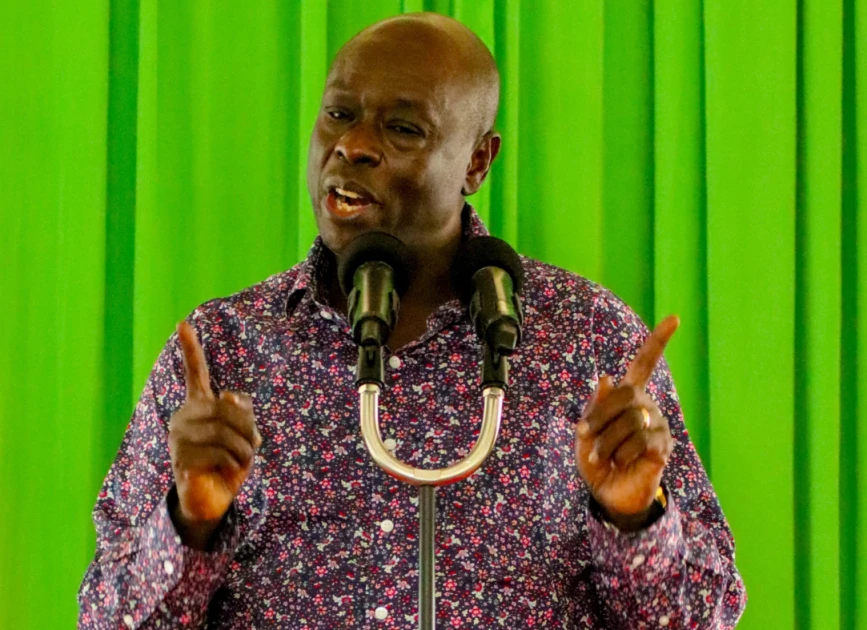
DCP party leader Rigathi Gachagua speaks when he hosted a delegation from Subukia Constituency, Nakuru County, at hs Wamunyoro Residence on August 6, 2026. PHOTO | COURTESY

Audio By Vocalize
In his appeal filed at the Court of Appeal, Gachagua says he is dissatisfied with the judgment and decree delivered by Justices E.O. Ogola, A. Mrima and Dr. F. Mugambi in June this year.
Gachagua argues that the High Court erred in law by finding that the Senate’s decision to impeach him was final and beyond judicial review, despite the same court finding that aspects of the impeachment process violated his rights to a fair hearing and fair administrative action.
He argues that the right to a fair trial is an absolute constitutional guarantee and cannot be sacrificed because of constitutional timelines or political considerations.
“No act in violation of the Constitution is outside the reach of the Courts....," read court papers
The former Deputy President also challenges the High Court’s interpretation of Article 145 of the Constitution, which provides for the impeachment of a Deputy President.
He argues that the High Court correctly found that the investigatory phase of the impeachment process was mandatory and that the committee route was the mechanism for dealing with evidentiary complexities, but subsequently reached what he describes as an “absurd, impracticable, illogical or artificial conclusion” on the application of Article 145.
On public participation, Gachagua argues that both the National Assembly and the Senate failed to facilitate adequate public participation during the impeachment process.
He says the proceedings did not meet the standards set by the Supreme Court in British American Tobacco Kenya PLC v Cabinet Secretary for the Ministry of Health and Others, particularly the requirement that public participation must be meaningful both qualitatively and quantitatively.
He is also challenging the constitutionality of Standing Order 64(2) of the National Assembly, arguing that the timelines prescribed under the provision undermined meaningful public participation and his right to a fair hearing.
The appeal further challenges the High Court’s decision concerning the appointment of Prof. Kithure Kindiki as Deputy President, with Gachagua arguing that the court erred in finding that public participation was not constitutionally required for his nomination and approval under Article 149(1).
A significant part of the appeal concerns an alleged discrepancy between the judgment delivered orally in open court and the written judgment subsequently issued.
Gachagua claims that the judges read four additional paragraphs immediately after paragraphs 484, 488, 503 and 508 during the delivery of the judgment, which was broadcast live, but that the paragraphs were later omitted from the written judgment.
He argues that the High Court therefore “improperly modified” its judgment after delivery and acted contrary to its role as a superior court of record.
According to the appeal, the discrepancy has deprived Gachagua of the benefit of the reasoning contained in the portions of the judgment allegedly read in open court.
The former Deputy President is also challenging the relief awarded by the High Court, including the Ksh.50 million constitutional damages ordered in his favour.
Gachagua argues that the damages were insufficient to vindicate the Constitution, restore his dignity and deter future violations because the court did not declare the impeachment unconstitutional, null and void.
He further faults the High Court for failing to determine whether a Deputy President removed through an unconstitutional impeachment process is entitled to retirement benefits.
In his prayers to the Court of Appeal, Gachagua wants the Senate resolution passed on October 17, 2024, removing him from office declared “unconstitutional, null and void.”
He is also asking the appellate court to grant the remedies sought in his Further Amended Petition dated August 13, 2025.
Gachagua has further asked the Court of Appeal to remit the High Court judgment for the limited purpose of correcting the record and direct the High Court Registrar, within 14 days, to ensure that the portions allegedly read in open court but omitted from the written judgment are inserted.
He is also seeking costs of the appeal.
Join the Discussion
Share your perspective with the Citizen Digital community.
No comments yet
This discussion is waiting for your voice. Be the first to share your thoughts!