
From five-time runner-up to world champion: Elfyn Evans’ long road to WRC glory
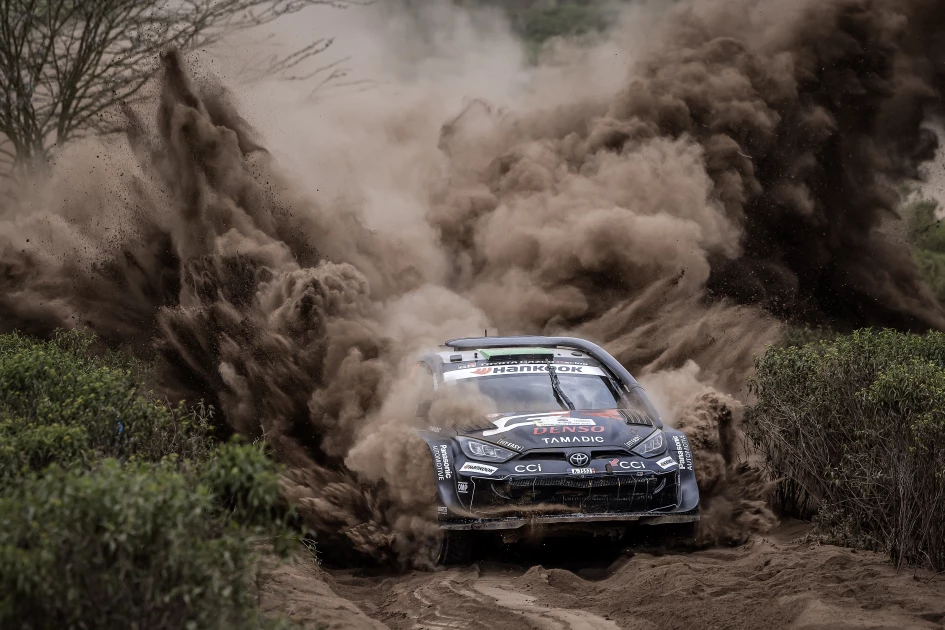
Toyota Gazoo Racing WRT's British driver Elfyn Evans steers his Toyota GR Yaris Rally1 with British co-driver Scott Martin during the World Rally Championship (WRC) Safari Rally Kenya Special Stage 7 (SS7) in Gilgil on March 21, 2025. (Photo by Luis TATO / AFP)

Audio By Vocalize
Five times the Welshman had finished runner-up in the World Rally Championship, each disappointment adding another chapter to a career defined as much by near misses as by speed, consistency and determination.
But on Sunday, the story finally changed after Evans and his co-driver Scott Martin were crowned FIA World Rally Champions after a remarkable and nerve-shredding finale to Rally Italia Sardegna, ending one of the longest waits for a WRC title in recent history.
The 37-year-old Toyota driver finished the season on 243 points, five clear of fellow Toyota driver Oliver Solberg and six ahead of Sami Pajari. More significantly, he became the first British WRC drivers' champion since Richard Burns in 2001 and only the third Briton to win the coveted crown after Colin McRae and Burns.
Yet the numbers alone do not explain how Evans finally got over the line.
His championship was built over 13 rallies, through victories and difficult weekends, punctures, road-position disadvantages and the relentless pressure of fighting three Toyota drivers for one prize.
And, fittingly, the title was decided in the most dramatic way imaginable.
A season built on consistency
Evans did not begin 2026 by dominating the championship.
He opened the campaign with second place at Rallye Monte-Carlo behind his Toyota team-mate Oliver Solberg. One event later, however, he struck back in Sweden, taking victory and moving to the top of the championship.
It would become a recurring theme of his season. While others produced spectacular performances, Evans repeatedly found a way to collect valuable points.
The Safari Rally Kenya and Croatia Rally brought difficult weekends, but Evans avoided allowing setbacks to derail his championship campaign. At Rally Islas Canarias, he returned to the podium with second place before adding another podium in Portugal.
Then came Japan.
On Toyota's home roads, Evans produced one of the defining performances of his season, winning Rally Japan for the third time in four years. He led a remarkable Toyota 1-2-3-4 finish, beating nine-time world champion Sébastien Ogier by 12.8 seconds.
The victory was his second of the season and the 13th WRC win of his career. It was also his 50th career WRC podium and extended his championship advantage to 20 points at the halfway stage of the season.
Japan demonstrated perhaps the most important quality Evans possessed in 2026 which is his ability to win without taking unnecessary risks.
He led from the early stages and managed the rally intelligently as his Toyota team-mates applied pressure. It was not simply about being the fastest driver on every stage; it was about understanding when to attack and when to protect the points.
That balance would become crucial as the season entered its more difficult second half.
The pressure begins to build
The gravel rallies of the summer presented Evans with a different challenge.
Running first on the road often meant sweeping loose gravel away and leaving a cleaner, faster racing line for those following. While drivers such as Pajari and Solberg began producing impressive results, Evans concentrated on limiting the damage.
He finished fifth in Greece, sixth in Estonia, third in Finland and fourth in Paraguay.
Pajari, meanwhile, went on a spectacular run, winning Estonia, Finland and Paraguay consecutively and transforming himself into a serious championship contender. Solberg also remained within striking distance.
By the time the championship reached Chile, Evans' advantage had been reduced to 20 points.
Then came another blow.
Evans had been running second in Rally Chile and appeared set for another important podium when a damaged tyre forced him to stop and change a wheel on the penultimate stage.
More than two minutes disappeared.
He fell to fifth and watched his championship lead shrink further as Solberg took victory. Evans, however, refused to let the disappointment define the campaign.
He finished the rally by going second-fastest on the Wolf Power Stage, salvaging valuable bonus points.
That response was characteristic of the season. When a victory was not possible, Evans kept searching for points.
When the car was not perfect, he kept it on the road.
And when rivals gained momentum, he refused to surrender the championship lead.
Sardinia: everything comes down to one final stage
The cancellation of Rally Saudi Arabia transformed Rally Italia Sardegna into the final round of the championship.
Evans arrived in Sardinia leading the standings with 230 points, 17 ahead of Pajari and 21 ahead of Solberg. All three Toyota drivers still had a mathematical chance of becoming world champion.
The equation was simple but unforgiving.
Evans needed to score 19 points to guarantee the title, regardless of what his rivals did.
But rallying rarely follows a script.
Opening the road on Friday made Evans' task difficult, while Solberg began to demonstrate the pace that had made him such a dangerous challenger throughout the season.
By Saturday, the young Swede had seized control of the rally.
Solberg entered the final day with a commanding lead, while Evans was fighting simply to keep his championship advantage alive.
Then, on Sunday, the situation became even more dramatic.
Evans suffered a puncture on the penultimate stage and was forced to stop and change the wheel. The delay cost him around two minutes and wiped out his hopes of collecting Super Sunday points.
Suddenly, the championship was no longer about Evans building a points advantage.
It was about one final stage. One final battle.
Evans and Solberg were effectively going head-to-head for the world championship.
The moment everything changed
The final Wolf Power Stage was just 7.1 kilometers long. For Evans, it was about survival.
For Solberg, it was about taking everything. Evans completed his final run first.
Then he had to wait.
Solberg, starting behind him, knew exactly what was required. He had to beat his team-mate on the stage to take the championship.
The Swede was faster at the opening timing points and appeared to be heading towards the title.
Then, with just two corners remaining, everything changed.
Solberg went wide, crashed down a bank and lost the crucial bonus points he needed to overturn Evans' advantage.
He managed to recover and still won the rally, but the lost points meant the championship belonged to Evans.
For Evans, there was no immediate celebration.
He had completed his own stage and could only wait for his rival to finish.
When Solberg's crash confirmed the outcome, relief replaced the tension.
Evans was finally a world champion.
Five times second, finally first
The significance of the achievement goes far beyond one dramatic afternoon in Sardinia.
Evans had finished second in the championship five times, including four consecutive runner-up finishes from 2021 through 2024 and another near miss in 2025, when he lost the title to Ogier by only four points.
The 2020 season remains particularly painful.
Evans arrived at the Monza finale leading the championship by 14 points but crashed in snowy conditions, allowing Ogier to take the title.
Five years later, he found himself in another decisive final stage.
This time, however, he was the one left standing.
There is an irony to the way Evans eventually won the championship. It was not secured with a dominant victory in Sardinia. He finished fifth in the rally.
Instead, it was the accumulated work of an entire season that gave him the margin he needed.
As Evans himself put it after the title was secured, the championship "wasn't won here".
It was won in Sweden.
It was protected through difficult rallies in Kenya and Croatia.
It was strengthened by second place in the Canary Islands and a podium in Portugal.
It was reinforced by his victory in Japan.
It survived the difficult gravel events of the summer.
It survived the puncture in Chile.
And it survived one of the most dramatic final stages WRC has witnessed.
A champion built on resilience
Evans' 2026 campaign was not simply a story of raw pace.
It was a story of resilience.
While Solberg demonstrated extraordinary speed and Pajari produced a remarkable run of three consecutive victories, Evans consistently remained within touching distance of the points he needed.
That consistency eventually proved decisive.
His season ended with 243 points, with Solberg second on 238 and Pajari third on 237. The margins were tiny, reflecting just how competitive the championship had been.
Toyota's dominance also played a major role.
The Japanese manufacturer secured its sixth consecutive manufacturers' championship and its 10th overall, matching Lancia's record for the most manufacturers' titles in WRC history.
But within that dominant Toyota squad, Evans emerged from an extraordinary internal battle with the prize everyone wanted.
He had beaten the young Solberg. He had held off the fast-rising Pajari.
And he had finally overcome the ghosts of his previous championship defeats.
For Scott Martin, the achievement was equally significant.
The Welsh co-driver secured his first world title alongside Evans, completing a partnership that finally converted years of promise into the ultimate reward.
A new chapter for British rallying
Evans' victory also closes one chapter of British rallying history while opening another.
Richard Burns was the last British driver to win the WRC title, in 2001.
Before him came Colin McRae, Britain's first world rally champion, who captured the crown in 1995.
For 25 years after Burns' triumph, British rally fans had waited for another driver to lift the championship trophy.
Evans has now ended that wait.
And he did it after enduring some of the hardest disappointments the sport can offer.
That is perhaps what makes his championship particularly compelling.
There was no straightforward march to the title. There were no guarantees. There were rallies when his rivals were faster.
There were moments when the championship appeared to be slipping away.
But Evans kept collecting points. He kept returning to the fight.
And when his opportunity finally came, he was ready.
The final scene in Sardinia was almost surreal: a driver who had spent years watching championship victories disappear from his grasp finally standing on top of the WRC standings, while his closest rival was left counting the cost of a mistake two corners from the finish.
Evans had waited long enough. This time, the title was his.
Join the Discussion
Share your perspective with the Citizen Digital community.
No comments yet
This discussion is waiting for your voice. Be the first to share your thoughts!