
From controversy to conservation: How the Mau is rewriting its story
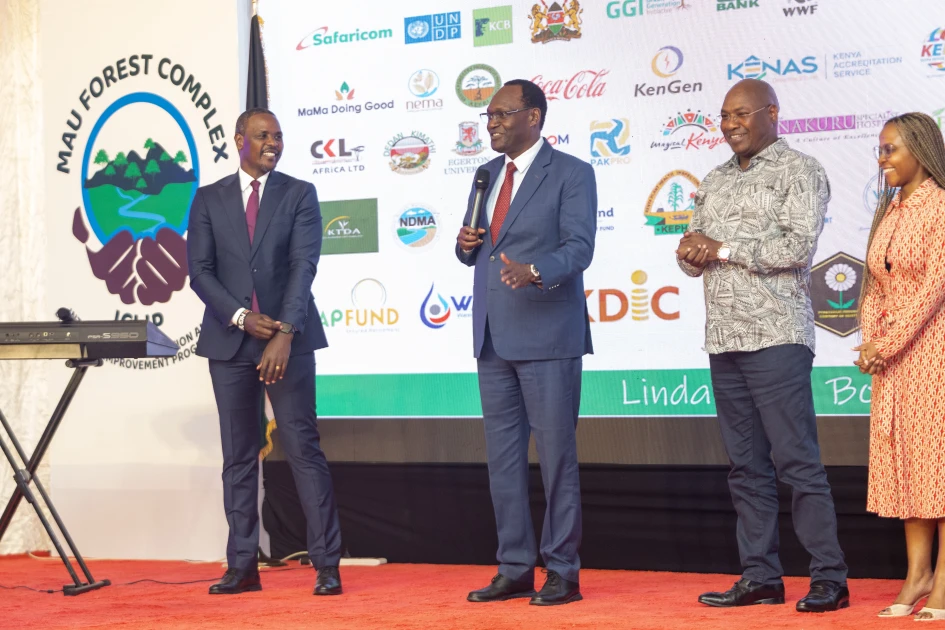
Eng. Festus K. Ngeno (left), Principal Secretary for Environment and Climate Change and Patron of MFC-ICLIP, with Dr. Chris Kiptoo, CBS, Principal Secretary for the National Treasury and Patron of Kaptagat Integrated Conservation Programme, whose innovative community-led conservation model is inspiring a new generation of integrated forest restoration and livelihood programmes across Kenya.

Audio By Vocalize
While many acknowledged the ecological importance of the Mau, achieving meaningful and lasting conservation outcomes remained elusive.
For the first time, restoration of the Mau Forest Complex is being driven not only by government policy but also by communities themselves through a transformative initiative known as the Mau Forest Complex Integrated Conservation and Livelihood Improvement Programme (MFC-ICLIP). The programme is anchored on a simple but powerful principle: conservation can only succeed when it simultaneously benefits People, Profit and the Planet.
The programme is anchored on a simple but powerful principle: conservation can only succeed when it simultaneously benefits People, Profit and the Planet. Importantly, the model draws inspiration from the Kaptagat Integrated Conservation Programme (K-ICP), which demonstrated that community-led conservation succeeds when forest-adjacent communities derive sustainable economic benefits from protecting, rather than exploiting, the ecosystem.
The approach recognizes that communities living around forests understand better than anyone that their water, agriculture, livelihoods, enterprises, and local economies are sustained by healthy forests. By creating alternative livelihood opportunities and conservation-linked enterprises, the programme empowers communities to become custodians of the forest while reducing pressure on forest resources.
The 10-year programme has demonstrated that communities are not the problem,they are the solution. Through innovative approaches such as the Trees Establishment and Livelihood Improvement Scheme (TELIS), local households are directly participating in restoration while improving food security and household incomes. More than 4,000 households are already benefiting from conservation-linked livelihoods, while approximately 1,500 hectares have been restored and over 1.5 million trees established in less than a year.
At the centre of this movement is the Principal Secretary for Environment and Climate Change, Dr. Eng. Festus K. Ngeno, a son of the Mau region who has become one of the programme's most visible champions. As Patron of MFC-ICLIP, he has spearheaded an ambitious resource mobilization effort that brings together government, development partners, communities, corporates, institutions, and individual philanthropists behind a shared restoration agenda.
"The future of the Mau is directly linked to the future of our economy, our food systems, our biodiversity, our climate resilience, and the well-being of present and future generations." PS Ngeno emphasized that the future of the Mau is inseparable from Kenya's future.
While speaking during the Resource Mobilization Dinner for the Second Edition of MFC-ICLIP
Under his leadership, restoration has evolved from a conservation project into a national movement. The recent fundraising dinner in Nairobi, which brought together senior government officials, business leaders, development partners, and community representatives, demonstrated growing confidence in the programme as it transitions into its second phase.
The results have been remarkable. In just ten months, the programme has restored forest landscapes, supported community enterprises in potatoes, avocados, pyrethrum, beekeeping, dairy value chains, and agroforestry, engaged 150 schools in restoration activities, and mobilized partnerships that continue to unlock new investments for conservation and livelihoods.
Perhaps most significantly, the programme has shown that restoring the Mau is no longer simply an environmental obligation, it is an economic opportunity. As PS Ngeno noted, every investment in the Mau is an investment in water security, clean energy, biodiversity conservation, climate resilience, food systems, and community prosperity.
As MFC-ICLIP enters its second edition, the focus is shifting from proving the model to scaling it. The vision is bold: restore thousands of additional hectares, strengthen green enterprises, empower women and youth, and create a globally recognized model where conservation and livelihoods advance together
Join the Discussion
Share your perspective with the Citizen Digital community.
No comments yet
This discussion is waiting for your voice. Be the first to share your thoughts!