
Four years, zero school fees: Inside Mandera's Elimu Kwa Wote Programme

Audio By Vocalize
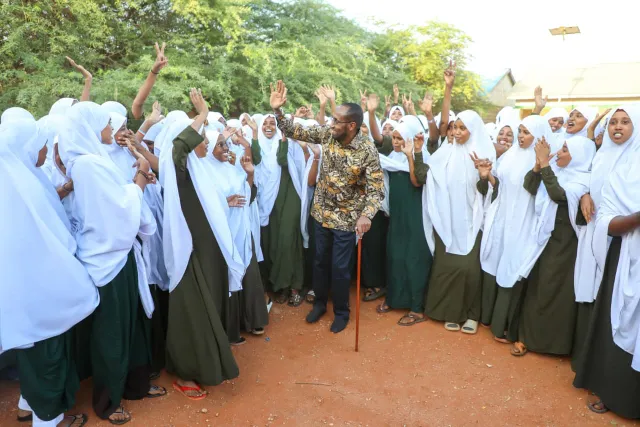
Outside the gate, parents and relatives wait to receive their daughters following the conclusion of the Kenya Certificate of Secondary Education (KCSE) examinations.
Among the students is Amran Abdullah Samow, wrestling with a mattress and a box as she makes her way from the dormitory.
But beyond the belongings she carries lies a milestone. Amran is among the first cohort of students in Mandera County to complete four years of secondary education without their families paying a cent in school fees, courtesy of the county government's Elimu Kwa Wote programme.
“As I complete my high school today, I am very grateful to the county government for giving us an opportunity to study free of charge from Form One,” she says.
For Amran and thousands of other students, the afternoon marks more than the end of national examinations. It brings to a close an educational journey that, for many, could have been interrupted by their families' inability to raise school fees.
At Mandera Boys Senior School, Caleb Makori, who hails from Kisii County, is another beneficiary of the initiative.
Despite schooling hundreds of kilometres away from home, Makori has completed his secondary education without his parents having to contend with the financial demands of school fees.
“I am very far from home but the Governor did not discriminate and has paid for my fees for four years. Since I came to Form One, my parents have not paid a single coin,” he says.
For his schoolmate Yunis, the programme has offered an opportunity that his family's financial circumstances would have otherwise made difficult to secure.
“I am from a poor background and my parents cannot afford to pay school fees,” he says.
Beyond his own experience, Yunis says he has witnessed students who had previously dropped out of school return to class following the introduction of the programme.
At Tawakal Mixed Day Secondary School, Form Four students recount similar experiences, having spent four years in school without the persistent threat of being sent home over unpaid fees.
Teachers have also observed changes in attendance and the amount of time students spend in class.
Abdulnasser Adam, Senior Principal at Wayam Senior Secondary School, says the initiative has reduced interruptions to learning, particularly among students from financially disadvantaged households.
“Since the introduction of the initiative in 2023, I have seen the students go through secondary school without paying anything. A lot of time that would have been wasted as students are sent home for fees is now being utilised in class,” he says.
Protecting education and livelihoods
In Mandera, the cost of education extends beyond the school gate.
With many households dependent on pastoralism, paying school fees can mean parting with livestock, often the family's primary source of income and financial security.
A goat, sheep, cow or camel can determine whether a child remains in school, a sick relative receives medical attention or a household has enough food to withstand a prolonged drought.
Every animal sold to settle school fees potentially diminishes a family's ability to withstand future economic shocks.
It is this reality, according to Mandera Governor Mohamed Adan Khalif, that informed his administration's decision to introduce Elimu Kwa Wote.
Launched in January 2023, months after Khalif assumed office, the programme covers school fees for students enrolled in public secondary schools across the county.
The initiative incorporated students who were already in Forms Two, Three and Four, alongside those joining Form One that year.
Four years later, the graduation of its inaugural Form One cohort offers an opportunity to assess the programme's impact on access to education, retention and household livelihoods.
According to the county government, Sh2.2 billion has been invested in Elimu Kwa Wote since its inception, supporting 71,868 students in public secondary schools.
A further 135,968 students in colleges and universities have received financial assistance through the county's wider bursary programme.
The county administration also reports that the transition rate from primary to secondary school has reached 100 per cent.
Governor Khalif says the investment must be understood within the broader economic circumstances of Mandera's predominantly pastoralist communities.
“When a family has to sell a goat, sheep, cow or camel to pay school fees, the cost of education is no longer just a school expense. It is a direct cost to the family's livelihood. By removing that burden, we are giving parents an opportunity to keep their children in school while also protecting the assets on which their livelihoods depend,” he says.
For households grappling with poverty and recurring drought, the money that would ordinarily have gone towards school fees can now be redirected towards food, healthcare and other essential needs.
Livestock that might otherwise have been sold to settle fee arrears can remain a source of income and financial security.
“For us, the real measure of Elimu Kwa Wote is not simply how much money we have spent. It is whether a child who completes primary school can proceed to secondary school without poverty deciding their future and it is very fulfilling to see this happen,” Khalif adds.
Keeping girls in school
The programme also seeks to address financial barriers to girls' education, particularly in households where limited resources force parents to make difficult decisions about which children remain in school.
By removing school fees, the county hopes to reduce the financial pressures that expose girls to the risk of dropping out.
“If poverty forces a family to choose which child should remain in school, girls can easily lose that battle. By taking school fees out of that equation, we are giving girls the same opportunity to stay in school and determine what comes next in their lives,” says Khalif.
Although secondary education falls under the mandate of the national government, the county administration says its intervention was necessitated by the socioeconomic challenges facing residents.
County Executive Committee Member for Education Bishar Ibrahim says the impact is already evident in growing enrolment across secondary schools.
“The programme is a success as we have witnessed numbers swelling in our secondary schools. The burden that parents harboured is now on the shoulder of the Government,” he says.
With the first cohort having completed its KCSE examinations, attention now turns to academic outcomes and the students' transition to tertiary institutions.
For Amran, Makori, Yunis and thousands of their peers, however, one milestone has already been achieved: completing secondary school without the burden of school fees.
For their families, it has meant four years in which educating a child did not have to come at the expense of their livelihoods.
Join the Discussion
Share your perspective with the Citizen Digital community.
No comments yet
This discussion is waiting for your voice. Be the first to share your thoughts!