
Food losses in Kenya occur more in markets than during transport - Study
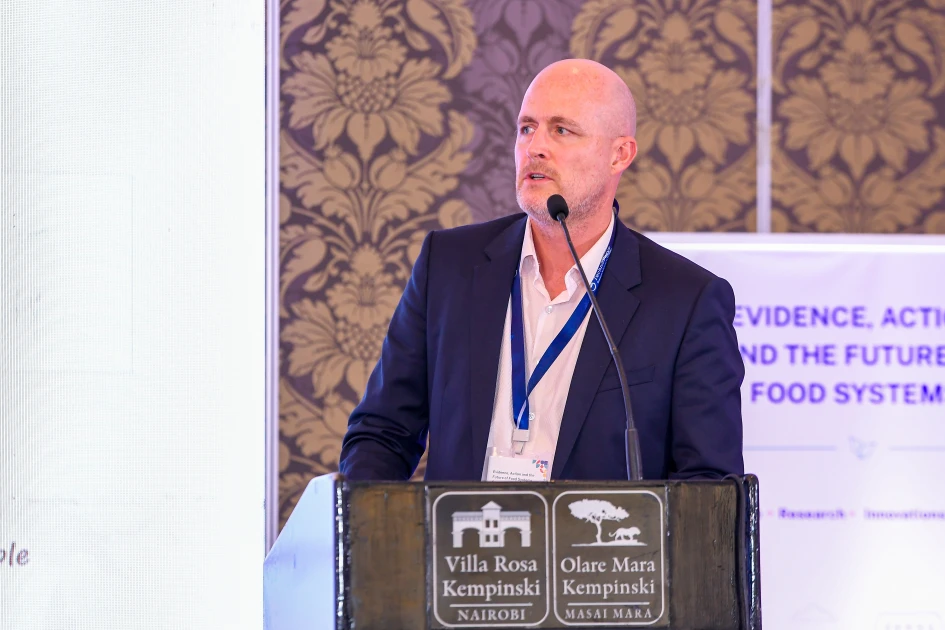
EDI Global Managing Director Chris Boyd speaks during presentation of the new research under the NutriSave programme in Nairobi on Tuesday, Sepetember 8, 2026. PHOTO | COURTESY

Audio By Vocalize
Food losses affecting tomatoes, mangoes and dark leafy vegetables in Kenya are more frequently linked to storage at markets than transportation, new research under the NutriSave programme has found.
The findings, presented in Nairobi on Tuesday, show that
produce is often lost while being stored during market hours or overnight,
challenging the commonly held view that transportation is the main contributor
to food loss.
The research, conducted by NutriSave in partnership with the
International Food Policy Research Institute (IFPRI), traced the movement of
the three types of produce through Nairobi’s wholesale markets, following them
from suppliers to informal retailers.
The study also found that losses are concentrated among
larger vendors who handle bigger volumes of produce and are more likely to
remain with unsold stock at the end of the day.
The findings were presented during a forum bringing together
researchers, government representatives, donors, private-sector players and
other food-system stakeholders to discuss ways of reducing food loss while
improving access to nutritious food.
TechnoServe Acting Country Director Sebastian Oggema said
informal food vendors could play a central role in addressing the challenge.
“Informal food vendors were central to achieving NutriSave’s
dual objectives: reducing food loss and waste while improving access to
nutritious food for low-income consumers. We need to invest more in their
agency if we are to achieve meaningful food system transformation in Kenya,”
said Oggema.
The research suggests that addressing food loss will require
better coordination between supply and demand, rather than focusing solely on
increasing food production.
It proposes connecting surplus produce with businesses and
organisations that can process it, while exploring cold-storage solutions in
areas where investment would be commercially viable.
Researchers, however, say more data and cost-benefit
analysis will be needed to determine which interventions can be implemented
commercially and at scale.
TechnoServe Director of Regenerative Agriculture Richard
Pluke said reducing food loss should be central to efforts to improve food
systems.
“Reducing food loss and waste is one of the clearest
indicators that a food system is truly regenerative,” said Pluke.
The NutriSave programme has also tested market-based
approaches to reducing food waste, including a partnership with Six Square
Limited to turn surplus and cosmetically imperfect produce into ready-to-cook
products.
The programme also partnered with Baba Mboga, a grocery
delivery platform, to improve access to fresh produce and pre-prepared
vegetables for consumers and informal vendors.
The three-year programme, funded by the Gates Foundation and
the UK’s Foreign, Commonwealth & Development Office (FCDO), is seeking to
address a food-system paradox in which nutritious produce is lost along supply
chains even as some households struggle to consume enough fruits and vegetables.
NutriSave has documented its findings and recommendations in
a practitioners’ playbook aimed at policymakers and practitioners working on
agriculture, nutrition and markets.
The programme's research partners include IFPRI, Jomo
Kenyatta University of Agriculture and Technology (JKUAT), EDI Global and
Mathematica.
As the programme enters its close-out phase, TechnoServe
says the evidence gathered will be used to inform future research, investment
and market-system strategies aimed at reducing food loss and improving food and
nutrition security in Kenya.
Join the Discussion
Share your perspective with the Citizen Digital community.
No comments yet
This discussion is waiting for your voice. Be the first to share your thoughts!