
FKF boss Mohammed hints at backing Infantino re-election
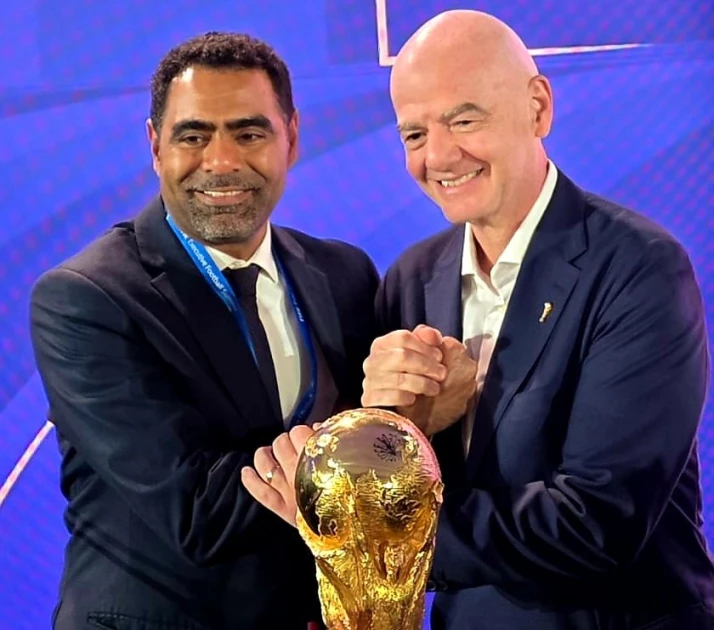
FKF president Hussein Mohammed (L) and FIFA president Gianni Infantino during a FIFA Executive Football Summit in Miami, USA. Photo/Handout.

Audio By Vocalize
This stance comes amidst growing resistance from confederations in Europe, North America, Central America, the international players' union, and several individual national federations following the collapse of the FIFA Forward Enterprise proposal.
In an interview with CGTN Africa, Mohammed noted that official campaigning has yet to commence and that Kenya is taking a measured approach.
“Campaigns have not started. We are waiting to see who is on the ballot,” said Mohammed.
Despite the broader geopolitical friction within global football governance, the FKF chief acknowledged Infantino’s contributions to football development. He suggested that Kenya would be inclined to support his continued leadership, emphasising the necessity for member associations to secure robust funding.
“Gianni is still running for office and when he asks us for the vote, we will make our decision. We wish that he continues to do the same. We have seen the good work. He has asked for our support and we have committed that support. When that moment comes, we will go all the way,” said Mohammed.
While hinting at a potential alignment with Infantino, Mohammed reiterated that the federation’s ultimate stance will depend on the complete roster of contenders once nominations close.
Central to the FKF chief's perspective is the critical role of increased financial distribution. Mohammed argued that expanding revenue streams allows member associations to build resilient institutions, run sustainable development programmes, and elevate overall capacity—provided that strong governance accompanies the capital.
“The more revenue member associations are able to access, the better for us. We just need to be accountable on how we use these funds,” he said.
He stressed that financial growth must be tied directly to strategic execution so that capital translates into long-term impact on the pitch and across administrative structures.
“In terms of football development, this is critical. This will help us build our institutions. The money should go to the right courses,” he added.
Mohammed’s position underscores a pragmatic balancing act as Kenya navigates international sports diplomacy.
As the country engages with global football's governing bodies, Infantino's track record on revenue distribution and development aid will clearly serve as benchmark considerations when Kenya ultimately casts its vote.
Join the Discussion
Share your perspective with the Citizen Digital community.
No comments yet
This discussion is waiting for your voice. Be the first to share your thoughts!