
FIFA Series changing women’s football - Harambee Starlets enjoying the fruit
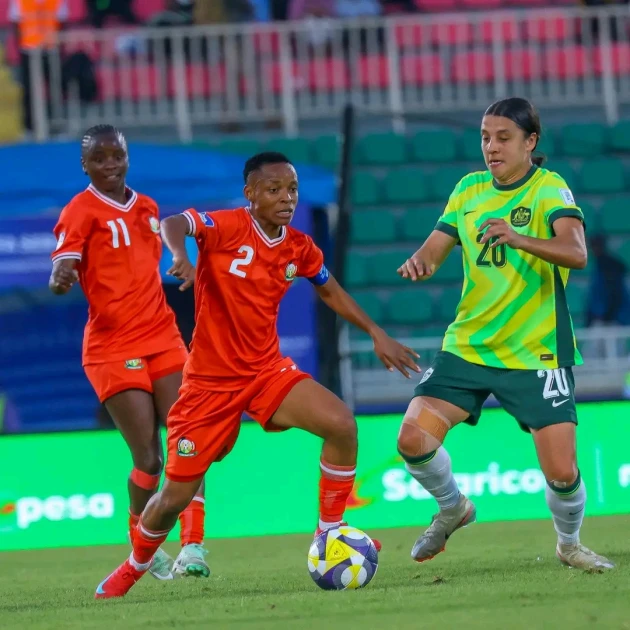
FILE: Harambee Starlets striker Mwanahalima Adam controls the ball against an Australian player during their FIFA Series final at the Nyayo National Stadium.

Audio By Vocalize
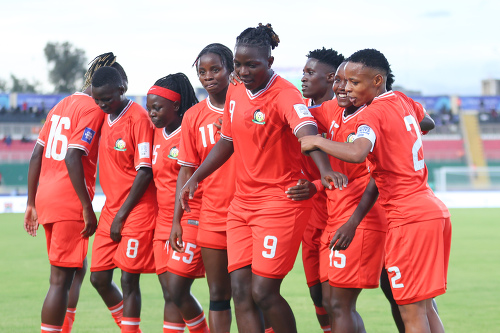
The FIFA Series - a biennial initiative aimed at fostering international friendlies between nations from different confederations, was held on Kenyan soil, and for the April edition, featured Harambee Starlets, the Matildas of Australia, India and Malawi.
For Kenya coach Beldine Odemba and her charge sit has been the catalyst for unprecedented tactical and psychological evolution, especially ahead of the 2026 Women’s Africa Cup of Nations, which will be held in July after being initially postponed from March.
A taste of World Cup
The tournament served as a barometer to measure the progress that Odemba’s charges have been making over the last three years.
After a convincing 2-0 victory over India, the Harambee Starlets faced a powerhouse Australian side that has graced nine World Cups. While Kenya fell 2-0 in the final, the performance was an undeniable statement of intent.
"We are very grateful to the federation, government, and FIFA for bringing this tournament to Kenya because it has given us a taste of the World Cup," said Harambee Starlets coach Beldine Odemba after their clash.
The sentiment was shared by co-vice captain Mwanahalima ‘Dogo’ Adam, who played a pivotal role throughout the series.
"We now believe women’s football is on the rise," Dogo remarked. "We played well against a side that has made nine appearances at the World Cup. We showed we have the capability to play against some of the best teams in the world. It should not stop. It must continue in order to create more opportunities for girls."
Starlets continue to benefit
It is evident that the series is continuing to make Starlets a stronger unit by the day. Immediately after their Nyayo Stadium exploits, Starlets recently took the momentum gained into the Four Nations Tournament in Ndola, Zambia.
They got to face the hosts, who have become somewhat of a powerhouse in Women’s African football in recent years, and managed to hold them to a commendable 1-1 draw.
However, they agonisingly lost 4-1 on post-match penalties. The defeat only made them even stronger, as the experience gained from playing sides of such magnitude gave them the resilience to bounce back.
In the third-place playoff, a ruthless Kenyan side completely dismantled Lesotho in a 6-0 demolition, with goals from Violet Nanjala, Terry Engesha, Fasila Adhiambo, Catherine Khaemba, and a brace from Eglay Mukhwana securing the bronze medal in emphatic style.
This ruthless scoring form and tactical maturity are direct bi-products of the high-stakes exposure provided by FIFA’s new initiative as Kenya sharpens its talons for the 2026 Africa Women's Cup of Nations (WAFCON) in Morocco.
FIFA Series evolving the meaning of friendlies
One of the most vocal advocates for the series’ competitive structure was Matildas coach Joe Montemurro, who previously guided the likes of Arsenal Women, Juventus Women and Lyon.
In his view, the era of picking and choosing "easy" friendlies must end to preserve the integrity of the sport.
"To have more realistic friendly series, like the Nations League in Europe, gives teams points to qualify for placings to the World Cup," Montemurro explained. "Picking and choosing the friendlies you want to take part in is only damaging the image of the game."
Australia’s talismanic captain and Chelsea star Sam Kerr, responding to Citizen Digital, emphasised that while talent is universal, investment is not. "Some countries are really investing in women’s football and others not so much," Kerr noted. "I want to see more quality across the countries so that more Kenyan girls get the same opportunities as the Australian girls."
Challenging status quo
The tournament also highlighted the limitations of the current global ranking system. India, who finished third after a narrow 3-2 victory over Malawi, often find themselves dominant in South Asia but lacking exposure to the physical, direct style of African football.
India coach Crispin Chettri argued that rankings become "completely unrealistic" when teams are siloed within their own regions. "For us, we often face sides like Bangladesh, Sri Lanka, Nepal, and Pakistan. This series was a massive experience for us," Chettri said.
"It would have been great if we also had a team from Latin America and another from Europe so we could play different playing styles."
Series even stronger
The financial and logistical weight of the tournament was entirely carried by FIFA, a move designed to remove the economic barriers that have historically prevented African and Asian nations from hosting elite global opposition.
Speaking during an interview on Sport On, Davis Ndayisenga, FIFA Regional Office Lead, remains firm in the belief that the "elite" tier of women's football is no longer an exclusive club.
"We believe that in women’s football there is a small gap between the top teams and the other national teams," Ndayisenga stated. "We are trying to work with CAF and the member associations to make sure we have more opportunities and tournaments in Africa."
During the series, it was not possible for all the sides to face each other, something the India coach lamented, claiming that getting to face Australia - the only side they never got to play in Nairobi - would have given them a lot of exposure.
These were sentiments shared by former Switzerland international and current FIFA Deputy Chief Member Associations Director for Africa Gelson Fernandes, who pledged to see to it that future editions would expand the round-robin feel:
"The next time, I promise that every national team will face each other to give every girl an opportunity."
With the FIFA Series definitely destined to be made better and better, its legacy will be found in the unshakeable belief it has instilled in more girls across the globe, not just in Kenya and Africa.
For a Harambee Starlets team building toward continental glory with an eye on making the World Cup for the first time in history, this initiative might perhaps be launchpad needed for a new era.
Join the Discussion
Share your perspective with the Citizen Digital community.
No comments yet
This discussion is waiting for your voice. Be the first to share your thoughts!